

A quality manager at a precision manufacturing operation in Dane County is reviewing a new supplier packet from a plating vendor headquartered several hours away, and running the same mental math a lot of Madison-area manufacturers run at some point the vendor’s certifications look solid, the pricing is competitive, and yet the whole proposal requires trusting that distance, transit time, and a less immediate working relationship won’t end up costing more than they save. Meanwhile, the plating vendor actually based in the Madison area the one whose phone number shares the same area code as the manufacturer’s own front office barely made it onto the shortlist, treated as a smaller local option rather than seriously evaluated on its actual merits. This happens more often than it should, and it’s worth examining directly, because for a lot of Dane County manufacturers, the best answer to their zinc plating needs has been operating close to home the entire time.
This piece is written for manufacturers, fabricators, and quality teams across Madison, Sun Prairie, Middleton, Fitchburg, and the broader Dane County industrial base who are evaluating zinc plating vendors and want a clear, honest look at what actually matters in that decision. We’ll cover what zinc plating involves, what makes Dane County’s manufacturing base distinct, what to evaluate in a plating partner serving this region, and how Plateco, based right in the Madison area, fits into that picture for local manufacturers.
Dane County’s Manufacturing Base Is More Diverse Than It Gets Credit For
Madison’s economy is often described in terms of state government, the University of Wisconsin, and the biotech and health technology sector that’s grown up around both, and all of that is genuinely true. What gets less attention is the real, substantial manufacturing base that operates alongside those better-known sectors across Dane County. Precision instrument and medical device component manufacturers, agricultural and specialty equipment producers, metal fabrication shops serving both regional and national customers, and a meaningful cluster of advanced manufacturing operations connected to the area’s research and technology ecosystem all depend on reliable outsourced finishing services, including zinc plating, as a standard part of their production process.
This mix matters for vendor selection because it means Dane County manufacturers, more than in some other regions, frequently need a plating vendor comfortable serving both ends of a genuinely wide spectrum tightly toleranced, lower-volume precision components common in medical device and instrument manufacturing, and higher-volume structural or agricultural hardware with more conventional thickness and finish requirements. A vendor that’s only built around one end of that spectrum, pure high-volume commodity work, or pure small-batch specialty work, may not actually serve either type of Dane County manufacturer particularly well, which makes genuine range a real evaluation criterion in this specific region, not just a marketing claim to check off a list.
Since 1974
Plateco has served Wisconsin manufacturers with zinc plating services, based in the Madison area and serving Dane County’s industrial sector directly
Multiple Alloys
Zinc plating capability across steel substrates, suited to both precision instrument components and higher-volume structural hardware
0.1%
Current defect rate across Plateco’s production lines, the result of automated bath chemistry monitoring and in-process thickness verification
What Zinc Plating Actually Does, in Plain Terms
For teams newer to specifying plated finishes, it’s worth grounding this discussion in the fundamentals before getting into what Dane County manufacturers specifically should evaluate.
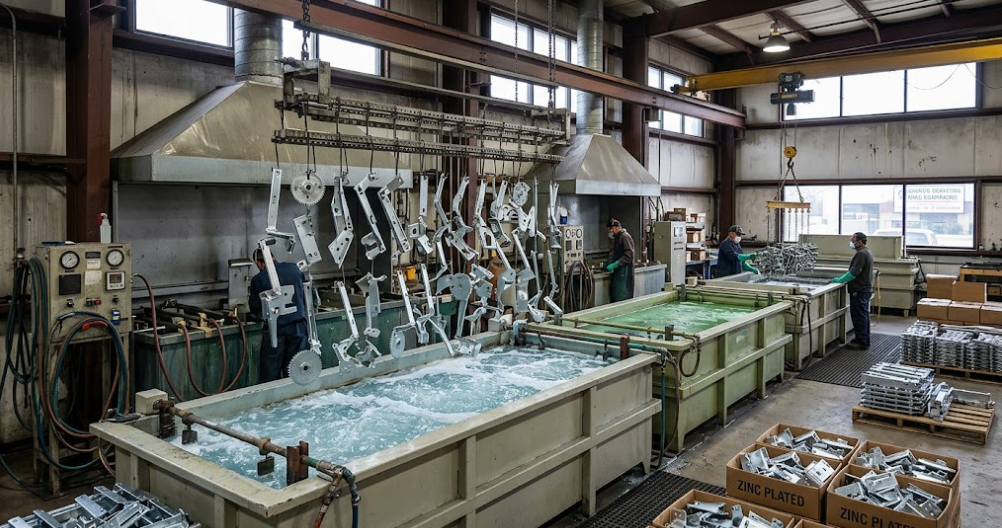
Zinc plating is an electrochemical process that deposits a controlled layer of zinc onto a steel or iron part, primarily to protect the base metal against corrosion. Zinc is more chemically reactive than the steel beneath it, so it corrodes sacrificially, protecting the underlying part even if the coating surface is scratched, until the zinc layer itself is eventually consumed. This sacrificial protection mechanism is why zinc plating remains one of the most widely specified corrosion protection methods across fasteners, brackets, structural components, and precision hardware throughout industrial manufacturing.
The process involves several tightly controlled stages thorough cleaning to remove oils, scale, and surface contaminants that would otherwise prevent proper adhesion an electroplating bath, where controlled electrical current drives zinc ions onto the part’s surface at a rate and thickness determined by dwell time and current density rinsing and, frequently, a chromate conversion coating applied over the zinc layer, adding further corrosion resistance and available in different finishes, clear, yellow, black, or olive drab, depending on the application. Each stage demands precise control, because an inconsistency anywhere in that sequence, drifted bath chemistry, an under-timed dwell period, an improperly cleaned part, can produce a lot that looks acceptable at a glance but fails a genuine thickness or adhesion test.
Most Dane County manufacturers specifying zinc plating are working against ASTM B633, the governing specification for electrodeposited zinc coatings on iron and steel, which defines coating thickness classes based on how demanding a part’s service environment will be. For the region’s medical device and instrument manufacturers specifically, thickness consistency often matters as much as, or more than, the specific class selected, since these components frequently integrate into precision assemblies where even minor plating variance can affect fit or function in ways that a more forgiving structural application would never notice.
Have Questions About Your Parts? – (608) 524-8241
Why a Madison-Based Vendor Is a Genuine Operational Advantage, Not Just a Local Preference
It’s worth making a direct, practical case for local sourcing here, since “buy local” can sound like a soft argument when what a Dane County purchasing manager actually needs is a hard operational one grounded in real cost and schedule impact.
Transit time directly compresses or expands your own production schedule. Every hour a part spends in transit to and from a plating vendor is an hour it’s unavailable for the next step in your process, whether that’s final assembly, packaging, or shipping to your own customer. A vendor genuinely based in the Madison area adds meaningfully less transit time to a production cycle than a vendor located several hours away, which translates directly into either faster overall lead times or more schedule buffer for the parts of your process you actually control.
Freight cost compounds with volume in a way that’s easy to underestimate at the quoting stage. A modest per-shipment freight difference between a Madison-area vendor and a distant one becomes a significant, recurring cost once multiplied across a year of regular production volume, and that differential deserves a place in any honest vendor cost comparison, not just the quoted plating rate per pound viewed in isolation.
A local vendor relationship supports faster problem resolution, including direct, in-person conversation when a problem genuinely warrants it. When a lot raises a question, an unusual part needs a direct discussion about rack design, or a rush order needs same-week turnaround, proximity changes how quickly that conversation can actually happen. A Madison-based vendor can accommodate site visits and direct part reviews in a way that’s structurally more difficult for a distant vendor, regardless of how responsive that vendor’s customer service team genuinely tries to be over phone and email.
Supporting Dane County’s own manufacturing ecosystem has real, practical value beyond sentiment. A regional plating vendor with deep, long-term investment in serving Dane County’s specific manufacturing base has a direct incentive to understand that base’s particular mix of precision and structural work, rather than treating the region as one interchangeable territory among many served from a much larger, more generic operational footprint.
The Misconception We Hear Most Often From Dane County Manufacturers
That a larger, more distant plating vendor must offer superior process control simply by virtue of scale, and that a Madison-area vendor is a smaller, more limited option by comparison. Vendor scale and process quality are not the same thing. A vendor’s actual bath chemistry monitoring, documentation rigor, and quality control discipline are what determine part consistency, not how many states its operations span. A properly resourced, well-run local vendor can match or exceed the process control of a much larger distant operation, while adding the transit time and communication advantages that scale alone doesn’t provide.
Serving Dane County’s Research and Startup Manufacturing Ecosystem
One aspect of Dane County’s industrial base that deserves specific attention is the region’s connection to university research and a genuinely active base of technology-driven manufacturing startups and scale-ups, many with roots in University of Wisconsin research programs or the broader Madison innovation ecosystem. This segment brings its own distinct set of needs to a plating vendor relationship, often quite different from an established, large-volume manufacturer’s requirements.
Early-stage and scaling manufacturers frequently need a plating partner willing to work with smaller initial order volumes, without the large minimum order quantities that make sense for an established, high-volume production line but create a genuine barrier for a company still validating its production process or working through early customer orders. They also often need a vendor genuinely willing to engage in direct conversation about an unfamiliar part geometry or a new application, rather than simply quoting a standard rate without deeper engagement, since a growing manufacturer’s parts and specifications are often still evolving as their product matures. A Madison-area vendor with genuine flexibility to serve this segment, alongside its larger, more established customers, fills a real gap in the regional supply chain that a distant, high-volume-focused vendor is often poorly positioned to serve well.
What Dane County Manufacturers Should Actually Evaluate in a Plating Vendor
Process control and documentation, confirmed directly rather than assumed. Ask specifically how bath chemistry is monitored continuous automated monitoring catches drift well before it produces a defective lot, while manual, periodic titration leaves real windows where inconsistency can develop undetected between checks. Ask whether thickness verification happens in-process or only as an end-of-run sample check, since the latter can let an entire lot run out of spec before anyone catches it. And ask what documentation actually accompanies a shipment, since lot-specific, time-stamped process data tied to your purchase order is a meaningfully stronger signal of genuine process control than a general certificate of conformance.
Demonstrated experience across your specific part category. Given Dane County’s genuine mix of precision instrument work and more conventional structural or agricultural hardware, it’s worth confirming directly that a prospective vendor has real, demonstrated experience with parts similar to yours in geometry, tolerance requirement, and volume, rather than a general capabilities claim that doesn’t speak to your specific application.
Capacity to handle tight tolerance requirements where they matter. For manufacturers producing components destined for precision assemblies, medical devices, scientific instruments, or similarly demanding applications, it’s worth asking specifically how a vendor’s rack design and thickness control process accounts for tighter tolerance requirements than a typical structural fastener application would need.
Turnaround reliability under real production pressure. Ask how a vendor’s production scheduling handles bath maintenance windows, seasonal volume spikes, and genuine rush orders, and whether committed delivery dates function as firm operational constraints rather than soft targets that slip during busy periods.
Environmental compliance and regulatory standing. Zinc plating involves regulated chemical processes, and a vendor’s environmental compliance history is a legitimate diligence item, reflecting both operational discipline and genuine supply chain risk for any manufacturer depending on that vendor for ongoing production.
Industries Around Madison and Dane County That Depend on Reliable Zinc Plating
Precision instrument and medical device component manufacturers. Dane County’s strong presence in medical device, scientific instrument, and precision technology manufacturing means real demand for zinc-plated components where thickness consistency directly affects fit within tightly toleranced assemblies, making bath chemistry control and in-process verification especially important for this segment.
Agricultural and specialty equipment manufacturers. Components destined for agricultural and outdoor specialty equipment face genuinely demanding corrosion environments, exposure to moisture, soil contact, and temperature swings, which makes correct thickness classification and consistent process control particularly important for suppliers serving this segment of the regional economy.
General metal fabrication and stamping operations. Dane County’s fabrication base regularly produces brackets, mounting hardware, and structural components needing consistent corrosion protection before shipping to assembly customers, and for these shops, plating turnaround reliability directly determines how tightly they can manage their own production schedules.
Research and technology-adjacent manufacturing. Madison’s connection to university research and a growing base of technology-driven manufacturing startups and scale-ups means a meaningful segment of local demand comes from smaller, often lower-volume, higher-mix production runs, which benefits from a plating vendor capable of handling varied part geometries without requiring large minimum order quantities that don’t fit that production model.
Automotive and industrial component suppliers. Suppliers feeding automotive or broader industrial assemblies, whether directly or through an intermediary, generally face demanding documentation and consistency requirements, making process rigor and verifiable documentation a genuine competitive necessity for this segment.
What Working With Plateco Looks Like for a Madison-Area Manufacturer
Plateco has served Wisconsin manufacturers, fabricators, and OEMs with zinc plating since 1974, and being based in the Madison area means Dane County isn’t a distant secondary market for this business, it’s home ground. For a manufacturer in this region evaluating Plateco, here’s what that relationship typically looks like in practice.
A quoting process built around your actual prints and specs. Send your prints, specification requirements, and expected volume through Plateco’s RFQ process, and receive a quote built around your specific parts, alloy, geometry, and thickness classification, not a generic rate that doesn’t reflect what actually makes your production run distinct.
Automated bath chemistry monitoring and in-process thickness verification on every run. The same process controls that drive Plateco’s current defect rate apply consistently, whether the order is a large recurring run for an agricultural equipment manufacturer or a smaller, tightly toleranced batch for a precision instrument maker, which matters given Dane County’s genuinely mixed manufacturing base.
Lot-specific process documentation with every shipment. Bath temperature, current density, and dwell time records tied to your specific lot number accompany your parts, giving your own quality team the documentation needed to reduce reliance on full incoming inspection over time, once consistency has been demonstrated across your production history.
A genuinely local relationship, not a remote vendor relationship managed entirely through email. Being based in the Madison area means direct conversation, site visits when warranted, and faster resolution of anything that comes up are a practical reality of working with Plateco, not an aspiration described in a sales pitch from a vendor located hours away.
“We’re not just a plating vendor that happens to have Dane County customers. We’re based here, which means understanding this region’s manufacturing base, precision instrument work sitting alongside structural fabrication and agricultural equipment, isn’t an abstraction to us. It’s the customer base we’ve served since 1974, and it’s exactly why proximity and process control need to go together, not compete against each other, in how we approach this business.”
Jim Schweich, Chief Executive Perfectionist, Plateco, Inc.
Questions to Ask Before Choosing a Zinc Plating Vendor in the Madison Area
What’s your realistic capacity, and how does our expected volume and tolerance requirement fit within it? Given Dane County’s mix of precision and structural manufacturing, it’s worth confirming directly that a vendor’s process genuinely accommodates your specific tolerance requirements, not just your total volume.
Can you walk me through your experience with parts genuinely similar to ours, not just your general capability list? A vendor’s specific answer about comparable part geometry, tolerance, and volume tells you considerably more than a general description of their equipment and certifications.
How do you handle bath maintenance scheduling relative to committed delivery dates? This is a direct, practical question that reveals whether a vendor treats scheduling discipline as a genuine operational priority.
What does your documentation package actually include, and can I review a sample before committing volume? A vendor confident in their process control should have no hesitation providing an actual sample of their lot documentation for review.
What’s your environmental compliance history, and how do you manage wastewater treatment and regulatory reporting? This is a legitimate diligence question for any plating vendor, worth asking directly rather than assuming based on general reputation.
Frequently Asked Questions
Is Plateco actually based in the Madison area, or simply serving it from elsewhere in Wisconsin?
Plateco is based in the Madison area and serves manufacturers, fabricators, and OEMs across Dane County directly, alongside customers across the rest of Wisconsin and in neighboring Illinois, Michigan, and Iowa.
What’s the typical turnaround time for a zinc plating order from a Dane County manufacturer?
Turnaround depends on part volume, complexity, and current production scheduling, and is best confirmed directly through a quote request that accounts for your specific parts and required delivery timeline, rather than a general estimate.
Can Plateco handle tightly toleranced components for precision instrument or medical device applications?
Plateco’s automated bath chemistry monitoring and in-process thickness verification are built to support consistent, tightly controlled results, and the right approach for a specific tolerance requirement is best confirmed directly through a conversation about your exact specification and application.
Does working with a Madison-area vendor actually save meaningful time compared to a vendor a few hours away?
Yes, in most cases. Reduced transit time translates directly into faster round-trip turnaround and more schedule flexibility, and that advantage compounds across regular production volume in a way that’s worth quantifying directly against your own shipping frequency and typical order size.
Can a smaller Dane County job shop or startup manufacturer with variable volume work with Plateco?
Plateco works with manufacturers across a genuine range of volumes, from large recurring production runs to smaller, variable batches, reflecting the mixed nature of Dane County’s manufacturing and technology-adjacent production base.
How does a Madison-area manufacturer get started with a quote from Plateco?
The process starts with sending prints, specifications, and expected volume through Plateco’s RFQ process, allowing a quote to be built around your actual parts and requirements.
Ready to Work With a Plating Partner Based Right Here in Dane County?
Tell Us About Your Project
Plateco has been zinc plating for Wisconsin manufacturers, fabricators, and OEMs since 1974, based in the Madison area and serving Dane County’s industrial sector directly. If distance, inconsistent quality, or unreliable turnaround from a current vendor is costing your production schedule more than it should, send us your prints and specs and let’s talk through what a closer, more consistent partnership could look like.