

A sourcing manager at a Milwaukee-area tool and die shop is reviewing next quarter’s outsourced finishing spend, and the same question comes up that comes up every quarter is the plating vendor currently running this work actually the right one, or is it simply the one the company has always used. Southeast Wisconsin has one of the densest concentrations of precision metal manufacturing in the Midwest, which means this particular sourcing manager has genuine options within a reasonable drive of Milwaukee, Waukesha, Racine, or Kenosha. Most of those options look similar enough on a website that the actual differences only become clear once a lot ships late, a certificate doesn’t match what incoming inspection finds, or a rush order gets quietly deprioritized during a busy week. This piece is written for that sourcing manager, and for every quality engineer, plant manager, and purchasing lead across Southeast Wisconsin’s manufacturing base trying to separate real differentiation from marketing language when evaluating a zinc plating vendor.
We’ll walk through what zinc plating actually involves, why Southeast Wisconsin’s manufacturing density makes vendor selection a genuinely higher-stakes decision here than in a region with fewer options, what to actually evaluate in a plating partner serving Milwaukee-area manufacturers, and how Plateco fits into that picture for manufacturers across the region.
Why Milwaukee’s Manufacturing Density Changes How This Decision Should Be Made
Southeast Wisconsin, anchored by Milwaukee and extending through Waukesha, West Allis, Racine, and Kenosha, carries one of the most concentrated precision manufacturing bases in the country heavy machinery and equipment manufacturers, tool and die shops, metal stamping and fabrication operations, automotive and off-highway component suppliers, and a deep bench of contract manufacturers serving national OEM supply chains. That density is genuinely valuable for a manufacturer sourcing outsourced services locally, but it also means the plating vendor comparison in this region isn’t a simple two-option decision. There are real alternatives within reasonable driving distance of nearly every Milwaukee-area manufacturer, which raises the bar for what “good enough” should actually mean, since a vendor with real quality or reliability gaps doesn’t have the excuse of being the only viable option nearby.
This density also means Milwaukee-area manufacturers tend to have more demanding, more varied part requirements than a region with a thinner manufacturing base. Heavy equipment manufacturers in this region often need corrosion protection on large, heavy structural components. Tool and die shops need precision plating on tightly toleranced parts where even minor thickness variance can affect fit. Automotive and off-highway suppliers, many feeding national and international OEM assembly lines, need documentation rigorous enough to survive a genuine supply chain audit. A plating vendor genuinely capable of serving Southeast Wisconsin’s manufacturing base well has to competently handle that range, not just specialize narrowly and hope every customer’s needs happen to fit.
Since 1974
Plateco has served Wisconsin manufacturers with zinc plating services, including operations across the Milwaukee and Southeast Wisconsin region
Multiple Alloys
Zinc plating capability across steel substrates, including high-strength and hardened steel common in heavy equipment and tool and die work
0.1%
Current defect rate across Plateco’s production lines, the result of automated bath chemistry monitoring and in-process thickness verification
What Zinc Plating Actually Does, in Plain Terms
For teams newer to specifying plated finishes, it’s worth grounding this discussion in the basics before getting into vendor evaluation criteria specific to this region.
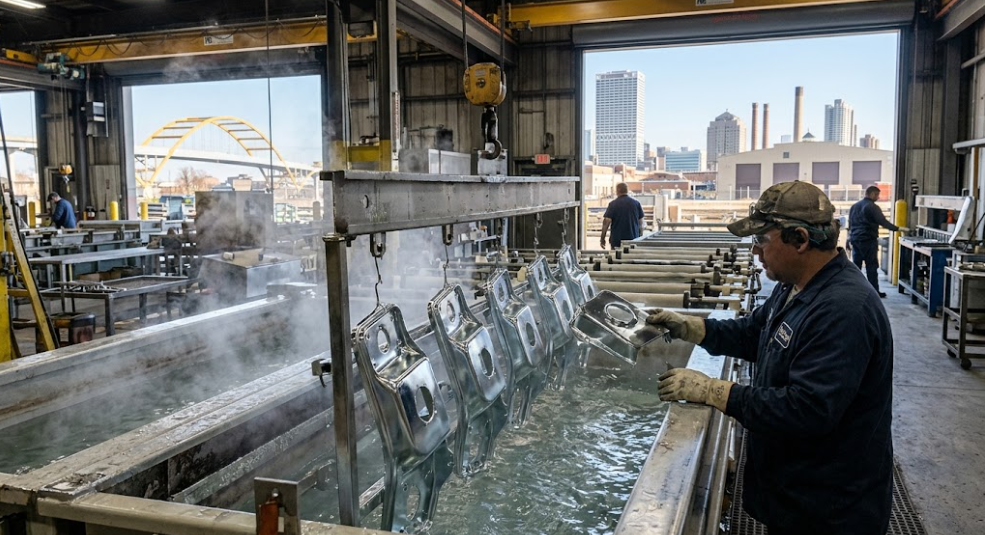
Zinc plating is an electrochemical process that deposits a controlled layer of zinc onto a steel or iron part, primarily to protect the base metal against corrosion. Zinc is more reactive than the underlying steel, which means it corrodes sacrificially, protecting the base metal even if the coating surface gets scratched, until the zinc layer itself is eventually consumed. This sacrificial protection is the core reason zinc plating remains one of the most widely specified corrosion protection methods across fasteners, brackets, structural hardware, and machined components in industrial manufacturing.
The process involves several tightly controlled stages thorough cleaning to remove oils, mill scale, and surface contaminants that would otherwise prevent proper adhesion an electroplating bath, where controlled electrical current drives zinc ions onto the part’s surface at a rate and thickness determined by dwell time and current density rinsing and, frequently, a chromate conversion coating applied over the zinc layer, which adds further corrosion resistance and can be specified in different finishes, clear, yellow, black, or olive drab, depending on the application. Every one of those stages requires precise control, because an inconsistency anywhere in that sequence, bath chemistry that’s drifted, an under-timed dwell period, an improperly cleaned part, can produce a lot that looks acceptable on a quick visual check but fails a genuine thickness or adhesion test.
Most Milwaukee-area manufacturers specifying zinc plating are working against ASTM B633, the governing specification for electrodeposited zinc coatings on iron and steel, which defines coating thickness classes based on how demanding the part’s service environment will be. A component destined for a mild indoor environment carries a different thickness requirement than one that will see outdoor exposure, road salt, or heavy equipment operating conditions, and specifying the correct class at the design stage is what actually determines whether a plated part performs as expected once it’s in service, not just whether it passes an initial inspection.
Have Questions About Your Parts? – (608) 524-8241
What Southeast Wisconsin Manufacturers Should Actually Evaluate in a Plating Vendor
Given the genuine density of options available to a Milwaukee-area manufacturer, the evaluation bar should be correspondingly higher and more specific than a general “who’s closest and cheapest” comparison.
Process control and documentation, not just a general quality statement. Ask specifically how bath chemistry is monitored continuous automated monitoring catches chemical drift well before it produces a defective lot, while manual, periodic titration leaves real windows where inconsistency can develop undetected between checks. Ask whether thickness verification happens in-process or only at the end of a run on a sample, since the latter approach can let a fully drifted lot ship before anyone catches the problem. And ask what documentation actually accompanies a shipment lot-specific, time-stamped process data tied to your purchase order is a meaningfully stronger signal of genuine process control than a general certificate of conformance.
Demonstrated experience with your specific part category, not just broad capability claims. Southeast Wisconsin’s manufacturing diversity, heavy equipment, precision tooling, automotive supply, general fabrication, means the right vendor for one manufacturer’s parts isn’t automatically right for another’s. A vendor with deep experience running high-volume, tightly toleranced fastener work may not have the rack-building expertise for a large, heavy structural component, and the reverse holds equally true. Ask a prospective vendor directly about their experience with parts genuinely similar to yours in size, geometry, and volume, not just a general capabilities list.
Turnaround reliability under real production pressure. Ask how a vendor’s production scheduling handles bath maintenance windows, seasonal volume spikes, and genuine rush orders, and whether committed delivery dates function as firm operational constraints rather than soft targets that slip during busy periods. A quoted lead time only has value if it holds consistently, particularly during the weeks when it matters most.
Capacity to actually handle your production volume without becoming a bottleneck. Southeast Wisconsin’s manufacturing base includes everything from small job shops to large-volume production operations, and it’s worth confirming directly that a prospective vendor’s actual production capacity comfortably accommodates your volume, rather than assuming a vendor serving smaller customers can seamlessly absorb a significantly larger order without disrupting either your schedule or their other customers’ commitments.
Environmental compliance and regulatory standing. Zinc plating involves regulated chemical processes, and a vendor’s environmental compliance track record is a legitimate diligence item, both as an indicator of overall operational discipline and because a vendor facing a regulatory disruption represents a genuine supply chain risk for any manufacturer depending on them for ongoing production.
Get a Free Quote For Your Project
Why Proximity Still Matters, Even With More Local Options
It might seem, given how many plating vendors operate within reasonable distance of Milwaukee, that proximity matters less here than in a less densely served region. In practice, the opposite is closer to true with genuine local alternatives available, there’s less excuse for a manufacturer to accept the transit time and freight cost penalty of a vendor located farther away, when a closer, equally capable option exists.
Transit time directly affects your own production schedule. Every hour a part spends in transit to and from a plating vendor is an hour it’s unavailable for the next step in your process. A vendor within a short, reliable drive of your Milwaukee-area facility adds meaningfully less transit time to every production cycle than one located further across the state or across state lines, which translates directly into faster overall lead times or more usable schedule buffer.
Freight cost compounds across a year of regular volume. A modest per-shipment freight difference between a nearby vendor and a more distant one becomes a significant recurring cost once multiplied across regular production volume, and that differential belongs in any honest vendor cost comparison, not just the quoted rate per pound in isolation.
Faster resolution when something needs a real conversation. When a lot raises a question, a rush order needs same-week turnaround, or an unusual part needs a direct discussion about rack design, proximity genuinely changes how quickly that conversation can happen, including the option of an in-person visit when a problem is complex enough to warrant one.
The Misconception We Hear Most Often From Milwaukee-Area Manufacturers
That with so many plating vendors operating in Southeast Wisconsin, any reasonably competent option nearby is fine, and the real differentiation only matters for manufacturers in less-served regions. In practice, manufacturing density in this region means the opposite with genuine alternatives close at hand, there’s less reason to tolerate an inconsistent vendor’s quality or reliability gaps out of a sense that “it’s the closest option available.” Density should raise the evaluation bar, not lower it.
Multi-Plant and Multi-Site Considerations
Many Southeast Wisconsin manufacturers operate more than one facility across the region, or coordinate production between a Milwaukee-area plant and a sister facility elsewhere in the state, which adds a layer of complexity to plating vendor selection that a single-site manufacturer doesn’t need to consider. If your production planning involves parts moving between multiple facilities before or after plating, it’s worth confirming directly with a prospective vendor how they handle multi-site logistics, whether that means coordinating pickup and delivery across more than one of your locations, or simply understanding your full production flow well enough to schedule plating at the right point in that sequence rather than treating each order as an isolated transaction.
This matters particularly for manufacturers with a corporate or engineering function based in one location and production capacity spread across others, since a plating vendor that only understands the single facility placing a given purchase order can miss scheduling opportunities, or create unnecessary friction, that a vendor with a genuine understanding of your full regional footprint would avoid. Raising this directly during vendor evaluation, rather than discovering the gap after the relationship is underway, is a straightforward way to avoid a preventable coordination problem later.
Industries Around Milwaukee That Depend on Reliable Zinc Plating
Heavy equipment and machinery manufacturers. Southeast Wisconsin’s strong heavy equipment and industrial machinery manufacturing base regularly produces large structural brackets, frame components, and mechanical hardware requiring reliable corrosion protection, often with thickness requirements driven by demanding outdoor or heavy-use operating environments.
Tool and die and precision machining shops. Milwaukee’s deep bench of tool and die and precision manufacturing operations produces tightly toleranced components where plating thickness consistency directly affects part fit and function, making bath chemistry control and in-process thickness verification particularly important considerations for this segment.
Automotive and off-highway component suppliers. Suppliers feeding automotive and off-highway equipment assemblies, whether directly or through Tier 1 intermediaries, generally face the most demanding documentation and consistency requirements of any regional segment, since a plating inconsistency traced to their parts can escalate into a visible supply chain risk for their own customers.
General metal fabrication and stamping operations. Southeast Wisconsin’s extensive metal fabrication base regularly produces brackets, mounting hardware, and structural components that need consistent corrosion protection before shipping to assembly customers, and for these shops, plating turnaround reliability directly determines how tightly they can manage their own production schedules.
Contract manufacturers serving national OEM supply chains. Milwaukee’s role as a contract manufacturing hub for national and international OEMs means many regional suppliers face plating specification and documentation requirements that flow down directly from major end customers, making process rigor and verifiable documentation a genuine competitive necessity, not just a nice-to-have.
What Working With Plateco Looks Like for a Milwaukee-Area Manufacturer
Plateco has served Wisconsin manufacturers, fabricators, and OEMs with zinc plating since 1974, and that statewide regional focus includes serving manufacturers across Milwaukee and Southeast Wisconsin specifically. For a manufacturer in this region evaluating Plateco, here’s what that relationship typically looks like in practice.
A quoting process built around your actual prints and specs. Send your prints, specification requirements, and expected volume through Plateco’s RFQ process, and receive a quote built around your specific parts, alloy, geometry, and thickness classification, rather than a generic rate that doesn’t account for what actually makes your production run distinct.
Automated bath chemistry monitoring and in-process thickness verification on every run. The same process controls that drive Plateco’s current defect rate apply consistently, whether the order is a large recurring production run for a heavy equipment manufacturer or a smaller, more complex job for a tool and die shop, which matters given Southeast Wisconsin’s genuinely mixed manufacturing base.
Lot-specific process documentation with every shipment. Bath temperature, current density, and dwell time records tied to your specific lot number accompany your parts, giving your own quality team the documentation needed to reduce reliance on full incoming inspection over time, once consistency has been demonstrated across your production history.
A production and logistics approach built to serve Wisconsin manufacturers reliably, including those across the Milwaukee and Southeast Wisconsin corridor, meaning transit time and delivery reliability are treated as core parts of the service, not secondary considerations to a plating operation designed primarily around a different part of the state.
“Milwaukee’s manufacturing base doesn’t need a plating vendor that’s simply nearby. It needs one that can genuinely handle the range of work this region produces, heavy structural components, precision tooling, automotive-grade documentation, and hold that standard consistently, order after order. That’s what we built this business to do for manufacturers across Wisconsin, and it’s exactly what Southeast Wisconsin’s manufacturers should expect from any vendor they’re evaluating.”
Jim Schweich, Chief Executive Perfectionist, Plateco, Inc.
Questions to Ask Before Choosing a Zinc Plating Vendor Near Milwaukee
Whether or not you evaluate Plateco directly, these are the specific questions worth bringing to any plating vendor conversation as a Southeast Wisconsin manufacturer.
What’s your realistic capacity, and how does our expected volume fit within it? Given Southeast Wisconsin’s manufacturing density, it’s worth confirming directly that a vendor’s capacity genuinely accommodates your production volume without creating scheduling risk for either party.
Can you walk me through your experience with parts genuinely similar to ours, not just your general capability list? A vendor’s specific answer about comparable part geometry, size, and volume tells you considerably more than a general description of their equipment and certifications.
How do you handle bath maintenance scheduling relative to committed delivery dates? This is a direct, practical question that reveals whether a vendor treats scheduling discipline as a genuine operational priority or an informal best effort.
What does your documentation package actually include, and can I review a sample before committing volume? A vendor confident in their process control should have no hesitation providing an actual sample of their lot documentation for review.
What’s your environmental compliance history, and how do you manage wastewater treatment and regulatory reporting? This is a legitimate diligence question for any plating vendor, and one worth asking directly rather than assuming based on general reputation alone.
Frequently Asked Questions
Does Plateco serve manufacturers specifically located in Milwaukee and Southeast Wisconsin?
Yes. Plateco serves manufacturers, fabricators, and OEMs across Wisconsin, including operations throughout Milwaukee, Waukesha, Racine, Kenosha, and the broader Southeast Wisconsin region, alongside customers across the state and in neighboring Illinois, Michigan, and Iowa.
What’s the typical turnaround time for a zinc plating order from a Milwaukee-area manufacturer?
Turnaround depends on part volume, complexity, and current production scheduling, and is best confirmed directly through a quote request that accounts for your specific parts and required delivery timeline, rather than a general estimate that doesn’t reflect your actual order.
With so many plating vendors near Milwaukee, how should a manufacturer actually differentiate between them?
Focus on verifiable process control and documentation, demonstrated experience with parts genuinely similar to yours, and confirmed scheduling discipline under real production pressure, rather than defaulting to whichever vendor is marginally closest or has been used historically without a recent, genuine re-evaluation.
What thickness classification should a Milwaukee-area manufacturer specify for heavy equipment components facing outdoor exposure?
This depends on the specific service environment the component will face and should be determined against ASTM B633’s classification system based on expected exposure severity, a specification conversation worth having directly with your plating vendor’s quality team rather than defaulting to an assumed class.
Can a smaller Milwaukee-area job shop with variable volume work with Plateco, or is the operation focused only on large-volume customers?
Plateco works with manufacturers across a genuine range of volumes, from large recurring production runs to smaller, variable job-shop batches, reflecting the mixed nature of Southeast Wisconsin’s manufacturing base, which includes both high-volume producers and specialized lower-volume shops.
How does a Milwaukee-area manufacturer get started with a quote from Plateco?
The process starts with sending prints, specifications, and expected volume through Plateco’s RFQ process, allowing a quote to be built around your actual parts and requirements rather than a generic rate.
Ready to Work With a Plating Partner That Actually Understands Southeast Wisconsin’s Manufacturing Base?
Tell Us About Your Project
Plateco has been zinc plating for Wisconsin manufacturers, fabricators, and OEMs since 1974, including operations across Milwaukee and Southeast Wisconsin. If inconsistent quality, unreliable turnaround, or a vendor that’s simply been “good enough” for too long is costing your production schedule more than it should, send us your prints and specs and let’s talk through what a more consistent partnership could look like.