

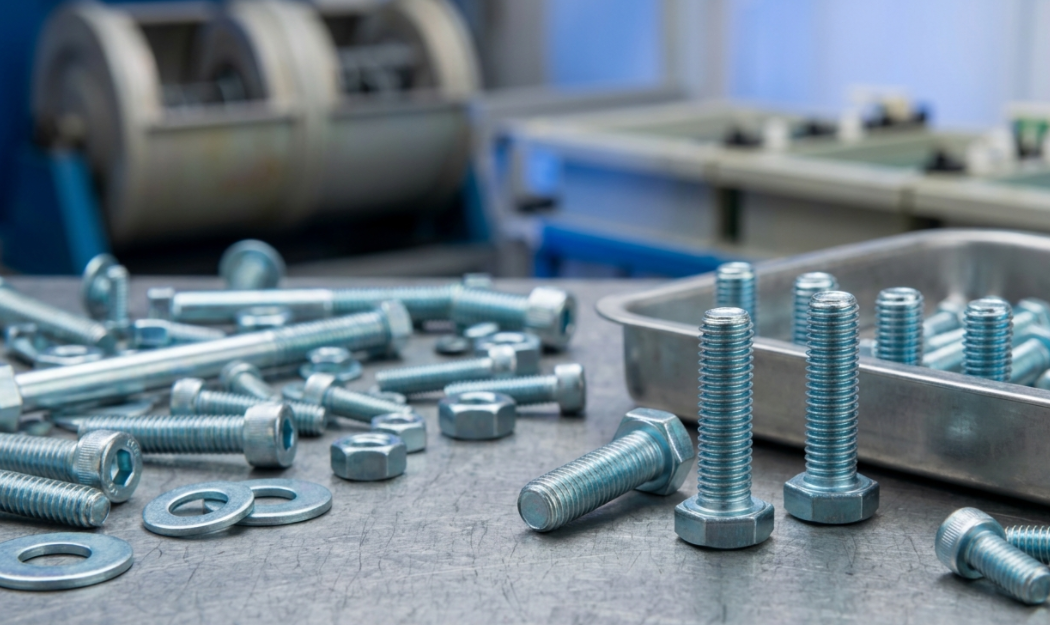
A fastener is the smallest, cheapest line item on most bills of material, and it’s also one of the most common sources of a supply chain quality escape. Not because fasteners are hard to make, but because the coating that protects them is easy to under-specify, easy to substitute quietly, and easy for a buyer without a metal finishing background to assume is standardized when it isn’t. If you’re the person signing off on fastener purchase orders, understanding a few specific things about zinc plating will save you from the two most common and most expensive fastener problems a shipment that gets rejected at receiving, and a field failure that shows up on a warranty claim eighteen months after the parts already shipped inside your product.
Procurement managers are rarely metal finishing specialists, and they shouldn’t need to be. But fasteners occupy a specific blind spot in a lot of purchasing organizations they’re bought in enormous volume, they’re treated as commodity items, and the corrosion protection on them is frequently specified with a single vague line, “zinc plated,” that leaves an enormous amount of room for interpretation between what an engineer intended, what a purchase order says, and what a supplier actually delivers.
That gap doesn’t usually cause a problem on the first order. It causes a problem eventually, when a batch fails a customer’s incoming inspection, when a fastener corrodes prematurely in a product already in the field, or when an OEM audit flags a supply chain gap that traces back to an under-documented plating spec three tiers down. This guide is built to close that gap, covering exactly what a procurement manager needs to know about zinc plating specifications, coating types, quality verification, and supplier evaluation to buy fasteners with real confidence instead of assumed confidence.
B633
The ASTM standard governing electrodeposited zinc coatings on steel fasteners
4
ASTM B633 service condition categories, from mild indoor to severe outdoor exposure
~3-5%
Typical share of total product cost that fasteners represent, despite outsized failure risk
Why Fasteners Deserve More Attention Than They Usually Get
Fasteners are, almost by definition, the parts a purchasing organization pays the least attention to per unit. They’re ordered by the thousand, priced in fractions of a cent difference between suppliers, and often treated in ERP systems as interchangeable commodity SKUs rather than engineered components with specific performance requirements. That treatment makes sense from a cost-management perspective. It creates real risk from a quality perspective.
The reason fasteners deserve more attention than their line-item cost suggests is straightforward a fastener holding a critical assembly together is doing structural work regardless of how little it costs, and a coating failure on that fastener can cause a failure of the entire assembly it’s securing. A corroded, seized bolt on outdoor equipment, a fastener that fails in a road-salt environment, or a plated screw that doesn’t survive a customer’s own accelerated corrosion testing doesn’t fail in isolation. It fails as part of whatever larger product or structure it was holding together, and the cost of that failure has nothing to do with the original price of the fastener itself.
This mismatch, between how little attention a fastener typically receives during sourcing and how much the coating on it actually matters once it’s installed, is exactly why procurement managers benefit from understanding the fundamentals covered in this guide, even without becoming metal finishing experts themselves.
The Most Common Procurement Mistake on Fasteners
Treating “zinc plated” as a single, standardized spec that any supplier can fulfill identically. In practice, zinc plating varies enormously by coating thickness, passivate type, and underlying process, and two suppliers both shipping “zinc plated” fasteners can be delivering meaningfully different corrosion performance, sometimes different enough to cause a field failure one supplier would have prevented and another didn’t.
Have Questions About Zinc Plating for Fasteners? – (608) 524-8241
The Fastener Coating Options You’ll Actually Encounter
Most fastener sourcing conversations end up choosing between a small number of coating families. Understanding what each one actually does, and where it fits, is the foundation for writing a specification that gets you the fastener you actually need.
Zinc Electroplating
Zinc electroplating deposits a thin, controlled layer of zinc onto a fastener using an electric current in a plating bath, governed by ASTM B633 for steel fasteners. This is the most common coating for standard commercial and industrial fasteners because it produces a smooth finish that preserves thread fit and dimensional tolerance, applies evenly across complex fastener geometries like socket heads and knurled shanks, and can be paired with different passivate finishes to adjust both appearance and corrosion resistance.
Zinc Mechanical Plating
Mechanical plating deposits zinc onto fasteners through a tumbling process using glass beads, zinc powder, and chemical promoters, rather than an electric current. This process avoids hydrogen embrittlement risk entirely, which makes it the preferred choice for high-strength fasteners, typically grade 8 and above, where electroplating’s hydrogen embrittlement risk (discussed below) becomes a genuine structural concern.
Hot-Dip Galvanizing
Hot-dip galvanizing immerses fasteners in molten zinc, producing a significantly thicker coating than electroplating, typically used for larger structural fasteners and anchor bolts where maximum coating mass matters more than precise dimensional control. The thicker coating can affect thread fit on standard nuts, which is why galvanized bolts are often paired with over-tapped nuts specifically sized to accommodate the extra coating thickness.
Zinc-Nickel and Zinc-Aluminum Alloy Coatings
For fasteners facing especially demanding corrosion environments, particularly in automotive underbody applications or heavy salt exposure, zinc alloy coatings like zinc-nickel provide meaningfully higher corrosion resistance than standard zinc electroplating at a comparable thickness, at a correspondingly higher cost. These are increasingly specified by automotive OEMs for fasteners in road-salt-exposed locations.
A Quick Way to Sort These Options
For standard commercial and industrial fasteners with typical strength requirements, zinc electroplating per ASTM B633 is the default and usually correct choice. For high-strength fasteners (grade 8+), ask specifically about mechanical plating to eliminate embrittlement risk. For large structural bolts and anchors, hot-dip galvanizing is often the governing requirement. For automotive or extreme-corrosion applications, ask whether a zinc alloy coating is actually specified before defaulting to standard electroplating.
The Hydrogen Embrittlement Risk Every Procurement Manager Should Understand
This is the single most important technical concept in this entire guide, because it’s the one most likely to cause a genuine structural failure rather than just a cosmetic or minor performance issue, and it’s frequently missed by procurement teams without a metal finishing background.
Hydrogen embrittlement is a phenomenon where hydrogen atoms, generated during the electroplating process itself, diffuse into high-strength steel and cause a loss of ductility that can lead to delayed, sudden fastener failure, sometimes days or weeks after installation, with no visible warning beforehand. This risk is specifically associated with electroplating processes on high-strength steel, generally fasteners rated grade 8, class 10.9, or higher, and it’s a genuine, well-documented structural safety concern, not a theoretical or rare edge case.
The industry solution is baking: after electroplating, high-strength fasteners are placed in a heated oven for a specified time and temperature to drive absorbed hydrogen back out of the steel before it can cause delayed cracking. ASTM B633 and related standards specify baking requirements based on fastener strength and coating thickness, and a supplier plating high-strength fasteners has an obligation to follow this baking process correctly and be able to document that they did.
For a procurement manager, the practical takeaway is this if you’re sourcing high-strength fasteners (grade 8 or higher) that will be electroplated, confirm directly with your supplier that hydrogen embrittlement relief baking is part of their standard process, and ask for documentation that it was actually performed on your specific lot. For the highest-strength or most safety-critical applications, ask whether mechanical plating, which avoids this risk entirely, is a better fit than electroplating in the first place.
Why This Deserves Real Attention, Not a Checkbox
Hydrogen embrittlement failures are dangerous specifically because they’re delayed and because the fastener can look completely normal, pass a visual inspection, and even pass initial torque testing before failing under load days or weeks later. This isn’t a defect you can catch by looking at the part. It has to be prevented at the process level, through correct baking procedures documented at the time of plating, which is exactly why asking about this proactively during supplier qualification matters more than trying to catch it after the fact.
ASTM B633 Service Conditions: Matching Coating Thickness to Actual Use
For zinc electroplated fasteners, ASTM B633 organizes required coating thickness into four service condition categories based on the severity of the exposure environment the fastener will actually face in service. Specifying the correct category, rather than defaulting to a generic minimum, is one of the most direct levers a procurement manager has over long-term fastener performance.
ASTM B633 Service Conditions for Fasteners
| Service Condition | Min. Thickness (µm) | Typical Exposure | Common Fastener Applications |
|---|---|---|---|
| SC 1 — Mild | 5 µm | Dry indoor environments | Interior appliance and equipment fasteners |
| SC 2 — Moderate | 8 µm | Indoor with occasional condensation | Indoor industrial machinery fasteners |
| SC 3 — Severe | 12 µm | Outdoor exposure, weather cycling | General outdoor equipment and hardware fasteners |
| SC 4 — Very Severe | 25 µm | Harsh outdoor exposure, road salt, prolonged weathering | Automotive underbody, agricultural, roadway-adjacent fasteners |
A common and costly procurement mistake is specifying, or accepting a supplier’s default of, SC1 or SC2 thickness for fasteners that will actually see SC3 or SC4 exposure once installed in the field. This often happens simply because nobody along the specification chain explicitly stated the actual service environment, and the supplier defaulted to the thinnest, cheapest option absent clear direction. Confirming and explicitly stating the correct service condition on every purchase order, rather than assuming a supplier will infer it correctly, closes this gap.
Passivate Types and What They Actually Change
Beyond the zinc layer itself, the passivate or chromate conversion coating applied afterward significantly affects both corrosion resistance and appearance, and different passivate types are specified for different reasons.
Clear (Blue) Passivate provides the lowest level of additional corrosion protection among common options and gives fasteners a bright, silvery appearance. It’s typically specified where appearance matters more than maximum corrosion resistance, or for indoor and low-exposure applications where minimal additional protection is needed.
Yellow Passivate (trivalent) is the most common choice for fasteners facing genuine outdoor or higher-corrosion exposure, providing meaningfully better protection than clear passivate while remaining RoHS compliant under current environmental regulations. This is the standard choice procurement managers should expect for SC3 and SC4 applications absent a specific reason to choose otherwise.
Black Passivate provides corrosion resistance generally between clear and yellow options, while giving fasteners a black, often architecturally preferred appearance for visible applications where aesthetics matter alongside function.
Olive Drab and Military Specification Passivates are specified for defense and certain industrial applications with specific government or military standard requirements, and typically require explicit confirmation that a supplier’s process is qualified to the relevant military specification, not just a general “olive drab appearance” coating.
A Practical Note on RoHS Compliance
Hexavalent chromium passivates, once common in the industry, are now restricted under RoHS Directive 2011/65/EU and equivalent regulations in most markets. If your supply chain sells into regulated markets, confirm directly that any passivate specified is trivalent chromium, not legacy hexavalent chemistry, since some older specifications and even some current suppliers may still default to outdated hexavalent processes without flagging the compliance issue proactively.
Building a Fastener Specification That Actually Protects You
A complete, unambiguous fastener plating specification protects both your organization and your supplier from the kind of miscommunication that leads to rejected shipments or field failures. Based on everything above, a specification a procurement manager should expect to see, or should push back and request if it’s missing, includes several specific elements.
The governing standard. ASTM B633 for standard zinc electroplating, or the appropriate alternative standard (ASTM F1941, ISO 4042, or a military specification) if your industry or customer requires a different governing document.
The service condition or coating class. SC1 through SC4, matched to the fastener’s actual field exposure, not a default assumption.
The passivate type. Clear, yellow, black, or a specific military or OEM-approved finish, explicitly stated rather than left to supplier discretion.
Hydrogen embrittlement relief requirements, where applicable. For any fastener grade 8 or higher, an explicit statement that baking per ASTM B633 (or the applicable standard) is required, along with a request for documentation confirming it was performed.
Any customer or OEM-specific approval requirements. If your fasteners feed into a specific customer’s assembly and that customer requires supplier approval for plating processes, this should be stated explicitly on the purchase order, not assumed to be understood.
A Complete Specification Example
Zinc electroplate per ASTM B633, SC3, Type II (trivalent yellow passivate). Fastener grade 8 hydrogen embrittlement relief baking required per ASTM B633 Section 9, documentation to accompany shipment. RoHS compliant, trivalent chromium only.
Compare that to a purchase order that simply says “zinc plate” with no further detail, and it becomes clear how much room for interpretation, and how much risk, sits inside a vague specification that seems adequate at a glance.
Quality Verification: What to Actually Check When Fasteners Arrive
Even with a clear specification on the purchase order, verification at receiving is what actually confirms a supplier delivered what was ordered. Procurement managers don’t need to become plating inspectors, but understanding what verification is realistic, and what to ask a quality team or third-party lab to check, closes the loop on a specification that would otherwise just be words on paper.
Visual inspection. A basic visual check can catch obvious problems, uneven coating, visible bare spots, incorrect color for the specified passivate type, but it cannot confirm actual coating thickness or verify hydrogen embrittlement relief was performed. Visual inspection is a useful first filter, not a substitute for the checks below.
XRF thickness testing. X-ray fluorescence testing provides a fast, non-destructive measurement of actual coating thickness against the specified service condition. This is the most practical verification method for confirming a supplier actually delivered the specified SC1 through SC4 thickness rather than a thinner, cheaper coating.
Salt spray testing. ASTM B117 salt spray testing measures how long a coating resists visible corrosion under accelerated laboratory conditions, and is a useful supplementary check, particularly for new suppliers or high-risk applications, though it’s typically used for periodic qualification testing rather than routine incoming inspection given the time required to run a full test cycle.
Supplier documentation review. For high-strength fasteners, requesting and reviewing documentation confirming hydrogen embrittlement relief baking was performed, including time, temperature, and the batch or lot it applies to, is a direct, low-cost way to verify this critical process step without requiring destructive testing on your own end.
A Practical Verification Cadence
For established, trusted suppliers, periodic XRF thickness spot-checks on incoming lots, combined with a documentation review for any high-strength or hydrogen-embrittlement-relevant fasteners, is usually sufficient. For new suppliers or safety-critical applications, add salt spray testing during initial qualification and consider more frequent incoming XRF checks until a consistent track record is established.
Evaluating a Fastener Plating Supplier: Questions Worth Asking Directly
Beyond the technical specification itself, the supplier relationship matters enormously for fasteners, precisely because so much of the actual quality control happens inside a process you can’t observe directly. A few direct questions during supplier qualification reveal a lot about whether a prospective plating partner will actually protect your supply chain or just fulfill orders at face value.
“What’s your standard process for hydrogen embrittlement relief on high-strength fasteners, and can you document it per lot?” A supplier with a mature process will answer specifically, referencing bake time and temperature standards, and will confirm documentation is standard practice, not a special request.
“What service condition do you default to if a purchase order just says ‘zinc plate’ without more detail?” This question reveals whether a supplier proactively flags ambiguous specifications back to the customer, a genuine quality-minded practice, or simply defaults to whatever’s cheapest and fastest to produce, which shifts risk onto you without your knowledge.
“Can you provide XRF thickness data or a certificate of conformance with each shipment?” Suppliers who can produce this documentation routinely, without treating it as an unusual or costly request, demonstrate a level of process control and record-keeping that correlates strongly with consistent quality overall.
“Are you ISO 9001 certified, and does that certification’s scope explicitly include fastener plating?” A current, appropriately scoped ISO 9001 certification is a meaningful proxy for the kind of documented process discipline, corrective action procedures, and traceability that protects you when something eventually does go wrong.
“What happens if a lot fails your own internal inspection before it ships to me?” A mature supplier will describe a specific containment and corrective action process. A vague answer, or a claim that failures essentially never happen, is itself a warning sign, since even the best-run plating operations experience occasional deviations, and how a supplier handles them matters more than pretending they don’t occur.
A Red Flag Worth Taking Seriously
If a fastener plating supplier is unable or unwilling to produce thickness verification data, hydrogen embrittlement documentation for high-strength fasteners, or a clear explanation of their nonconformance process, treat that reluctance as meaningful information about the underlying process, not just an administrative inconvenience. The documentation exists, or it doesn’t, and a supplier’s willingness to share it is a reasonably reliable signal of how seriously the underlying process is actually controlled.
Cost Considerations Without Losing Sight of Risk
Fastener plating costs vary based on coating type, thickness, passivate, and volume, and it’s genuinely reasonable for procurement to manage these costs carefully given the volume fasteners are typically purchased in. But the cost differences between service conditions, passivate types, and process rigor are usually modest on a per-fastener basis, while the cost of a field failure, warranty claims, a recall, or a damaged customer relationship, is not modest at all.
The more useful framing for a procurement manager isn’t “how do I get the cheapest zinc plating,” it’s “am I specifying the right level of protection for how this fastener will actually be used, and am I sourcing from a supplier who can reliably deliver and document that protection.” Getting those two things right usually costs only marginally more than getting them wrong, and the marginal cost is a rounding error compared to the cost of the failure it prevents.
Building Fastener Sourcing Into a More Reliable Supply Chain
Fasteners will likely always be the smallest line item on most bills of material, and that’s not a problem in itself. The problem is when that small line-item cost leads to correspondingly little scrutiny of a coating specification and supplier relationship that actually carries outsized risk relative to its price. A procurement manager who understands the basics covered here, coating options, hydrogen embrittlement risk, service condition matching, passivate selection, and what documentation to actually ask for, is positioned to close that gap without needing to become a metal finishing engineer.
Plateco has plated fasteners for Wisconsin and Midwest manufacturers since 1974, with the ISO 9001 certified process controls, hydrogen embrittlement relief documentation, and service-condition-specific expertise this guide has walked through. If you’re building or reviewing a fastener sourcing specification, we’re glad to walk through exactly what documentation and verification you should expect from any plating partner, including us.
Frequently Asked Questions
Does every zinc plated fastener need hydrogen embrittlement relief baking?
No. Hydrogen embrittlement relief baking is specifically required for high-strength steel fasteners, generally grade 8, class 10.9, and above, where the combination of high strength and hydrogen absorption during electroplating creates genuine delayed-failure risk. Lower-strength fasteners are not considered to be at meaningful risk and typically don’t require this additional process step, though confirming this with your supplier for any fastener above a moderate strength rating is good practice.
What’s the difference between zinc electroplating and mechanical plating for fasteners, and does it matter which one I specify?
Zinc electroplating uses an electric current to deposit zinc and is the most common, cost-effective option for standard fasteners, but carries hydrogen embrittlement risk on high-strength parts. Mechanical plating uses a tumbling process with zinc powder and glass beads, avoiding hydrogen embrittlement risk entirely, which makes it the preferred and sometimes required choice for high-strength fasteners where embrittlement risk is a genuine structural concern. For standard-strength fasteners, either process can work, but for grade 8 and above, mechanical plating removes a risk that electroplating requires active mitigation (baking) to manage.
How do I know what service condition (SC1 through SC4) to specify if I’m not sure exactly where a fastener will end up in the field?
When there’s genuine uncertainty about long-term exposure, specifying the more demanding service condition is the safer default. The cost difference between service conditions is a modest percentage of total fastener cost, while a premature corrosion failure on an installed fastener, particularly in a structural or safety-related application, carries costs far beyond that modest difference, including potential warranty claims, field service costs, and reputational damage.
Can I request a certificate of conformance for every fastener shipment, or is that an unusual ask?
Requesting a certificate of conformance, confirming the coating type, thickness, passivate, and (where applicable) hydrogen embrittlement relief baking performed on a specific lot, is a completely reasonable and increasingly standard request, particularly for fasteners feeding into regulated or safety-critical applications. A supplier with a mature quality system should be able to provide this routinely without treating it as a special or costly accommodation.
Is yellow passivate always better than clear passivate, or does it depend on the application?
Yellow (trivalent) passivate generally provides meaningfully better corrosion resistance than clear passivate at a comparable zinc thickness, which is why it’s the standard choice for outdoor or higher-exposure fasteners. Clear passivate remains a reasonable choice for indoor, low-exposure applications where a bright, silvery appearance is preferred and maximum corrosion resistance isn’t the primary driver, so the choice does depend on the actual application rather than one option being universally superior.
What should I do if I discover partway through a supplier relationship that they’ve never documented hydrogen embrittlement relief on high-strength fasteners I’ve been purchasing?
This deserves immediate attention rather than being treated as a minor documentation gap. Request documentation for recent lots immediately, and if the supplier can’t produce it or confirms baking hasn’t been consistently performed, treat any high-strength fasteners already in field-installed products as a potential safety concern worth escalating internally, since delayed hydrogen embrittlement failure is a genuine structural risk, not a theoretical one.
Ready to Build a Fastener Specification You Can Trust?
Tell Us About Your Project
Plateco has been zinc plating fasteners for Wisconsin and Midwest manufacturers since 1974, with the certified process controls, hydrogen embrittlement relief documentation, and service-condition expertise procurement teams need to source with confidence. Send us your fastener specifications and we’ll walk you through exactly what our process verifies on every lot.