
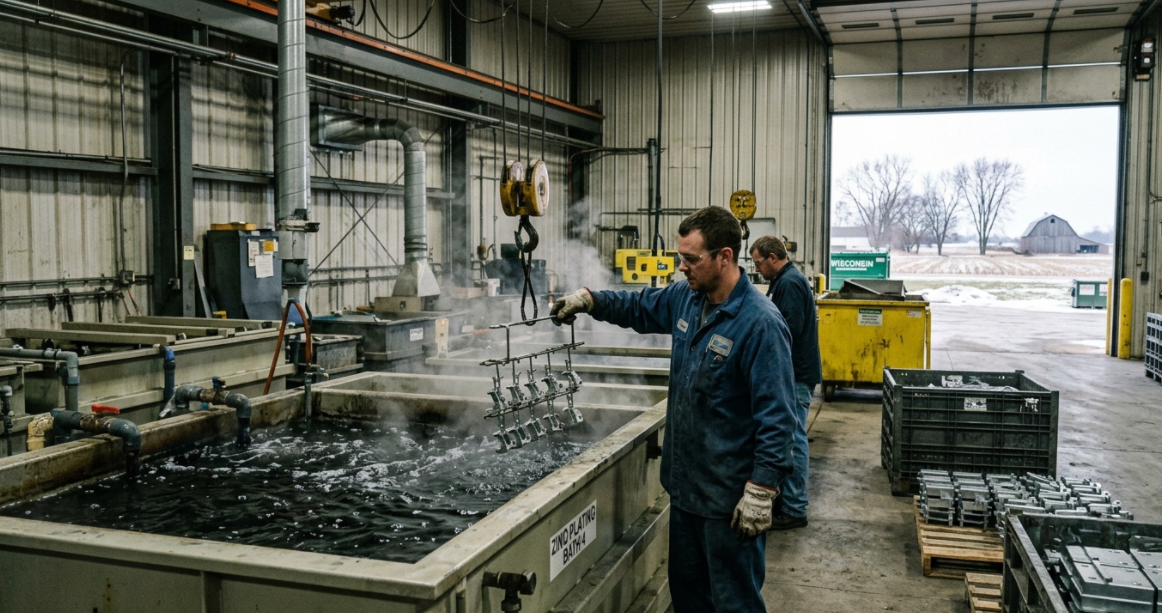
A purchase order lands on your desk with a single line buried in the terms “Supplier must maintain ISO 9001 certification.” Easy to skim past. Expensive to ignore. For manufacturers sourcing zinc plating in Wisconsin, that one line determines whether your parts sail through your customer’s incoming inspection or get flagged, quarantined, and sent back on your dime. This guide breaks down what ISO 9001 actually certifies, why it matters more for plating than almost any other outsourced process, and how to use it to de-risk your supply chain instead of just checking a compliance box.
If you buy zinc plating as a purchased service rather than performing it in-house, you’ve inherited a risk you can’t see directly. You don’t control the plating line, the chemistry, the inspection process, or the people running it. What you’re actually buying, whether your purchasing team realizes it or not, is trust that a process you can’t observe is producing a consistent, documented, repeatable result every single time.
ISO 9001 certification is the mechanism that makes that trust verifiable instead of assumed. It doesn’t grade the zinc itself it grades the system that produces the zinc coating, batch after batch, for the next customer and the one after that. For manufacturers in Wisconsin’s automotive, agricultural, and industrial supply chains, understanding what that system actually guarantees and what it doesn’t is the difference between a plating partner you can build a supply chain around and one that becomes your next quality escape.
This guide covers what ISO 9001 requires of a zinc plating operation, why it matters specifically for outsourced metal finishing, how to read a certificate instead of just filing it, and what to ask a Wisconsin plater before you commit your supply chain to them.
9001
The ISO quality management standard governing certified processes
3 Years
Typical ISO 9001 certification and surveillance audit cycle
100%
Of nonconforming lots that should be traceable back to root cause under a certified QMS
What ISO 9001 Actually Certifies (And What It Doesn’t)
ISO 9001 is a quality management system standard, not a product standard. This distinction trips up a lot of buyers, so it’s worth stating plainly ISO 9001 does not certify that a part meets a specific zinc thickness, passes a specific salt spray hour requirement, or conforms to a particular ASTM or OEM specification. Those are product-level requirements, governed by standards like ASTM B633 or a customer’s internal print callouts.
What ISO 9001 certifies is the system the plater uses to consistently meet whatever specification you give them. It confirms that the company has documented procedures for how work is planned, how equipment is maintained, how nonconformances are identified and contained, how corrective actions are tracked to closure, and how records are kept so that any lot can be traced back to the process conditions that produced it.
Think of it this way ASTM B633 tells you how much zinc a part needs. ISO 9001 tells you whether the company plating that part has a system reliable enough to hit that number the same way on run 1 and run 10,000. A plater can be excellent at the chemistry and still lack the systemic discipline to catch a drifting bath, an expired chemistry lot or a mislabeled shipment before it reaches your dock. That’s precisely the gap ISO 9001 is designed to close.
The Most Common Misunderstanding
Buyers sometimes assume an ISO 9001 certificate means every part that comes off the line is automatically “in spec.” It doesn’t. It means the supplier has a documented, audited system for planning the work, controlling the process, catching deviations, and proving after the fact what was done. The specification compliance still comes from a correctly written purchase order and a plater who follows it and it comes with the audit trail to prove it.
Why ISO 9001 Matters More for Plating Than for Most Outsourced Processes
Zinc plating sits in an unusual position in a manufacturing supply chain. It’s typically the last operation before a part ships, it’s applied to parts that are otherwise finished and often expensive, and it’s a chemical process where the inputs (bath chemistry, current density, time, rinse quality) are largely invisible to the customer receiving the finished part. A machined part can be measured with calipers on your own receiving dock. A plated coating’s thickness, adhesion, and corrosion performance require specialized equipment and destructive or semi-destructive testing that most buyers can’t do on every incoming lot.
That invisibility is exactly why a documented quality system matters so much here If a plater’s process drifts a rinse tank runs low, a rectifier miscalibrates a passivate dip time gets shortened during a busy week the defect isn’t visible until the part is in service and starting to corrode. By then, it may be installed on a piece of agricultural equipment in a field, bolted into an automotive underbody assembly, or shipped to an OEM’s own customer. The cost of finding that defect at that stage is not comparable to the cost of catching it at the plating line.
ISO 9001 forces a plater to build the controls that catch that drift before it becomes your problem calibrated instrumentation on a documented schedule, defined in-process checks, a formal nonconformance and corrective action process, and records that let both the plater and the customer trace a defect back to its root cause instead of guessing. For a process this consequential and this invisible, that system isn’t paperwork overhead it’s the actual product you’re buying alongside the zinc.
The Core Requirements of ISO 9001 in a Plating Operation
An ISO 9001-certified zinc plating facility has to demonstrate specific, auditable practices across the operation. Here’s what that looks like on the shop floor not just in a policy manual.
Document and Process Control
Every plating line running to a certified specification whether ASTM B633 a John Deere JDM spec or a Caterpillar CAT standard needs a documented work instruction tied to that job. Operators aren’t running from memory or verbal instructions. Bath parameters, rack or barrel loading procedures, plating time, and passivate steps are written down version-controlled and matched to the customer’s specific requirement before the parts ever touch the tank.
Equipment Calibration and Maintenance
Rectifiers, XRF thickness gauges, pH meters and salt spray chambers all require scheduled calibration against traceable standards. An ISO 9001 audit checks calibration records directly instrument by instrument, date by date. A facility that can’t produce a current calibration certificate for its thickness gauge has a credibility problem that goes well beyond paperwork.
Incoming Material and Chemistry Control
Zinc anodes, brighteners, passivate chemistries and rinse water all have to meet defined acceptance criteria before they’re used in production. Certified facilities log chemistry lot numbers and tie them to the production lots they were used on which is exactly the traceability link you need if a customer ever reports a field failure and asks “what was different about this batch?”
Nonconformance and Corrective Action
This is arguably the most operationally important requirement for a buyer. When a lot fails an in-process or final inspection whether it’s a thickness reading below spec, a visible defect or a dimensional issue caused by over-plating a certified facility has a documented procedure for containing the lot, investigating root cause and implementing a corrective action that prevents recurrence. Without this discipline, the same defect can resurface on your next order with no institutional memory of what caused it the first time.
Internal Audits and Management Review
ISO 9001 requires the facility to audit itself against its own documented system on a regular cycle, and requires leadership to formally review quality performance data (customer complaints, scrap rates, corrective actions) at defined intervals. This is the mechanism that keeps the system from becoming a binder that sits on a shelf it forces ongoing accountability at the management level, not just on the shop floor.
What This Looks Like From the Outside
You won’t personally witness any of these controls in daily operation. What you should see as a customer a current, valid ISO 9001 certificate from an accredited registrar a willingness to share calibration and process records relevant to your parts a documented corrective action response when something goes wrong and consistent results, lot after lot, without you having to re-specify the same requirement every time.
ISO 9001 Certification Requirements at a Glance
| Requirement Area | What It Means for a Plating Supplier | Why It Matters to Your Supply Chain |
|---|---|---|
| Document Control | Work instructions tied to each customer spec, version-controlled | Prevents your part from being plated to the wrong revision or a competitor’s requirement |
| Calibration Program | Scheduled, traceable calibration of XRF gauges, rectifiers, test equipment | Confirms the thickness and process data you receive is actually accurate |
| Traceability | Chemistry lots and process parameters linked to production lot numbers | Enables root-cause investigation if a field failure occurs months later |
| Nonconformance Process | Documented containment, root cause analysis, corrective action | Stops a defect from repeating silently across future orders |
| Internal Audit Cycle | Facility audits its own QMS against ISO 9001 clauses annually | Keeps the system enforced day-to-day, not just at renewal time |
| Management Review | Leadership formally reviews quality metrics on a defined schedule | Ensures quality performance drives business decisions, not just floor-level fixes |
| External Surveillance Audits | Accredited third-party registrar audits annually, recertifies every 3 years | Independent verification that the system is real and functioning not self-reported |
Why This Matters Specifically for Wisconsin’s Manufacturing Base
Wisconsin’s manufacturing economy runs heavily through automotive suppliers, agricultural equipment builders, construction hardware producers and industrial machinery manufacturers many of whom supply directly into OEM programs at companies like John Deere, Caterpillar, Case CNH, and Parker Hannifin. These OEMs don’t just require ASTM B633 compliance on the parts they buy they typically require their entire supply chain, down through second- and third-tier suppliers, to hold ISO 9001 certification or an equivalent automotive/industrial quality standard as a condition of doing business at all.
That requirement doesn’t stop at your factory door If your plater isn’t certified, you may technically be unable to fulfill your own contractual obligations to your OEM customer, regardless of how good your in-house processes are. A single uncertified link anywhere in that chain, whether it’s a machine shop a heat treater or a plating house can put an entire supplier relationship at risk during an OEM’s own supplier audit.
For manufacturers sourcing zinc plating locally in Wisconsin this creates a straightforward practical filter if you sell into automotive, agricultural or construction OEM programs and your plater isn’t ISO 9001 certified you have a supply chain gap that your customer’s next audit will eventually find. Sourcing plating from a certified Wisconsin partner isn’t a nice-to-have credential for many of these programs it’s a prerequisite that keeps your own certifications and contracts intact.
There’s also a practical non-audit reason certification matters locally Wisconsin manufacturers moving parts through in-state and regional supply chains benefit from shorter transit times and easier in-person quality reviews when something needs to be resolved quickly. Pairing that logistical advantage with a certified quality system means you get both the speed of a local partner and the documentation discipline of a formally audited one two things that are hard to get together from an out-of-state or overseas supplier.
What to Actually Ask a Wisconsin Plater About Their ISO 9001 Certification
A certificate hanging on a wall or linked as a PDF on a website tells you a company was certified at some point. It doesn’t tell you whether that certification is current whether it covers the specific process you’re buying or whether the system behind it is actually functioning. Here’s what to verify before you commit a supply chain to a plating partner.
Is the certificate current and who issued it?
ISO 9001 certificates are issued by accredited third-party registrars and are valid for a defined period typically three years with annual surveillance audits in between. Ask for the certificate directly and check the issue date, expiration date and registrar name. A registrar accredited by a recognized national accreditation body carries more weight than an unaccredited or unfamiliar issuer.
Does the certification scope include the actual process you’re buying?
Some certificates are scoped narrowly for example covering general operations but excluding a specific plating line or service added after the last certification cycle. Ask specifically whether zinc barrel plating, rack plating or the passivate systems you need are within the certified scope not just the company as a whole.
Can they produce calibration and traceability records on request?
A certified facility should be able to show you calibration records for the XRF gauge used on your parts and trace a specific lot back to the chemistry and process parameters used to produce it. If this request is met with hesitation or an inability to produce documentation quickly that’s a signal the system exists on paper more than in daily practice.
What does their corrective action process look like in practice?
Ask for an example (with customer details redacted, if needed) of a past nonconformance and how it was resolved. A mature certified system will have a clear unemotional answer what was found how it was contained what the root cause was and what changed as a result. A supplier who can’t describe this process or who claims defects “never happen,” is a bigger risk than one who can walk you through a real corrective action.
Do they hold any OEM-specific certifications or approvals in addition to ISO 9001?
Many Wisconsin platers serving automotive and agricultural OEMs maintain specific approvals to John Deere, Caterpillar or other customer-specific quality programs in addition to their ISO 9001 base certification. If you supply into one of these programs ask directly whether your plater is an approved source for that OEM not just generally ISO 9001 certified.
A Quick Verification Checklist
Before adding a plater to your approved supplier list confirm: (1) a current ISO 9001 certificate from an accredited registrar (2) the certified scope explicitly includes your plating process (3) they can produce calibration and lot traceability records on request (4) they can describe a real corrective action example and (5) any OEM-specific approvals relevant to your program are documented separately from the base ISO 9001 certificate.
How Certification Protects You When Something Goes Wrong
No plating process, however well controlled, is immune to the occasional deviation a bath that drifts out of range a rack that gets mis-loaded a lot that’s shipped before final inspection catches an issue. The real value of ISO 9001 shows up not when everything goes right but when something goes wrong.
Without a certified system a defect discovered in the field often becomes an unresolvable mystery. Nobody can say with confidence which lot the part came from what the process parameters were at the time or whether the same conditions exist on your next order. You’re left re-inspecting everything in inventory and hoping the problem doesn’t repeat.
With a certified system the same situation plays out very differently. The lot is traceable back to a specific date process record and chemistry batch. The nonconformance is documented and investigated to root cause instead of guessed at. A corrective action is implemented and verified before the next production run and you receive documentation of what changed. This is the practical difference between a supply chain incident that costs you a few days of investigation and one that costs you months of uncertainty, repeated failures and an eroded relationship with your own customer.
For manufacturers running lean supply chains without the bandwidth to independently audit every supplier’s internal processes, ISO 9001 certification is effectively a proxy for due diligence you don’t have to perform yourself. It’s a third party’s ongoing verification that a supplier’s system meets a recognized standard so you don’t have to take their word for it, and you don’t have to build your own auditing infrastructure to confirm it.
Frequently Asked Questions
Does ISO 9001 guarantee my parts will meet ASTM B633 or my customer’s specific thickness requirement?
No. ISO 9001 certifies the quality management system not a specific product outcome. Meeting ASTM B633 or an OEM spec depends on a correctly written purchase order and the plater’s process controls being applied correctly to that specific job. What ISO 9001 does guarantee is that the plater has a documented, auditable system for controlling the process catching deviations and correcting them consistently across every order not just the ability to hit a number once under ideal conditions.
How is ISO 9001 different from IATF 16949 which some automotive suppliers require?
IATF 16949 is an automotive-specific quality standard built on top of ISO 9001 adding requirements specific to automotive supply chains like production part approval processes (PPAP) and more rigorous statistical process control. ISO 9001 is the foundational industry-neutral standard IATF 16949 layers automotive-specific rigor on top of it. If you supply directly into automotive OEM programs ask your plater whether they hold IATF 16949 in addition to ISO 9001 since some automotive customers require it specifically.
How often does a plating facility need to be recertified?
ISO 9001 certification typically runs on a three-year cycle, with annual surveillance audits by the accredited registrar in between to confirm the system is still functioning as certified. A facility that lets its certification lapse or fails a surveillance audit can lose certification before the three-year mark, which is why checking the current certificate date directly rather than relying on memory of a past audit matters.
If a plater loses ISO 9001 certification, does that mean their zinc plating quality has changed?
Not necessarily overnight but it’s a serious signal worth investigating. Certification can lapse due to a failed surveillance audit a lapse in a registrar relationship or an internal decision to let it expire. Any of these should prompt a direct conversation with the supplier about what happened and whether their internal quality controls have actually changed rather than assuming everything else about their operation remains the same.
Can a smaller regional plater in Wisconsin realistically maintain ISO 9001 alongside larger national competitors?
Yes. ISO 9001 certification is achievable and maintained by plating operations of all sizes it’s a function of documented process discipline not company scale. In some respects a regional Wisconsin plater with a long-tenured stable workforce may maintain more consistent process control than a larger multi-site operation juggling standardized procedures across locations with more staff turnover. Certification status not company size is the relevant signal to check.
What should I do if my current plater isn’t certified but I need to sell into an OEM program that requires it?
Start the conversation early since achieving initial ISO 9001 certification typically takes many months of system-building and documentation before a registrar audit can even be scheduled. If your timeline doesn’t allow for that, evaluate whether transitioning some or all of your plating volume to an already-certified Wisconsin supplier is a faster path to meeting your OEM’s supply chain requirement without risking your own contract.
Building a Supply Chain You Can Trust
ISO 9001 certification isn’t a marketing badge it’s the documented independently audited proof that a zinc plating partner’s process is controlled traceable and accountable when something doesn’t go as planned. For Wisconsin manufacturers supplying automotive agricultural and industrial OEM programs it’s often the quiet prerequisite that keeps an entire supply chain relationship intact.
Plateco has maintained ISO 9001 certification while zinc plating parts for Wisconsin and Midwest manufacturers since 1974 serving automotive, agricultural, equipment and industrial hardware supply chains that depend on documented repeatable quality. If your supply chain requires a certified zinc plating partner or you’re not sure whether your current process documentation would hold up under your customer’s next audit send us your specification and we’ll walk you through exactly what our certified system verifies on every lot.