

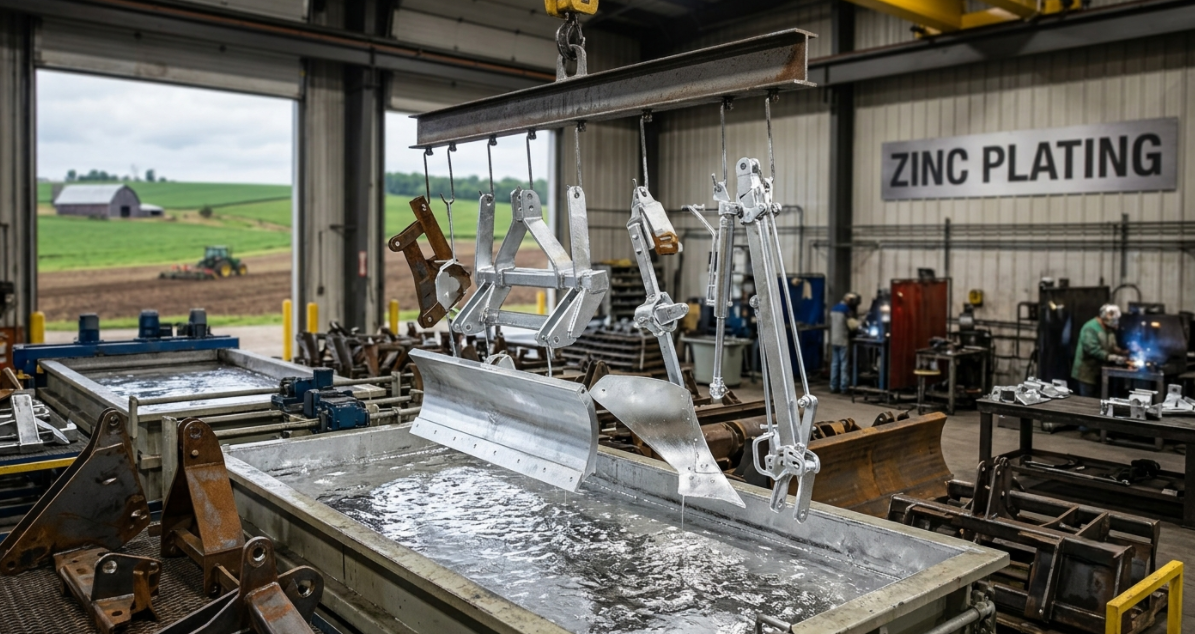
It’s the third week of April, ground temperature just crossed 50 degrees, and a Wisconsin corn grower is finally rolling into the field after a wet spring pushed planting back further than anyone wanted. Two hundred acres in, a parallel arm bushing on the planter seizes. The operator climbs down, finds surface rust has swollen a pin that should slide freely, and now the whole row unit is out of alignment. That’s not a two-minute fix. That’s a call to the dealer, a wait for a part, and idle acres while a ten-day planting window keeps closing.
Multiply that single pin by every fastener, pin, bracket, chain, and hydraulic fitting on a modern planter, combine, sprayer, or tillage tool, and you start to understand why corrosion resistance isn’t a nice-to-have for agricultural equipment manufacturers and dealers in the Midwest. It’s the difference between a machine that performs through a 15-year service life and one that nickel-and-dimes an operation to death with field failures, warranty claims, and downtime during the two windows of the year when downtime costs the most: planting and harvest.
Zinc plating is the quiet workhorse behind a huge share of that reliability. It’s not the part of the machine anyone brags about at the farm show. But ask any equipment engineer, dealer parts manager, or ag component manufacturer in Illinois, Wisconsin, Iowa, or Minnesota what keeps fasteners turning free and brackets from seizing after a decade of corn, beans, hogs, and Midwest winters, and zinc plating is almost always part of the answer.
Why the Midwest Is a Uniquely Hard Environment for Ag Equipment
Corrosion engineers talk about “environmental severity” the way agronomists talk about growing degree days it’s the variable that determines how fast a part degrades, and it’s not the same everywhere. The Midwest stacks several corrosion accelerants on top of each other in a way that few other regions do.
Road salt and calcium chloride brine. Equipment doesn’t live in the field year-round. It gets trailered on state highways, parked in yards next to salted driveways, and driven across county roads that get brined ahead of every winter storm from November through March. Chloride ions are one of the most aggressive drivers of corrosion on unprotected steel, and once brine works its way into a fastener thread or a linkage pin bore, it doesn’t rinse back out easily.
Humidity swings and freeze-thaw cycling. A Midwest summer runs hot and humid; a Midwest winter runs well below freezing with repeated thaw cycles in between. That cycling is worse for coatings and bare steel than a climate that’s simply cold or simply humid, because expansion and contraction opens up microscopic gaps in any protective layer that isn’t fully bonded to the base metal.
Manure, fertilizer, and ag chemical exposure. Livestock operations and row-crop operations both expose equipment to compounds that are far more corrosive than plain water anhydrous ammonia, liquid nitrogen, manure slurry, and various crop protection chemistries. A spreader, manure spreader axle, or sprayer boom fitting sees chemical exposure that a comparable part on, say, a piece of construction equipment never has to survive.
Dust, grit, and abrasion. Field dust is fine, sharp, and constant. It wears through thin or poorly bonded coatings, exposing bare steel underneath, which then becomes the entry point for the corrosion described above. A coating that looks fine in a lab salt-spray chamber can fail fast in a machine shed if it can’t also hold up to abrasive wear.
Put those four factors together and you get a corrosion environment that’s tougher, in a lot of respects, than what equipment faces on either coast. It’s also why Midwest ag OEMs, implement dealers, and component suppliers tend to be far more particular about plating specs than buyers in milder climates they’ve watched what happens when a supplier cuts corners, and they’ve paid for the warranty claims.
Get a Coating That Survives the Field – (608) 524-8241
Where Corrosion Actually Shows Up on Ag Equipment
Ask a service manager where corrosion failures cluster and you’ll get a fairly consistent list, because the geometry of these parts makes them vulnerable in predictable ways.
- Fasteners — Grade 5 and Grade 8 bolts, nuts, and washers used throughout planters, combines, balers, and tillage equipment. Corroded threads mean a bolt that won’t torque correctly, won’t back out for service, or shears under load because it’s seized rather than turning.
- Hydraulic fittings and hardware — Cylinders, hose ends, and quick-connect couplers that need to seal reliably for years, often while sitting exposed on the underside of a frame where road spray and mud collect.
- Pins, bushings, and linkage hardware — Exactly the kind of part in the planter example above. These need a smooth, corrosion-free surface to move freely; even light surface rust changes the tolerance enough to bind.
- Brackets, clips, and small stampings — High-volume, lower-cost parts that are easy to overlook in a spec sheet but that fail constantly if plating is inconsistent, since there are simply so many of them on a single machine.
- Chain, sprockets, and drive components — Anything with moving metal-on-metal contact where corrosion adds friction, accelerates wear, and eventually causes a chain to jump or a sprocket to gall.
- Disc blades, shanks, and wear-adjacent hardware — Parts that already take abrasive wear from soil contact; corrosion at the mounting hardware around them compounds that wear pattern.
None of these parts fail because of one single dramatic exposure. They fail because they sit through a hundred small exposures a winter of road brine, a summer of humidity, a season of manure or chemical contact with nothing standing between bare steel and the environment except a coating that was either specified correctly or wasn’t.
Zinc Plating vs. the Alternatives for Ag Components
Ag equipment manufacturers have real options for corrosion protection, and it’s worth being clear-eyed about the trade-offs rather than assuming one finish is automatically “better.” The right answer usually depends on the part’s function, not just its exposure.
Zinc electroplating deposits a thin, uniform layer of zinc directly onto the base metal through an electrochemical process, typically followed by a chromate conversion coating (clear, yellow, or black) that adds another layer of protection and, for buyers, a visual cue for spec identification. It holds tight dimensional tolerances, which matters enormously for threaded fasteners, precision pins, and anything that has to fit a mating part without re-machining. It’s also sacrificial: zinc corrodes preferentially to the steel underneath, so even where the coating gets scratched in the field, the surrounding zinc keeps protecting the exposed steel rather than letting rust creep in immediately.
Hot-dip galvanizing builds a much thicker zinc coating and is the right call for structural steel, frames, and large weldments that don’t need tight tolerance and benefit from decades of outdoor exposure resistance. It’s overkill and often dimensionally incompatible for threaded fasteners and precision hardware.
Powder coating gives a durable, attractive, often colored finish that’s popular for exterior sheet metal and shrouding, but it’s a barrier coating, not a sacrificial one. Once it’s chipped or scratched which happens constantly in a field environment bare steel is exposed with no ongoing protection, and corrosion starts right at that chip.
E-coating applies a very thin, highly uniform paint layer through an electrical deposition process and is excellent for complex geometries and paint adhesion on visible components, but like powder coat, it’s a barrier system rather than a sacrificial one once damaged.
For the high-volume threaded fasteners, pins, brackets, and hardware that make up the bulk of an ag machine’s corrosion-vulnerable parts, zinc plating tends to be the specified finish for a simple reason: it protects even after it’s been scuffed, gouged, or chipped in service which is exactly what happens to hardware that lives on a planter frame or a combine header for a decade.
Barrel Plating, Rack Plating, and Mechanical Galvanizing: Matching the Process to the Part
Not all zinc plating happens the same way, and for ag equipment manufacturers, choosing the right plating process matters as much as choosing zinc in the first place.
Zinc barrel electroplating is built for exactly the kind of small, high-volume hardware ag equipment consumes by the truckload bolts, nuts, washers, cotter pins, small brackets. Parts tumble in a rotating barrel through the plating solution, which is efficient and cost-effective at volume, and it’s the right process for the vast majority of an ag OEM’s fastener spend.
Zinc rack electroplating holds larger, more delicate, or more precisely finished parts individually on a rack rather than tumbling them together. It’s the right call for bigger components, parts with critical surface finish requirements, or hardware that would nick, tangle, or dent if tumbled with hundreds of other pieces think larger brackets, shafts, or linkage components where cosmetic and dimensional precision both matter.
Zinc mechanical galvanizing deposits zinc through a mechanical, non-electrolytic process rather than an electrical one. This matters enormously for one specific category of ag hardware: high-strength fasteners. Grade 8 bolts, spring-tempered pins, and other hardened, high-tensile-strength components are susceptible to hydrogen embrittlement during electroplating, because the electrochemical process can drive atomic hydrogen into the steel, where it embrittles the metal and can cause a fastener to fail sometimes catastrophically, and sometimes months after it’s been put into service under load. Mechanical galvanizing avoids that risk entirely because there’s no electric current and no hydrogen-generating chemistry involved.
A plater who understands ag equipment knows which parts on a bill of materials need barrel electroplating for cost efficiency, which need rack plating for precision, and which high-strength fasteners need mechanical galvanizing to avoid an embrittlement failure down the road. A plater who doesn’t make that distinction or who plates everything the same way to keep their own process simple is passing risk straight to the OEM’s warranty department.
Hydrogen Embrittlement: The Failure Mode Ag Engineers Should Ask About by Name
It’s worth dwelling on hydrogen embrittlement specifically, because it’s the failure mode that turns a routine plating decision into a liability question. High-strength steel fasteners the kind used throughout combines, tillage tools, and heavy implements where load and vibration are constant can absorb hydrogen during electroplating or even during the acid pickling steps that precede it. That hydrogen doesn’t necessarily cause a problem on day one. It can sit in the steel’s grain structure and cause a delayed fracture weeks or months later, often with no warning, under a load the fastener was rated to handle.
The industry-standard mitigation is a post-plating bake holding parts at an elevated temperature for a specified time shortly after plating to drive residual hydrogen back out of the steel before it does damage. ASTM B850 and related specifications lay out baking requirements based on fastener strength and coating type. A plating partner working with ag equipment fasteners should be baking high-strength parts as a matter of standard procedure, not as an upcharge, and should be able to document it. If a plater can’t speak to baking times, temperatures, and the specific hardness thresholds that trigger the requirement, that’s a real gap not a minor one for any fastener carrying structural load on a machine that runs sixty-hour weeks during harvest.
The Specs That Actually Matter on an Ag Equipment Print
Most ag equipment purchase orders and part prints carry a plating spec line the same way an automotive or industrial print does and just like in those industries, it’s a line that gets treated as boilerplate far more often than it should.
ASTM B633 is the baseline specification most zinc electroplating callouts reference, defining coating thickness classes (by service condition severity) and the type of supplementary chromate treatment. A part destined for constant outdoor exposure needs a different thickness class than one that lives inside a sealed gearbox housing, and the spec line should reflect that difference not default to whatever’s cheapest to run.
Major ag OEM specifications the equivalent of what an automotive supplier deals with under a GM or Ford spec, or what a construction equipment supplier deals with under a CAT material spec layer additional requirements on top of ASTM baselines. Deere, Case IH, AGCO, and CNH component specs frequently call out specific salt-spray hour requirements, torque-tension testing for fasteners, and appearance standards that go beyond the ASTM minimum. A component supplier bidding on ag OEM work needs a plating partner who can read and hit those specs precisely, not one who plates to “standard zinc” and hopes it passes incoming inspection.
Salt spray testing (ASTM B117) is the standard accelerated corrosion test used to validate a coating before it ever reaches a field. It doesn’t perfectly replicate a Midwest winter, manure exposure, and dust abrasion all at once no single lab test can but it remains the industry benchmark for comparing coating performance, and it’s the number that shows up in most ag component specs as a pass/fail threshold.
Treating that spec line as boilerplate is exactly how a component ends up dimensionally perfect, correctly machined, and still rejected or worse, not rejected, and instead shipped into the field where it fails during a customer’s planting season and turns into a warranty claim, a dealer relationship problem, and a very uncomfortable phone call for the OEM’s quality team.
Why Ag Manufacturers and Dealers Lean on a Local Midwest Plating Partner
There’s a pattern that shows up again and again with ag equipment manufacturers and component suppliers who’ve tried an out-of-state or lowest-bid plating house: the quote looks good on paper, and the relationship falls apart the first time timing actually matters.
Ag manufacturing runs on a calendar that most industries don’t have to think about. Planters, drills, and tillage tools need to ship ahead of spring; combines, headers, and grain handling equipment need to ship ahead of fall. There is no “we’ll get it to you next month” in that world a two-week plating delay in March can mean a dealer doesn’t have equipment on the lot when a farmer needs it, and that’s a lost sale, not just a late delivery.
A Midwest-based plater, sitting inside the same regional supply chain as the OEMs and component manufacturers it serves, means shorter freight lanes, faster turnaround on rework if a batch needs adjustment, and maybe most importantly a plating partner who actually understands why an ag customer’s timeline is non-negotiable during specific windows of the year. That’s a very different relationship than a national plating conglomerate handling an ag account as one line item among hundreds of unrelated industries.
It also means accountability that’s easier to enforce. When a plating problem does surface and across a long enough relationship, something eventually will proximity matters. A phone call and a same-day plant visit beat a three-day wait for a callback from a plater eight states away, every time.
What an Ag Equipment Manufacturer Should Look for in a Zinc Plating Partner
Based on everything above, a short, practical checklist for evaluating a zinc plating supplier for ag equipment components:
- Process fit — Do they run barrel electroplating, rack electroplating, and mechanical galvanizing, and can they explain which process fits which part on your bill of materials, rather than pushing everything through one process?
- Hydrogen embrittlement control — Do they bake high-strength fasteners as standard practice, and can they document baking parameters against ASTM B850?
- Spec literacy — Can they read and quote against ASTM B633, major ag OEM material specs, and salt-spray requirements without translation help?
- Quality track record — What’s their actual return/reject rate, not just their marketing copy? A plater with a track record under half a percent is telling you something real about their process control.
- Certifications — ISO 9001 certification indicates a documented, audited quality system rather than a one-off inspection process.
- Turnaround reliability — Can they commit to and consistently hit delivery dates around planting and harvest production schedules, not just quote a lead time and hope?
- Proximity — Are they close enough to your production or your dealer network that freight time and relationship responsiveness both work in your favor?
FAQ: Zinc Plating for Agricultural Equipment
Does zinc plating actually hold up to manure and fertilizer exposure?
Yes, better than most barrier coatings, because zinc plating is sacrificial rather than a simple physical barrier. Even where chemical exposure degrades the surface faster than it would on, say, a piece of equipment that never sees livestock or fertilizer contact, the zinc continues protecting the underlying steel rather than failing all at once. For components with heavy, sustained chemical exposure certain manure spreader and sprayer parts a thicker coating class under ASTM B633 or an upgrade to zinc-nickel plating is worth discussing with your plater rather than assuming standard zinc thickness is automatically sufficient.
What’s the difference between zinc plating and hot-dip galvanizing for ag equipment, and how do I know which one my part needs?
Zinc plating is a thin, precise, electrochemically applied coating that holds tight dimensional tolerances the right call for fasteners, pins, and hardware that has to fit mating parts without re-machining. Hot-dip galvanizing builds a much thicker coating and suits large structural weldments, frames, and parts where tolerance isn’t a concern but decades of outdoor exposure is. If the part has threads, a bore, or a precision fit, it almost always needs plating rather than galvanizing.
Why does hydrogen embrittlement matter more for some ag fasteners than others?
Risk rises with fastener strength and hardness. Grade 8 bolts, spring pins, and other high-tensile hardware are far more susceptible than lower-grade fasteners, because their microstructure holds less tolerance for absorbed hydrogen before it causes a delayed fracture. A plater should be baking these parts per ASTM B850 as standard procedure not as an optional step and should be able to tell you their specific baking parameters without hesitation.
Can zinc-plated ag equipment parts be repainted or powder coated afterward?
Generally yes, and it’s common on visible sheet metal and shrouding where corrosion protection and cosmetic finish both matter. The zinc plating (with its chromate conversion coating) provides the corrosion protection underneath, and a compatible primer or paint system goes over the top for color and UV resistance. The plating and topcoat should be specified together so the surface prep and chromate type don’t interfere with paint adhesion.
How long does zinc plating actually last on equipment that sits outdoors year-round?
It depends on coating thickness class, chromate type, and exposure severity which is exactly why ASTM B633 defines different service condition classes rather than a single blanket standard. A correctly specified coating on hardware exposed to Midwest winters, road brine, and field chemicals can reasonably be expected to protect a part through a 10- to 15-year equipment service life, provided the plater hit the correct thickness class and baking requirements to begin with. Under-specifying the class to save a fraction of a cent per part is the single most common reason a coating underperforms its expected life.
Does a small or mid-size ag component manufacturer need to worry about minimum order quantities for plating?
It’s worth asking upfront. Zinc plating economics favor higher volumes, and a plater who doesn’t accommodate smaller mid-size manufacturer runs well can leave you either overpaying per part or stuck batching orders around someone else’s larger jobs. A plating partner who works regularly with ag component suppliers of different sizes should be able to talk through realistic minimums and lead times specific to your production volume, rather than applying a one-size-fits-all policy.
Who sets the plating spec on an ag equipment part the OEM, the component manufacturer, or the plater?
The OEM (Deere, Case IH, AGCO, CNH, or another equipment manufacturer) typically sets the baseline requirement on the part print, referencing ASTM B633 plus any OEM-specific salt-spray or torque-tension requirements. The component manufacturer is responsible for sourcing a plater who can hit that spec consistently. A good plating partner will flag it if a spec line looks inconsistent with the part’s actual service condition, rather than silently plating to the letter of an outdated or mismatched callout.
The Plateco Approach
Plateco has been running zinc barrel electroplating, zinc rack electroplating, and zinc mechanical galvanizing out of Reedsburg, Wisconsin since 1974 long enough to have plated parts for the same Midwest ag manufacturers and component suppliers across multiple equipment generations. The shop is ISO 9001 certified, has been named to the Products Finishing Top Shops list seven years running, and posted a 0.1% customer return rate in the first quarter of 2026 a number that reflects the kind of process discipline that ag component buyers should be asking every plater to produce, not just Plateco.
For manufacturers and Tier 1 suppliers building fasteners, pins, brackets, hydraulic hardware, and linkage components for planters, combines, sprayers, and tillage equipment, that means a plating partner inside the same regional supply chain, working from the same understanding of what a Midwest spring or a Midwest winter actually does to unprotected steel and a quality system built to hit spec every time, because a Grade 8 bolt that fails in a field during harvest isn’t a paperwork problem. It’s a farmer standing next to a broken machine at the worst possible moment of the year.
If your current plating supplier can’t answer specific questions about baking parameters, ASTM classifications, or their own return rate, that’s worth a conversation. Request a quote from Plateco or call (608) 524-8241 to talk through what your ag equipment components actually need.