
A purchase order lands on your desk with a new checkbox: “RoHS Compliant Required.” Your plater needs to certify it. Your quality team needs to document it. But what does it actually mean for zinc plating specifically and what changes in the process when RoHS is on the line? This guide answers every question, clearly.
If you manufacture components for automotive OEMs, consumer electronics, appliances, or any industrial product that ships into European markets or supplies a company that does you have almost certainly encountered a RoHS compliance requirement on a customer purchase order or drawing in the past few years. And if your parts go through zinc electroplating as part of their finishing process, RoHS compliance has a very specific, actionable meaning that affects the chemistry your plater uses on every single job.
The good news: RoHS compliance in zinc plating is not complicated once you understand what it actually requires. At Plateco, we’ve been processing RoHS-compliant zinc-plated parts since the directive’s requirements began flowing through North American supply chains in the mid-2000s. Our entire commercial zinc plating operation uses trivalent chromate chemistry the RoHS-compliant standard as the default for every job. This guide explains exactly why, what RoHS means in the context of zinc plating, and what you and your plater need to do to demonstrate compliance.
What Is RoHS? The Plain-Language Explanation
RoHS stands for Restriction of Hazardous Substances. It is a European Union directive that restricts the use of specific hazardous materials found in electrical and electronic equipment (EEE). The original directive Directive 2002/95/EC was adopted by the EU in 2003 and took effect in 2006. It was superseded by RoHS 2 (Directive 2011/65/EU), which expanded the scope and strengthened compliance requirements. RoHS 2 is the current operative standard.
The directive’s core purpose is straightforward: to reduce the amount of toxic substances entering the waste stream when electronic and electrical products reach end-of-life. The EU determined that certain hazardous materials most prominently lead, mercury, cadmium, and hexavalent chromium were creating significant environmental and human health risks through improper disposal and recycling of electronics. RoHS restricts these substances to threshold concentrations in electrical and electronic equipment placed on the EU market.
🇪🇺 Geographic ScopeRoHS is an EU directive, but its practical reach extends globally. Any manufacturer anywhere in the world that sells products into the EU market, or supplies components to companies that do, must comply. North American manufacturers supplying into automotive, electronics, and industrial supply chains that touch European markets are subject to RoHS requirements through their customer specifications, even if the manufacturer itself never sells directly to Europe.
The Ten Restricted Substances
RoHS 2 restricts ten substances. The original six from the 2003 directive plus four phthalates added in 2015:
Lead (Pb) (Max 0.1% by weight)
Historically used in solder, coatings, and alloys. One of the primary drivers of the original directive. Relevant to plating operations using lead-containing alloys or surface treatments.
Hexavalent Chromium Cr(VI) (Max 0.1%)
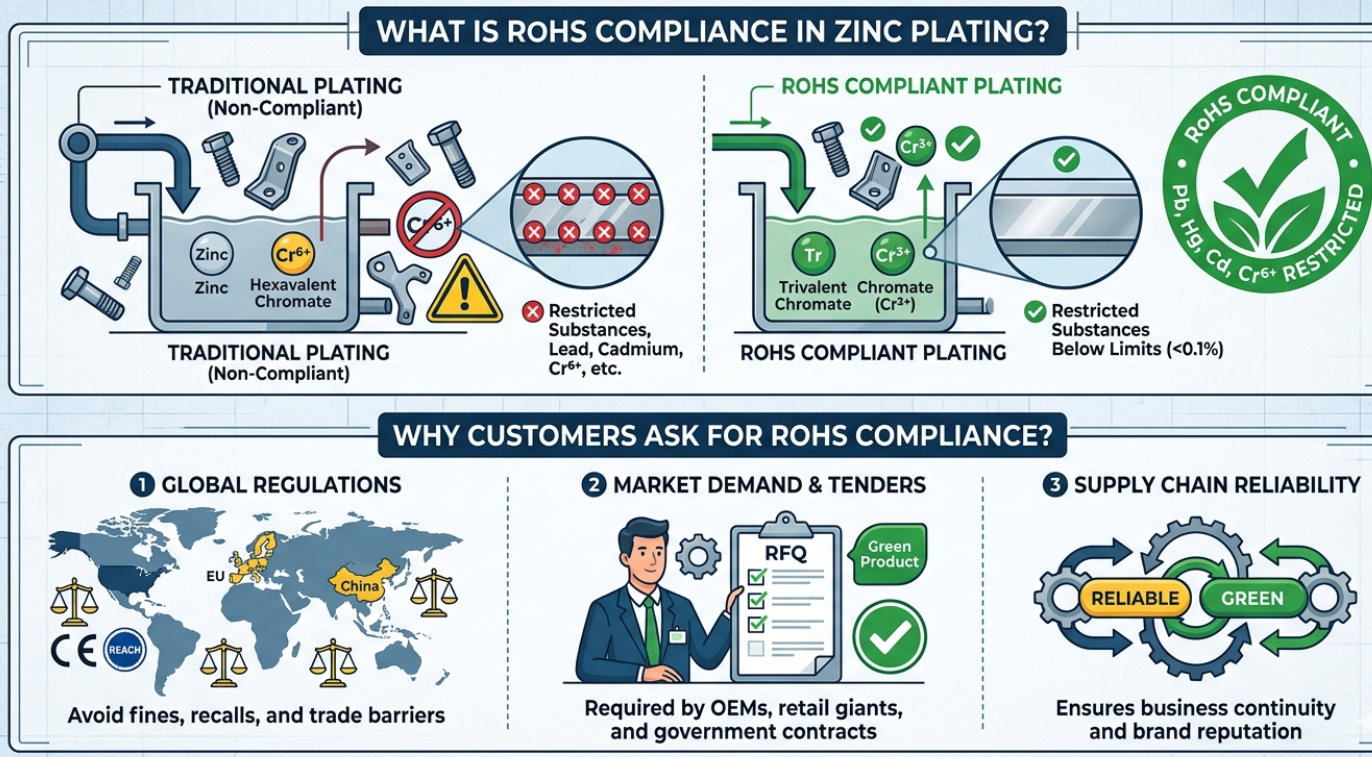
Directly relevant to zinc plating. Hexavalent chromate passivation (the traditional yellow “dichromate” finish) contains Cr(VI) and is restricted. This is why RoHS compliance in zinc plating means trivalent passivate only.
Mercury (Hg) (Max 0.1%)
Used in fluorescent lighting, certain switches, and older electronics. Not typically relevant to standard zinc plating operations.
Cadmium (Cd) (Max 0.01%)
Cadmium plating was a common aerospace and military coating. RoHS (and the ELV directive) has driven the near-complete elimination of cadmium plating from commercial applications, with zinc plating as the primary replacement.
Polybrominated Biphenyls (PBB ) (Max 0.1%)
Flame retardants used in plastics. Not relevant to zinc plating operations.
PBDE, DEHP, BBP, DBP, DIBP (Max 0.1%)
Flame retardants and phthalate plasticizers. Added in 2015 expansion. Not relevant to standard metal finishing.
Of these ten substances, hexavalent chromium (Cr(VI)) is the one that directly and exclusively affects zinc plating. Every other restricted substance is irrelevant to standard zinc electroplating operations. Hexavalent chromium was the chemistry used in traditional passivation the post-plate treatment that seals the zinc surface and provides corrosion resistance. Replacing it is what RoHS compliance means in the zinc plating context.
Hexavalent vs. Trivalent Chromate: The Chemistry Behind the Compliance
To understand RoHS compliance in zinc plating, you need to understand the fundamental chemistry divide between the two types of passivation that have existed side-by-side in the industry for decades: hexavalent chromate (Cr(VI)) and trivalent chromate (Cr(III)).
Hexavalent Chromate: The Legacy Standard
For most of the twentieth century, zinc-plated parts were passivated using chromate solutions containing chromium in the hexavalent (+6) oxidation state hence “hexavalent chromate” or Cr(VI). The chemistry produced excellent, reliable corrosion protection and was well-understood by platers and customers alike. The vivid, deep golden-yellow color of traditional “yellow zinc” and the mirror-bright finish of “clear chromate” were both hexavalent products.
Hexavalent chromium is also, however, a known human carcinogen. Cr(VI) compounds are highly toxic by inhalation and ingestion, classified as Group 1 carcinogens by the International Agency for Research on Cancer (IARC), and implicated in lung cancer, nasal cancer, and other serious health conditions among occupationally exposed workers. When products containing hexavalent chromate passivation enter the waste stream, Cr(VI) can leach into groundwater and soil, creating environmental contamination risks.
Why Cr(VI) Is RestrictedHexavalent chromium (Cr(VI)) is classified as a known human carcinogen. Industrial exposure through inhalation is associated with lung and nasal cancers. Environmental release through improper waste disposal contaminates groundwater. RoHS, REACH, and ELV restrict Cr(VI) to a maximum of 0.1% by weight in homogeneous materials a threshold that a standard hexavalent chromate passivate layer would violate by a wide margin.
Trivalent Chromate: The RoHS-Compliant Replacement
Trivalent chromate passivation uses chromium in the +3 oxidation state (Cr(III)) rather than +6. Trivalent chromium is the biologically common form it is an essential trace element in human nutrition and is not classified as carcinogenic. It is also not restricted by RoHS, REACH, or ELV at concentrations found in zinc passivate layers.
Modern trivalent chromate systems developed specifically to replace hexavalent chemistry while preserving corrosion performance have been refined over 20-plus years and now match or approach the corrosion protection of their hexavalent predecessors in most commercial applications. Trivalent clear passivate and trivalent yellow passivate are both commercially mature, widely available, and fully capable of meeting OEM salt spray requirements for standard zinc plating applications.
Trivalent chromate passivation (Cr(III)) is not restricted by RoHS, REACH, or ELV. It is the industry-standard, fully compliant replacement for hexavalent chromate in zinc plating passivation. When a customer asks for “RoHS-compliant zinc plating,” they are asking for zinc plating with trivalent passivation chemistry not hexavalent. Plateco runs exclusively trivalent chromate systems as our commercial standard.
Performance Trade-offs: What Changed When the Industry Switched
The transition from hexavalent to trivalent passivation was not seamless early trivalent systems underperformed hexavalent chemistry in salt spray testing, and the industry spent years refining trivalent bath formulations to close the gap. Today’s trivalent systems are significantly better than first-generation products but there are still some performance differences worth understanding:
- Corrosion performance: Modern trivalent yellow passivate is fully capable of meeting the 120–240+ hour salt spray requirements specified in most commercial and OEM zinc plating standards. The gap between hexavalent and trivalent has narrowed substantially with improved trivalent bath chemistry and topcoat sealer systems.
- Appearance: Trivalent yellow passivate produces a lighter, more variable iridescent gold-amber tone compared to the deep, saturated gold of legacy hexavalent yellow. This is a cosmetic difference, not a performance one, but it has caused confusion when customers familiar with hexavalent yellow receive trivalent parts and assume the lighter color indicates a processing defect.
- Self-healing: Hexavalent chromate layers had a degree of self-healing capability released Cr(VI) ions could re-passivate minor scratches. Trivalent systems do not have this property, making topcoat sealers more important for maximum corrosion performance.
RoHS Is Not the Only Directive: REACH, ELV, and WEEE
RoHS gets the most attention in supply chain compliance conversations, but it is not the only European directive restricting hexavalent chromium. Understanding the full regulatory landscape helps explain why your automotive, electronics, and industrial customers are asking for compliance documentation across multiple frameworks simultaneously.
REACH and Automotive: Parallel RequirementsAutomotive manufacturers supplying into Europe must comply with both the ELV Directive and REACH for hexavalent chromium. Many North American automotive Tier 1 and Tier 2 suppliers operate under OEM specifications that explicitly call out ELV compliance for Cr(VI) restriction often in addition to or instead of explicitly citing RoHS because ELV predates RoHS for automotive applications. If your automotive customer’s drawing says “ELV compliant, no hexavalent chromium,” the zinc plating compliance requirement is identical to a RoHS requirement: trivalent passivate only.
What RoHS Compliance Means for Your Zinc-Plated Parts
Practically speaking, RoHS compliance for zinc-plated parts means one thing above all else: no hexavalent chromate passivation. The zinc deposit itself metallic zinc electrodeposited onto the steel substrate is not a restricted substance. The passivation chemistry is where the compliance question lives.
Here is what changes, and what doesn’t, when you specify RoHS-compliant zinc plating:
Why Your Customer Is Asking The Supply Chain Reality
You may be a Wisconsin manufacturer making brackets for a harvesting machine, or a fastener distributor supplying a Tier 2 automotive supplier. Your end product may have nothing to do with consumer electronics. So why is RoHS compliance showing up on your purchase orders?
The answer is supply chain cascade. RoHS 2 placed explicit compliance obligations on manufacturers selling EEE into the EU market and those obligations flow downstream through the supply chain via contractual and specification requirements. A US automotive Tier 1 supplier selling to a European OEM requires their Tier 2 suppliers to comply. That Tier 2 requires it of their sub-suppliers. The compliance obligation migrates upstream until it reaches the plating shop finishing the individual fasteners even if no one in the chain except the Tier 1 ever directly interacts with European regulations.
Additionally, many OEMs John Deere, Caterpillar, Parker Hannifin, CNH Industrial have adopted trivalent-only requirements across their global supply chains, regardless of whether the specific product or market technically falls under EU jurisdiction. The simplicity of a single global standard is operationally attractive, and the direction of regulatory travel worldwide is clearly toward restricting hexavalent chromium further, not relaxing those restrictions. Proactive adoption of trivalent chemistry protects supply chain relationships and avoids future disruptive changes.
“We treat zinc plating as an extremely complex process demanding state-of-the-art technology, painstaking planning, obsessive quality control, and a tremendous amount of talent. Our customers don’t come to us for excuses they come to us for perfection. And we’ll do whatever it takes to give them nothing less.” Jim Schweich, Chief Executive Perfectionist, Plateco, Inc.
Industries Where RoHS Compliance Is Now Standard Practice
Automotive and light truck: ELV compliance with no Cr(VI) has been mandatory in European automotive supply chains since 2003. North American OEMs and their suppliers have adopted equivalent requirements globally. For any automotive-adjacent zinc plating, assume trivalent chemistry is required unless the customer explicitly states otherwise which almost never happens today.
Agricultural and construction equipment: John Deere, AGCO, Caterpillar, and CNH Industrial have all incorporated RoHS-equivalent requirements into their internal specifications. Agricultural hardware supply chains supplying these OEMs must use trivalent chemistry.
Electronics and electrical equipment: RoHS applies directly. Consumer electronics, industrial controls, switchgear, motors, transformers, and any other EEE entering EU markets must comply fully. Zinc-plated enclosures, mounting hardware, and fasteners used in EEE must carry trivalent passivation.
Appliances and HVAC: White goods (washing machines, refrigerators, dishwashers) and commercial HVAC equipment sold in the EU fall under RoHS scope. Zinc-plated components within these products must comply.
Industrial distribution: Large industrial distributors (Fastenal, MSC, Grainger, and their equivalents) increasingly require RoHS-compliant certifications from their supply base as standard commercial practice, regardless of the ultimate end market because they cannot predict or track where individual line items ultimately ship.
Documentation: What You Need and How to Get It
RoHS compliance is not self-certifying. A part that looks identical before and after the transition from hexavalent to trivalent passivation provides no visual evidence of which chemistry was used. Compliance must be documented through the supply chain which means your plater needs to provide appropriate certification, and you need to retain and pass that documentation to your customer.
What Documentation RoHS Requires
RoHS 2 requires manufacturers to maintain technical documentation demonstrating compliance and, for direct EU market products, to provide an EU Declaration of Conformity. For components and sub-assemblies within a supply chain, the practical requirement is typically a Certificate of Compliance (CoC) or RoHS Compliance Declaration confirming that the product or process does not use restricted substances above threshold concentrations.
For zinc-plated parts specifically, the documentation should confirm:
- That trivalent chromate passivation (Cr(III)) was used, and hexavalent chromate (Cr(VI)) was not
- The applicable standard referenced (typically “RoHS compliant per EU Directive 2011/65/EU”)
- The specific restricted substance covered (hexavalent chromium Cr(VI), below 0.1% by weight in homogeneous material)
- The passivate chemistry system and supplier, if required by the customer’s specification
- Lot or batch traceability linking the documentation to the specific parts shipped
Plateco Documentation CapabilityPlateco provides RoHS Compliance Certificates (CoC) with shipments on request, confirming trivalent chromate chemistry for all passivated zinc-plated parts. Our ISO 9001:2015 quality management system maintains process records, bath chemistry supplier certifications, and lot-level traceability for compliance documentation purposes. Specify your documentation requirement at the time of quoting so it’s built into the job traveler from the start.
How to Write RoHS Compliance into Your Specification
The clearest way to communicate RoHS compliance requirements to your plater is through the drawing specification. A complete RoHS-compliant zinc plating specification includes the process standard, the passivate type and chemistry, and the explicit RoHS reference:
Zinc electroplate per ASTM B633, SC3 (12µm minimum), trivalent yellow passivate (Type II). Trivalent chromate chemistry (Cr(III)) only. No hexavalent chromium (Cr(VI)). RoHS compliant per EU Directive 2011/65/EU. Certificate of compliance required with shipment.
Zinc electroplate per ASTM B633, SC3 (12µm minimum), trivalent yellow passivate + topcoat sealer. No hexavalent chromium (Cr(VI)), compliant with EU ELV Directive 2000/53/EC and RoHS 2 (2011/65/EU). REACH SVHC compliant. Minimum 240 hours to red rust per ASTM B117. RoHS Certificate of Compliance with each shipment lot.
RoHS Compliance at a Glance: Hexavalent vs. Trivalent
| Property | Hexavalent Cr(VI) | Trivalent Cr(III) |
|---|---|---|
| RoHS 2 Compliant | No | Yes |
| ELV Directive Compliant | No | Yes |
| REACH SVHC Status | Substance of Very High Concern | Not restricted |
| Health Classification | Known carcinogen (IARC Group 1) | Essential trace element not carcinogenic |
| Appearance Clear | Bright blue-silver | Blue-silver (slightly less bright) |
| Appearance Yellow | Deep, saturated gold | Lighter iridescent gold-amber |
| Salt Spray Performance | Excellent | Very good (equivalent with topcoat sealer) |
| Self-Healing Capability | Yes (Cr(VI) ions re-passivate scratches) | No topcoat sealer recommended |
| Plateco Standard Chemistry | Not Used | Default |
| Documentation Available | N/A — not offered | RoHS CoC on Request |
| Automotive OEM Acceptable | No (ELV prohibited) | Yes |
Common RoHS Compliance Mistakes in Zinc Plating
Despite the relative simplicity of RoHS compliance in zinc plating it essentially means “use trivalent passivate” several recurring mistakes cause compliance failures, customer complaints, and supply chain disruptions. Knowing these ahead of time prevents them.
- Assuming RoHS compliance without confirmation: The most common mistake. A manufacturer assumes their plater uses trivalent chemistry because “everyone does now” — without ever confirming it in writing or obtaining a CoC. For compliance documentation, assumption is not evidence. Always get written confirmation.
- Confusing “RoHS compliant” with “RoHS certified”: RoHS is a self-declaration standard, not a third-party certification scheme like ISO 9001. There is no external body that “certifies” products as RoHS compliant. The compliance is demonstrated through a manufacturer’s declaration, supported by documentation. A plater who says they are “RoHS certified” is using imprecise language what they mean is that their process uses compliant chemistry and they can provide documentation confirming it.
- Failing to specify chemistry explicitly on the drawing: Drawings that say only “zinc plate per ASTM B633, SC3” without specifying trivalent passivation leave the chemistry unspecified. A plater who happens to have residual hexavalent chemistry on-site could technically comply with the drawing while violating your customer’s RoHS requirement. Always put “trivalent chromate, no Cr(VI), RoHS compliant” in the specification.
- Mistaking color variation for non-compliance: Trivalent yellow passivate looks different from hexavalent yellow. Receiving inspectors trained on hexavalent appearance may flag trivalent parts as non-conforming based on color alone. This is incorrect color variation within the expected trivalent appearance range is normal. Educate your incoming inspection team on the appearance of trivalent passivate.
- Not retaining documentation in the supply chain: RoHS 2 requires technical documentation to be retained for ten years. If your plater provides a CoC and you discard it at receiving, you have lost the documentation trail needed to demonstrate compliance if a customer or regulator requests it later. Establish a document retention practice for plating compliance certificates.
- Overlooking RoHS when switching platers: If you change plating suppliers for cost, capacity, or geographic reasons confirming RoHS-compliant chemistry at the new supplier is a required step, not an assumption. Include RoHS compliance confirmation in your new supplier qualification checklist.
Frequently Asked Questions
Need RoHS-Compliant Zinc Plating with Documentation?
Plateco runs exclusively trivalent chromate chemistry and provides RoHS Compliance Certificates on every applicable shipment. ISO 9001:2015 certified. Send us your print and compliance requirements and we’ll confirm the process before your first run.