
For automotive suppliers, zinc plating is never just a finishing step. It is a compliance obligation, a quality gate, and a supply chain dependency — all compressed into a single subcontract operation that sits on the critical path between your steel components and your customer’s assembly line. Miss the spec, and you fail PPAP. Miss the delivery window, and you create a line stoppage. Do both, and you lose the program.
This guide is written for the engineers, quality managers, and procurement professionals at Tier 1 and Tier 2 automotive suppliers who need to understand exactly what OEM zinc plating specifications require, how compliant plating is achieved and verified, and how to choose a plating partner capable of keeping pace with automotive delivery timelines at volume.
Why Automotive Zinc Plating Is Different
Every industry that uses zinc-plated steel faces corrosion. The automotive industry faces it at an entirely different level of specification rigor, volume pressure, and consequence for failure.
Vehicles operate in some of the most corrosion-aggressive environments that manufactured goods encounter outside of marine applications. Road salt — sodium chloride dissolved in standing water and spray — is one of the most effective electrolytes for accelerating iron corrosion that exists. Under-hood components face heat cycling from near-ambient to well above 200°F, combined with moisture intrusion and exposure to coolants, brake fluids, and cleaning chemicals. Body and chassis hardware experiences direct road spray, mud packing, and freeze-thaw cycling across a vehicle service life that OEMs now design to exceed 150,000 miles or 15 years in many programs.
Against this environment, zinc plating is the corrosion protection backbone for the vast majority of steel fasteners, brackets, clips, stampings, and structural hardware on a modern vehicle. But “zinc plating” written on a drawing is not sufficient specification. Automotive OEMs have learned through decades of field experience exactly how much corrosion protection different vehicle zones require — and they have codified that knowledge into specification systems that govern every parameter of the plating: zinc thickness, passivate chemistry, sealer requirement, and the minimum salt spray performance the assembly must achieve before a part is approved for production.
Zinc plating written on a drawing is not a specification. It is a description that leaves every meaningful performance parameter undefined — and in automotive supply chains, undefined parameters become field failures.
Decoding OEM Zinc Plating Specifications
Automotive OEM specifications for zinc plating are more demanding and more detailed than the general commercial standards most contract manufacturers encounter. The two most widely referenced — GMW3044 from General Motors and Ford WSS-M21P17 — define not just corrosion performance targets but the specific passivate chemistry, sealer type, and testing protocol required to meet them. Understanding these specs in depth is the baseline requirement for any supplier attempting to qualify zinc-plated components for automotive production.
GMW3044 (General Motors)
GM’s global specification for zinc and zinc alloy electroplated coatings covers trivalent chromate passivation requirements, sealer specifications, and salt spray performance requirements that vary by coating type and service zone. GMW3044 explicitly requires trivalent chromium (Cr3+) passivates and prohibits hexavalent chromium coatings across all applications — a restriction driven by GM’s GADSL (Global Automotive Declarable Substance List) compliance requirements. Coating thickness requirements under GMW3044 are tiered by service condition, with exterior-facing and chassis components requiring heavier coatings and higher salt spray performance than interior or protected-zone parts.
Ford WSS-M21P17
Ford’s specification similarly governs trivalent chromate passivated zinc plating, with particular attention to topcoat sealer requirements for components requiring extended salt spray performance. WSS-M21P17 includes specific requirements for under-hood applications where thermal stability of the passivate coating is critical — trivalent chromium’s heat resistance advantage over hexavalent chemistry (trivalent remains stable above 150°F while hexavalent degrades rapidly at this temperature) is directly relevant to Ford’s engine compartment applications.
ASTM B633 as the Baseline Standard
ASTM B633 is the foundational commercial standard for electrodeposited zinc coatings, and it is referenced in most OEM specifications as a baseline — with OEM-specific requirements layering additional constraints on top. B633 defines four service condition classes:
| Service Class | Min. Zinc Thickness | Typical Automotive Use |
|---|---|---|
| SC1 — Mild | 5 µm | Interior fasteners, protected assemblies |
| SC2 — Moderate | 8 µm | General interior hardware, instrument panel brackets |
| SC3 — Severe | 12 µm | Under-hood fasteners, brake hardware, chassis clips |
| SC4 — Very Severe | 25 µm | Direct road exposure, suspension hardware, exterior structural bolts |
Most automotive chassis and under-hood applications fall in the SC3 to SC4 range. Engineers who specify SC2 for components that will actually live in SC3 or SC4 environments are not saving money — they are scheduling a warranty claim.
Salt Spray Hour Requirements by Zone
The salt spray performance target — expressed as hours to red rust in ASTM B117 standardized testing — is the functional performance specification that ties zinc thickness, passivate chemistry, and sealer selection together. Automotive requirements vary significantly by vehicle zone and component type:
- Interior fasteners and protected assemblies: 96–120 hours to red rust (trivalent clear passivate typically sufficient)
- Under-hood hardware, engine compartment brackets: 200–240 hours to red rust (trivalent yellow passivate + sealer typical)
- Chassis and underbody components, brake hardware: 240–500+ hours to red rust (heavy zinc + yellow or black trivalent + sealer required)
- Exterior structural fasteners, direct road exposure: 500+ hours per JS-500 or equivalent OEM spec (mechanical galvanizing often preferred)
Key Compliance FactSince the early 2000s, RoHS, REACH, and direct OEM policy have effectively eliminated hexavalent chromium (Cr6+) passivates from new automotive programs. Any zinc plating supplier still offering “yellow zinc” using hexavalent chemistry is not compliant with current automotive supply chain requirements. All Plateco passivate offerings are trivalent — fully REACH and RoHS compliant.
The PPAP Requirement — What Your Plating Partner Must Support
For most automotive suppliers, zinc-plated components must pass through the Production Part Approval Process (PPAP) before they can ship in production quantities. PPAP is the formal system by which OEMs and Tier 1 customers verify that a supplier’s production process is capable of consistently producing parts that meet the engineering specification. For zinc-plated parts, PPAP has specific implications that directly involve the plating operation.
Material & Process Documentation
The plating process must be documented: bath chemistry, process parameters, equipment specifications, and the specific passivate and sealer materials used. Material certifications confirming REACH and RoHS compliance for all chemistry used in the process are typically required.
Dimensional Verification (Post-Plating)
Plating adds material to part dimensions. For components with tight fit or thread tolerances, post-plate dimensional verification is required to confirm that the plated part still meets the drawing. This requires coordination between the supplier’s quality system and the plater’s ability to hold coating thickness within specified ranges.
Salt Spray Test Data
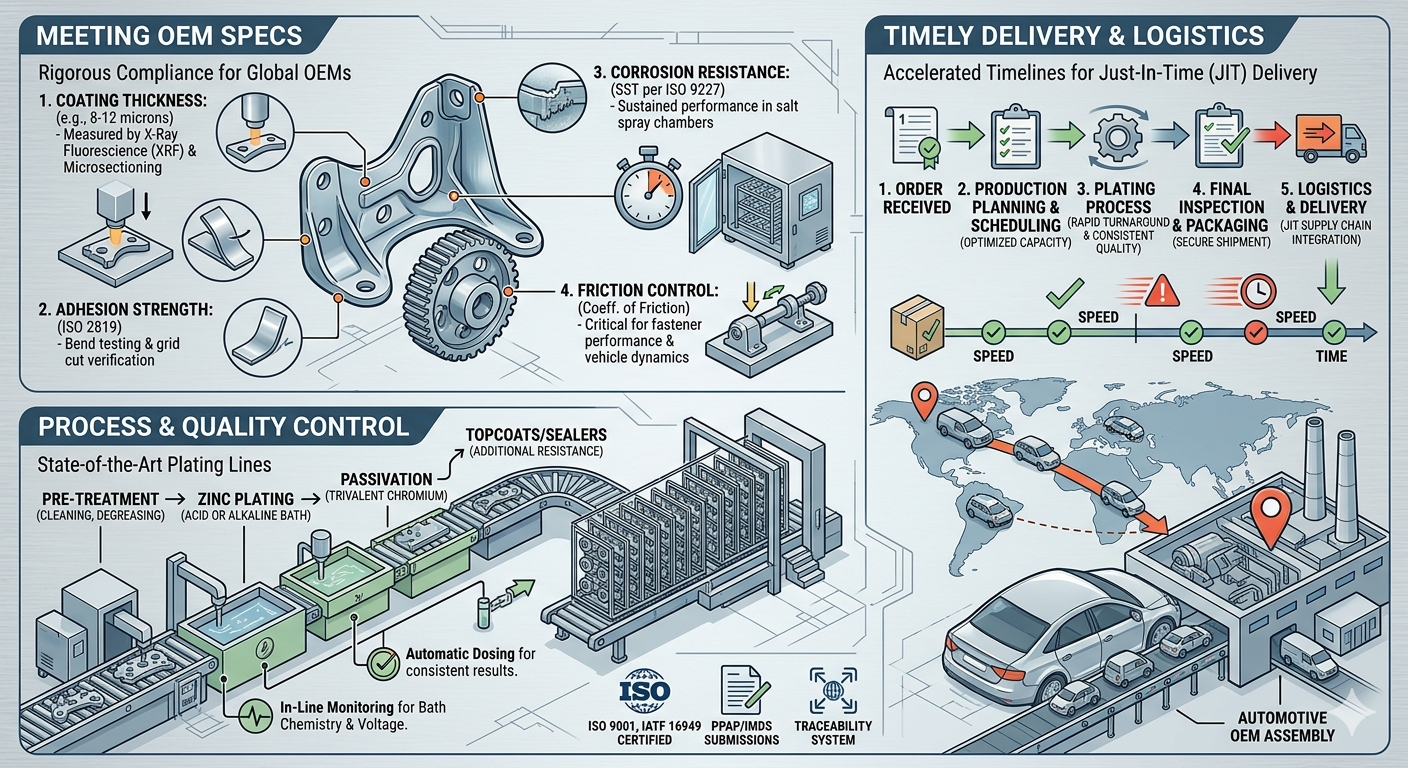
PPAP for zinc-plated automotive components typically requires witnessed or certified salt spray test results from production samples — not prototype or generic process samples. The test must be run per ASTM B117 or ISO 9227, with the specific part configuration and plating stack (zinc + passivate + sealer as specified) confirmed in the test report.
Control Plan & Reaction Plan
The PPAP control plan must document how plating quality is monitored in ongoing production — including bath chemistry controls, periodic salt spray verification, and the reaction plan for out-of-spec results. A plating supplier with an ISO 9001:2015 quality management system has this infrastructure in place. One without it is asking the supplier to build it from scratch.
Hydrogen Embrittlement Relief Documentation
For high-strength steel components (typically those above Rockwell C 39 or 150,000 psi tensile), PPAP must document that hydrogen embrittlement relief baking was performed per ASTM F1941 or SAE/USCAR-5. This means time, temperature, and bake cycle documentation for the production lot, not just a process claim.
The practical implication for automotive suppliers is that your plating partner is a PPAP participant, not just a subcontract service provider. They need the documentation infrastructure, the testing capability, and the engineering communication bandwidth to support PPAP submissions on your timeline — not at some future date when they’ve caught up on their backlog.
The Compliant Zinc Plating Process for Automotive Parts
Understanding what a compliant automotive zinc plating process looks like gives suppliers the ability to evaluate whether a given plating operation can actually deliver what the specification requires. The process is more complex than it appears from the outside, and the quality variation between operations that do it well and those that treat it as a commodity is large.
Surface Preparation: The Non-Negotiable Foundation
Zinc bonds to iron. It does not bond to oil, cutting fluid, heat treat scale, weld flux, rust, or any other manufacturing residue covering the iron surface. Adhesion failures — plating that blisters, peels, or develops bare areas in the field — are almost always traceable to inadequate surface preparation before plating, not to deficiencies in the plating process itself.
Automotive components are among the most challenging to clean. High-strength fasteners go through heat treatment, which bakes a tenacious oxide scale onto the surface. Stampings and brackets are formed with lubricants and cutting fluids that polymerize on the metal during storage. Welded assemblies carry flux residue that requires targeted chemistry to remove.
Effective surface preparation for automotive parts requires multiple cleaning stages: heated alkaline soak cleaning, acid pickling, and in some cases proprietary cleaning chemistries developed specifically for the most stubborn contaminants. Plateco operates seven integrated cleaning stages on its production lines — including heated soaps, multiple acid stages, and proprietary steps developed over 50 years of working with heavily contaminated industrial and automotive parts. This matters in practical terms because it eliminates the precleaning requirement that less-capable platers impose on their customers, which in turn eliminates the added cost, lead time, and quality variability that come with customer-side cleaning.
Zinc Electroplating: Bath Chemistry Selection
Two primary zinc electrolyte systems are used in automotive applications, each with performance characteristics that suit different part types:
Alkaline zinc: Non-cyanide alkaline zinc electrolytes provide better throwing power — the ability to deposit zinc uniformly into recesses, blind holes, and complex geometries. They are the preferred choice for components with intricate shapes where coating uniformity is critical. Alkaline zinc is particularly important for threaded fasteners, where consistent zinc coverage in thread roots affects both corrosion performance and the torque-tension relationship.
Acid zinc (chloride): Acid zinc electrolytes deposit a brighter, more ductile zinc coating and operate at higher current efficiency. They are often used where cosmetic finish quality matters or where production throughput is the priority. The trade-off is reduced throwing power compared to alkaline systems.
The bath chemistry must be controlled continuously — pH, zinc metal concentration, brightener additions, and contaminant levels all affect the quality and consistency of the zinc deposit. Automated bath monitoring and dosing systems maintain these parameters across production runs, ensuring that the 50,000th part in a batch performs the same as the first. Manual bath management introduces variability that is incompatible with automotive quality requirements.
Passivation: The Automotive-Critical Step
The passivate (chromate conversion coating) applied over the zinc is the single most impactful variable in determining whether the plated part meets its salt spray requirement. Zinc alone provides modest corrosion resistance. The passivate extends that dramatically — the right trivalent chromate on an appropriate zinc thickness can add 100 to 300 additional hours of salt spray performance compared to unpassivated zinc of the same thickness.
Critical Note for Automotive Engineers: The passivate must be applied within a controlled time window after plating — typically within 30 minutes — before the zinc surface oxidizes. Passivation applied over oxidized zinc performs significantly worse than passivation applied over fresh, clean zinc. This process timing is a production control requirement, not just a quality preference.
For automotive applications requiring 200+ hours to red rust, trivalent yellow passivate with sealer is the standard system. For components requiring 500+ hours, a heavy zinc deposit combined with a high-performance trivalent passivate and a topcoat sealer is necessary. The chemistry of the passivation bath — including pH control, chromate concentration, and contamination management — requires the same rigor as the plating bath itself.
Hydrogen Embrittlement Relief
Automotive programs increasingly include high-strength structural fasteners — Grade 8 hex bolts, prevailing-torque nuts, spring-hardened clips — that are electrochemically susceptible to hydrogen embrittlement during the plating process. The electroplating reaction generates hydrogen ions that can absorb into high-strength steel substrates and create internal stress concentrations capable of causing sudden brittle fracture under service loads.
The solution is hydrogen embrittlement relief baking: controlled heating at 375°F (190°C) for a minimum of four hours, initiated within four hours of plating and completed before passivate application. The requirement sounds straightforward, but execution quality matters enormously. Parts baked in a batch oven that is merely brought to temperature from the outside of the load — without verification that all parts at the center of the load have reached the required temperature — may not receive adequate hydrogen relief. Plateco uses a conveyor belt oven exceeding 90 feet in length to ensure complete temperature exposure of every part, not just those on the periphery of the load.
Barrel vs. Rack: Process Selection for Automotive Parts
| Process | Best For | Key Advantage | Consideration |
|---|---|---|---|
| Barrel Electroplating | Small fasteners, clips, stampings; high volume | Lowest cost per unit; efficient at scale (up to 800 lbs/load) | Part-on-part contact; not for delicate geometries |
| Rack Electroplating | Large brackets, frames, suspension parts; tight tolerances | Superior thickness control; no surface damage; per-part inspection | Higher cost per unit; custom fixture engineering required |
| Mechanical Galvanizing | High-strength fasteners; very heavy coatings; structural hardware | No hydrogen embrittlement; thickest coatings achievable | Not suitable for fine threads or tight tolerances at heavy thickness |
Delivery Timelines in Automotive Supply Chains
The delivery requirement is the second half of the automotive supplier’s challenge — and it is every bit as unforgiving as the specification requirement. Automotive assembly lines operate on just-in-time scheduling. A plating operation that delivers on time 90% of the time is creating a line stoppage risk one in ten production runs. That is not a supply chain risk — it is a recurring operational problem.
What On-Time Actually Means in This Context
Automotive “on time” is not “within a day or two of the promised date.” It means delivery on the date committed, in the quantity committed, at the quality level committed — consistently, run after run, not just when things go well. The upstream scheduling dependencies that have been built around a committed delivery date do not flex when the plater runs behind. They simply fail.
Plateco’s documented on-time delivery rate of 95%+ reflects a production planning and scheduling system designed around automotive customer requirements — not production convenience. This includes:
- Production scheduling that accounts for plating chemistry cycle times, not just labor hours
- Bath monitoring and maintenance schedules timed to prevent mid-run chemistry failures
- Incoming inspection capability that identifies non-plateable parts before they enter the production queue, not after
- Communication protocols that provide proactive status updates rather than reactive explanations after a miss
- Capacity planning that maintains buffer for rush orders and urgent automotive production support requests
The Lead Time Factors That Automotive Suppliers Often Underestimate
Lead time for zinc plating of automotive components involves more than the plating process itself. Suppliers who build schedules around only the plating cycle time routinely find themselves behind because they have not accounted for the full value chain of the subcontract operation.
Incoming cleaning and inspection: Parts that arrive heavily contaminated may require extended cleaning cycles or precleaning before they can enter the plating line. A plater with limited cleaning capability can create a queue at the front end that extends lead time significantly. Integrated, multi-stage cleaning — as Plateco operates — eliminates this variable.
Hydrogen embrittlement bake cycles: A four-hour bake cycle initiated within four hours of plating, before passivate application, adds process time that must be factored into committed delivery dates. Platers who offer hydrogen embrittlement relief but have not integrated it into their production flow can create scheduling disruptions.
Salt spray testing: PPAP and periodic production verification testing takes time. A 200-hour salt spray test takes 200 hours plus setup and evaluation time. Scheduling this testing appropriately — so results are available when needed for PPAP submission or production lot release — requires coordination between the plating operation and the customer’s quality team.
Post-plate packaging: Automotive parts often require specific packaging to prevent damage to the zinc coating during shipping and storage. Plating-induced surface condition changes (the coating is soft immediately after plating and hardens over time) affect how quickly parts can be packaged after processing. Specialized packaging requirements — such as individual wrapping for rack-plated components — must be factored into cycle time.
A plating partner with a 95%+ on-time delivery rate is not a lucky operation. It is one that has invested in production planning, capacity management, and customer communication infrastructure specifically calibrated to automotive scheduling requirements.
Quality Systems That Automotive Suppliers Require
Automotive supply chain quality requirements extend beyond the individual part to the quality management system of the supplier. ISO 9001:2015 certification is the baseline — it establishes that the plating operation has documented processes, calibrated measurement equipment, trained personnel, and a corrective action system that is capable of identifying and resolving problems systematically rather than repeatedly.
In-Process Quality Controls
Bath chemistry monitoring is the quality control mechanism with the greatest leverage on plating consistency. Zinc metal concentration, pH, brightener levels, and contamination loads must be measured at defined intervals and maintained within established control limits. An automated monitoring and dosing system provides continuous control; manual titration at shift intervals leaves significant variation unaddressed between measurements. The quality of the zinc deposit — and therefore the corrosion performance of the finished part — varies continuously with bath chemistry, not just at measurement intervals.
Coating Thickness Measurement
Coating thickness is measured using calibrated magnetic or X-ray fluorescence (XRF) gauges on finished parts. For automotive applications, thickness must be verified against the specified minimum and, for rack-plated parts with tight tolerances, against specified maximum limits as well. Thickness measurement frequency, sample size, and acceptance criteria should be documented in the control plan and reviewed during PPAP.
Salt Spray Testing as an Ongoing Production Verification Tool
Beyond PPAP, ongoing production lot verification through periodic salt spray testing provides the early warning system that prevents a bath chemistry drift problem from becoming a field failure. Plateco conducts monthly salt spray testing across its most frequently run automotive processes — not just at customer request or after a complaint. This proactive testing approach is the mechanism that maintains the 0.13% reject rate as a sustained operational reality rather than a historical achievement.
Plateco Quality CredentialsISO 9001:2015 Certified — Documented quality management system with calibrated equipment, trained personnel, and corrective action infrastructure.
REACH & RoHS Compliant — All trivalent passivate coatings are fully compliant. No hexavalent chromium in any standard process.
ASTM B117 / ISO 9227 Salt Spray Testing — In-house chamber checked daily by certified lab personnel. Testing at source, not at customer site.
OEM Specification Compliance — GMW3044, Ford WSS-M21P17, CAT 1E0397, JDM F15/F22/F23, JS-500, Toro M-300/M-310, JLG, and others.
Choosing a Zinc Plating Partner for Automotive Supply Chains
The decision to qualify a zinc plating operation for automotive production is consequential. A plating partner who fails PPAP qualification costs weeks of program delay. One who cannot maintain bath chemistry or on-time delivery creates recurring disruptions across the life of the production program. The due diligence investment upfront — in evaluating capability, not just price — pays dividends across years of production volume.
Specialization vs. Multi-Service Operations
A plating operation that specializes exclusively in zinc plating — as Plateco has since 1974 — has made a fundamentally different investment than one that offers zinc plating among a menu of finishing services. Specialization means the capital investment (automated plating lines, bath monitoring systems, hydrogen embrittlement bake ovens, salt spray chambers) is fully deployed toward zinc quality rather than spread across multiple processes. It means the engineering staff’s expertise is deep rather than broad. It means the operational knowledge accumulated over 50 years of running zinc plating is available to address the specific challenges your automotive parts present.
Questions to Ask Before Qualifying a Plating Supplier
- What OEM specifications are you currently qualified to and running production against?
- What is your current on-time delivery rate, and how do you measure it?
- What is your documented reject rate, and what is your process for handling a non-conformance?
- Can you provide current salt spray test data for the specific process and passivate combination our drawing requires?
- Do you require precleaning, or do you have integrated cleaning capable of handling parts as received from our manufacturing operation?
- What hydrogen embrittlement relief baking capability do you have, and how do you document time-at-temperature for each batch?
- What is your PPAP support capability — documentation, testing, engineering communication?
- What is your capacity, and what is your process for managing surge demand during automotive model year launch periods?
The Cost vs. Capability Trade-off
Zinc plating quotes from different suppliers for the same part can vary significantly. The low-price quote is not necessarily the low-cost option once PPAP failures, quality escapes, field warranty costs, and expedited freight to address delivery misses are included in the calculation. The difference in per-part plating cost between a capable automotive supplier and a commodity operation is typically measured in cents. The difference in total program cost when something goes wrong is measured in thousands — or more.
For automotive programs where the plated components are on the vehicle’s exterior, structural chassis, or brake systems, the quality of the zinc plating directly affects warranty performance and, in worst cases, vehicle safety. The economics of quality in this context are not ambiguous.
Closing Thoughts: Zinc Plating as a Strategic Supply Chain Decision
For automotive suppliers, zinc plating is not a commodity purchasing decision. It is a technical compliance requirement, a quality system integration, and a delivery dependency — all in one subcontract relationship. The OEM specifications governing zinc plating are not suggestions; they are the engineering standard that your customer’s design and warranty assumptions are built on. Meeting them consistently, at volume, on schedule, is the baseline requirement for a sustainable automotive supply chain position.
The suppliers who treat zinc plating as a strategic supplier relationship — qualifying carefully, communicating clearly, and building long-term capacity alignment with a capable plating partner — consistently outperform those who re-quote it on price at every renewal cycle and discover new problems with new suppliers.
Plateco, Inc. has focused exclusively on zinc plating since 1974. We support automotive suppliers with barrel electroplating, rack electroplating, and mechanical galvanizing — with integrated cleaning that eliminates precleaning requirements, hydrogen embrittlement relief baking on a conveyor oven system that ensures complete temperature compliance, in-house ASTM B117 salt spray testing checked daily, and an ISO 9001:2015 quality management system built to support PPAP and ongoing automotive production requirements. Our documented reject rate is 0.13%. Our on-time delivery exceeds 95%. If your parts do not ship on spec and on time, it is on us.