
In the industrial manufacturing world, we often talk about “zinc plating” or “galvanizing” as the ultimate solution for rust. However, if you were to look at a steel part immediately after it emerges from a zinc plating bath, you would see a surface that is highly reactive and chemically unstable. Without a critical secondary step, that expensive zinc coating would begin to oxidize within hours, turning into a powdery mess known as “white rust.”
That secondary step is Passivation.
Often invisible to the naked eye, passivation also known as chromating or conversion coating is the thin chemical shield that sits atop the zinc. It is the final barrier between your steel component and the destructive forces of moisture, salt, and oxygen. At Plateco, we consider passivation to be the most vital phase of the finishing process. This 2,000-word guide will explain exactly what passivation is, how it works at a molecular level, and why it is the single most important factor in your part’s service life.
The Science of the “Conversion Coating”
To understand passivation, we must first understand the chemistry of zinc. Zinc is a “sacrificial” metal. We use it to coat steel because zinc is more electronegative than iron. When the environment attacks the part, the zinc “sacrifices” itself by corroding first, leaving the steel underneath untouched.
However, zinc is too good at its job. It is so reactive that even atmospheric humidity can cause it to oxidize. Passivation is a chemical reaction that converts the very top layer of the zinc into an inert, non-reactive film.
The Chemical Bath
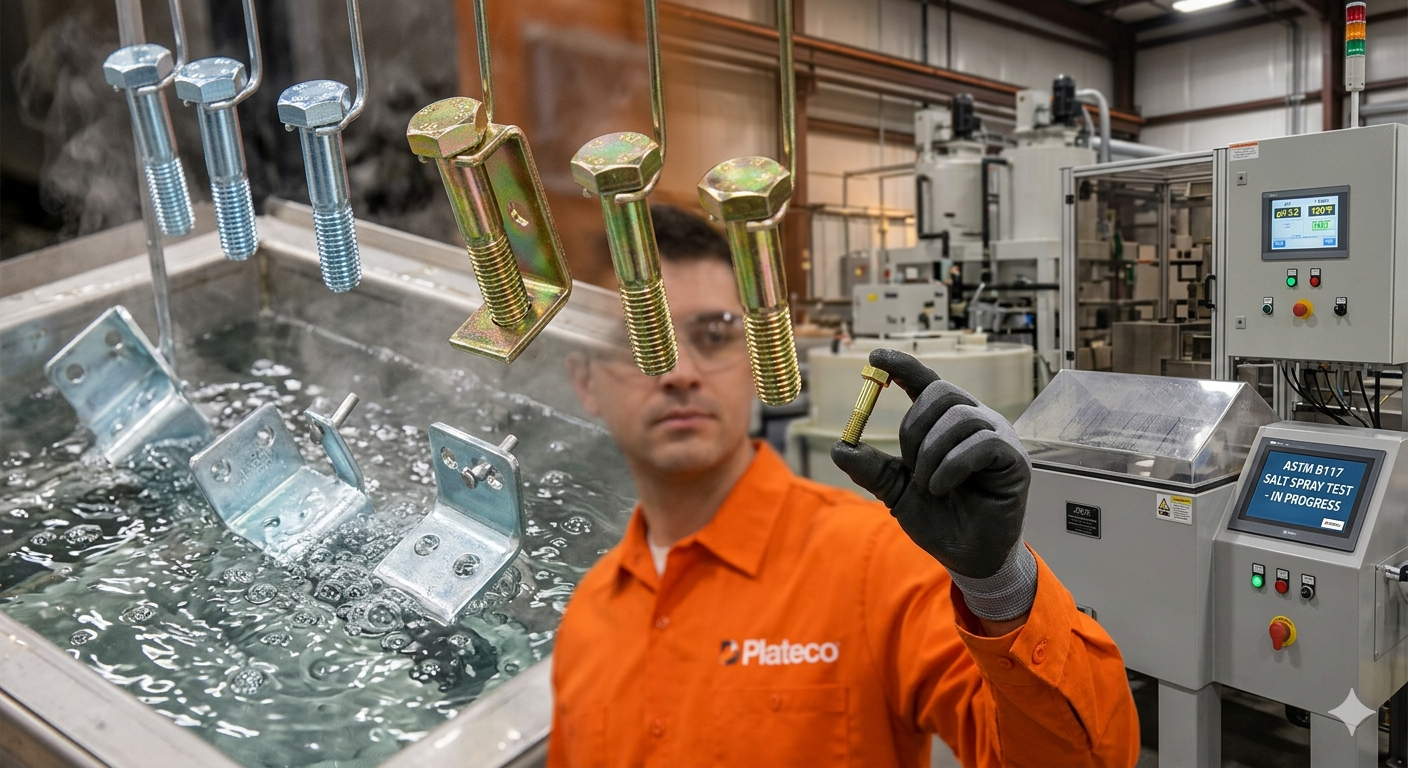
After the zinc has been applied (via electroplating or mechanical galvanizing), the parts are rinsed and then submerged in a passivation solution. This solution typically contains chromium salts and an acid (like nitric or sulfuric acid). The acid slightly “attacks” the surface of the zinc, dissolving a microscopic amount of it. As the pH at the surface rises, the chromium ions react with the zinc to form a complex, hydrated gel-like film.
As this film dries, it hardens into a dense, crystalline structure. It is no longer “bare zinc” it is now a zinc-chromium conversion coating.
Why Passivation is Non-Negotiable
For any manufacturer, the goal is to prevent the “Double Failure” of a part.
- First Failure: The zinc oxidizes (White Rust).
- Second Failure: The zinc is exhausted, and the steel begins to rust (Red Rust).
Passivation is designed specifically to delay that first failure for as long as possible.
White Rust vs. Red Rust
White rust is technically zinc hydroxide. While it doesn’t immediately compromise the strength of the steel, it is voluminous and messy. In precision assemblies, white rust can “gum up” moving parts or interfere with electrical connections. More importantly, it signals that the sacrificial protection is being depleted. Passivation can extend the time until white rust appears by 500% to 1,000%.
The “Self-Healing” Advantage
One of the most unique properties of chromate passivates (especially the high-build yellow varieties) is their “self-healing” capability. If a part is scratched during shipping or assembly, the chromium ions within the passivation layer remain slightly “mobile.” When moisture hits the scratch, these ions can migrate into the wound and re-passivate the exposed zinc. This makes passivation vastly superior to paint or powder coating, where a single scratch can lead to “corrosion creep” under the finish.
Seeing white rust already? Call (608) 524-8241 before red rust sets in
The Evolution of Chromium: Trivalent vs. Hexavalent
Historically, the industry used Hexavalent Chromium (Cr6+). You likely know this as “Yellow Zinc” or “Gold Chromate.” It offered incredible corrosion resistance and excellent self-healing properties. However, Hexavalent Chrome is a known carcinogen and an environmental hazard.
The Rise of Trivalent (Cr3+)
Driven by global regulations like RoHS (Restriction of Hazardo us Substances) and REACH, the industry has shifted almost entirely to Trivalent Chromium.
At Plateco, we have embraced this shift. Modern Trivalent passivates are safer for the environment and for our workers, but they also offer a technical advantage: Heat Resistance. * Hexavalent coatings break down when exposed to temperatures above 150°F, losing their corrosion resistance.
- Trivalent coatings remain stable at much higher temperatures, making them ideal for automotive engine compartments and heavy machinery.
The Aesthetics of Protection: Choosing Your Color
In the world of metal finishing, color is usually a byproduct of the chemical concentration and immersion time in the passivation tank.
Clear or “Blue” Passivate
This is the most common finish for parts used in electronics, appliances, and indoor hardware. It results in a bright, silver-like finish with a slight blue tint. It offers moderate corrosion resistance and is the “standard” for RoHS compliance.
Yellow Passivate
This iridescent, gold-colored finish is the workhorse of the automotive and agricultural industries. It traditionally indicates a higher concentration of protective ions and provides significantly better salt-spray performance than clear coats.
Black Passivate
Used primarily for aesthetics, black zinc passivation is common in the firearms industry, architectural hardware, and automotive trim. Achieving a consistent, deep black requires precision chemistry and is usually followed by a sealer to prevent the color from fading or “silvering” over time.
Measuring Performance: The Salt Spray Test
How do we prove that a passivate works? At Plateco, we rely on ASTM B117 Salt Spray Testing. We place parts in a heated chamber and blast them with a continuous fog of 5% saline solution.
| Passivate Type | Hours to White Rust (Zinc Failure) | Hours to Red Rust (Steel Failure) |
| No Passivate | < 8 Hours | 24 – 48 Hours |
| Clear Trivalent | 24 – 96 Hours | 120 – 250 Hours |
| Yellow Trivalent | 96 – 250 Hours | 350 – 500 Hours |
| High-Build Trivalent + Sealer | 250 – 500 Hours | 1,000+ Hours |
For many of our customers in the renewable energy and marine sectors, hitting that 1,000-hour mark is a baseline requirement. This is only possible through the synergy of a high-quality zinc base and a high-performance passivation layer.
Topcoats and Sealers: The “Force Multipliers”
While passivation is a chemical reaction with the metal, Sealers are supplemental films applied over the passivate. Think of the passivate as the “primer” and the sealer as the “clear coat” on a car.
Why Add a Sealer?
- Enhanced Barrier: Sealers plug the microscopic pores in the passivation film, creating a more uniform barrier against moisture.
- Torque Tension Control: In the fastener industry, sealers can be “loaded” with lubricants (like PTFE) to ensure that bolts can be tightened to a specific torque with predictable results.
- Leaching Protection: Sealers prevent the “leaching” of the passivation color, ensuring the part looks new for years, even in harsh conditions.
Common Industry Specifications
When engineers send us prints at Plateco, they often reference specific global standards for passivation. Understanding these is key to project success.
- ISO 2081: The international standard for electroplated coatings of zinc with supplementary treatments.
- ASTM F1941: Specific to fasteners, focusing on both the coating and the risk of hydrogen embrittlement.
- Automotive Specs (GMW3044, Ford WSS-M21P17): These are extremely rigorous standards that dictate exactly which trivalent passivates and sealers must be used for chassis and under-hood components.
Factors that Affect Passivation Quality
Passivation is a sensitive chemical balance. At Plateco, our quality control team monitors several variables to ensure a perfect finish:
- pH Balance: If the bath becomes too acidic, it will strip away the zinc coating entirely. If it’s not acidic enough, the conversion reaction won’t take place.
- Contamination: Even a small amount of iron or copper “dragged” into the passivation tank from previous stages can ruin the corrosion resistance of the batch.
- Drying Temperature: If parts are dried too quickly at high temperatures, the passivation film can “dehydrate” and crack on a microscopic level, creating paths for moisture to reach the zinc.
Is Passivation Right for Your Project?
Nearly every zinc-finished part should be passivated. The only exceptions are parts that will be immediately painted or powder-coated, where a specific phosphate coating might be used instead to improve paint adhesion.
If your part will see the light of day or even just sit in a box in a humid warehouse passivation is the cheapest insurance policy you can buy. For a fraction of a cent per part, you can double or triple the lifespan of your component.
The Plateco Advantage: Precision Finishing
At Plateco, we don’t treat passivation as an afterthought. We treat it as a critical engineering step. Our Wisconsin facility features automated lines where dwell times in the passivation tanks are controlled down to the second.
We offer:
- RoHS Compliant Trivalent Options: Meeting all modern environmental standards.
- Custom Color Matching: Ensuring your parts meet your brand’s aesthetic requirements.
- Integrated Sealer Stations: For those projects requiring 1,000+ hours of salt-spray protection.
- In-House Lab Testing: We test our baths daily and our finished parts weekly to ensure our “shield” never fails.
Protecting Your Reputation
In the end, passivation matters because your reputation as a manufacturer depends on the reliability of your products. A rusted bracket on a piece of agricultural equipment or a corroded bolt on a solar rack doesn’t just look bad it costs money in warranty claims and damages your brand’s integrity.
Passivation is the microscopic difference between a part that fails and a part that endures. It is the “invisible shield” that allows zinc to do its job effectively for years on end.