

In the world of industrial manufacturing, the “silent enemy” is always corrosion. For decades, engineers and project managers have relied on zinc to protect steel from the elements. Zinc is the sacrificial lamb of metallurgy it corrodes so that the steel underneath doesn’t have to.
However, how that zinc is applied makes all the difference in the world. While most are familiar with the bright sheen of electroplating or the rugged, thick coat of hot-dip galvanizing, there is a specialized middle ground that solves the most “difficult” engineering problems Mechanical Galvanizing.
In this guide, we will explore the mechanics, the chemistry, and the strategic advantages of this cold-application process. If you are dealing with high-strength fasteners, precision threads, or components at risk of hydrogen embrittlement, this is the process you need to understand.
What Exactly is Mechanical Galvanizing?
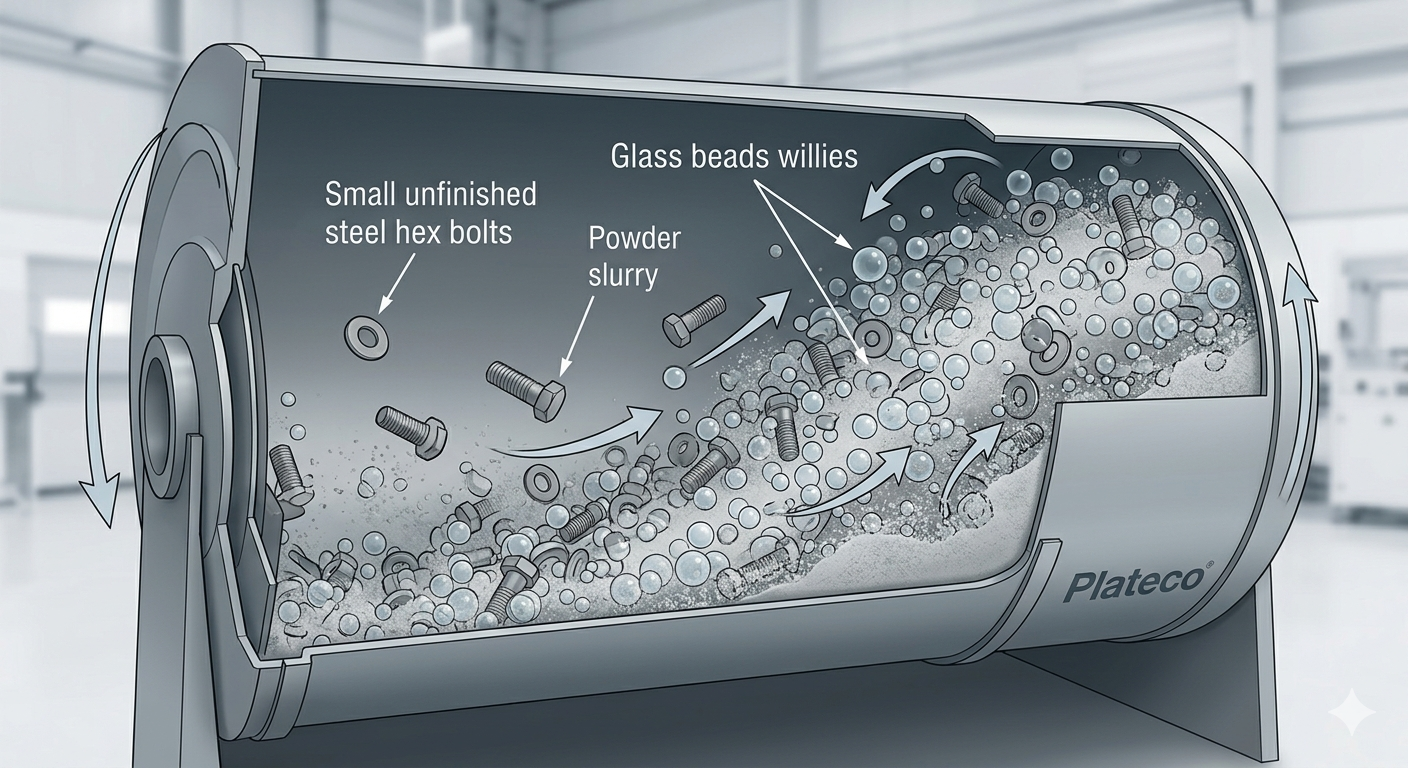
Mechanical galvanizing often referred to as “impact plating” is a process that uses kinetic energy rather than electricity or extreme heat to deposit zinc onto a steel substrate. It is a room-temperature process that involves tumbling parts in a rotating barrel with a mixture of water, chemicals, zinc powder, and glass impact beads.
Unlike electroplating, which relies on a chemical-electrical bond, or hot-dip, which creates a metallurgical alloy through heat, mechanical galvanizing creates a mechanical bond. The zinc is literally “cold-welded” onto the steel through millions of tiny impacts.
Get Reliable Mechanical Galvanizing for Your Parts – (608) 524-8241
The “Cold-Weld” Phenomenon
Think of it like this If you take a piece of soft lead and hit it repeatedly with a hammer against a steel plate, the lead will eventually flatten and stick to the steel. On a microscopic level, mechanical galvanizing does this millions of times per minute. The glass beads act as the “hammers,” and the zinc powder acts as the coating material.
The Step-by-Step Mechanics of the Process
To appreciate the quality of a mechanically galvanized part from Plateco, one must understand the precision that goes into the tumbling barrel.
1. Surface Decontamination
The process begins with a multi-stage cleaning cycle. Parts are loaded into a cleaning tank or the galvanizing barrel itself to undergo degreasing. This removes manufacturing oils, shop dirt, and lubricants. Following degreasing, the parts are “pickled” in an acid solution to remove mill scale and rust. A perfectly clean surface is non-negotiable if the steel isn’t pristine, the mechanical bond will fail.
2. The Surface Preparation (The “Copper Flash”)
Once cleaned, the parts are given a very thin coating of copper, often called a “flash” or “trans-coat.” This isn’t for corrosion protection rather, it acts as a chemical bridge. Zinc adheres much more readily to copper than it does to bare steel. This ensures that the first layer of zinc has a solid foundation to build upon.
3. The Addition of Impact Media
A specific volume of glass impact beads is added to the barrel. These beads are not all the same size; we use a “graded” mix. Larger beads provide the heavy force needed to bond zinc to flat surfaces, while tiny beads ensure that zinc is driven into the roots of threads and small crevices.
4. The Zinc Slurry and Promoting Chemicals
Zinc powder is introduced into the barrel along with “promoter” chemicals. These chemicals keep the zinc particles clean and “active,” allowing them to bond to each other and the steel part.
5. The Build-Up Phase
As the barrel rotates at a controlled speed, the glass beads constantly strike the parts. Each strike flattens a tiny particle of zinc onto the steel. This phase continues until the desired thickness is reached. Because the zinc is added in measured doses, we can control the thickness with incredible precision something that is much harder to do with hot-dip galvanizing.
6. The Post-Plate Treatment (Passivation)
Once the parts are coated, they are rinsed and then moved to a passivation bath. This usually involves a chromate conversion coating (available in clear, yellow, or olive drab) or a high-performance sealer. This final layer prevents “white rust” (zinc oxidation) and significantly extends the life of the part in salt-spray environments.
Request Your Mechanical Galvanizing Quote Today
Mechanical vs. Electro-Galvanizing: The Engineering Divide
When choosing between mechanical and electro-galvanizing, the decision usually comes down to three factors Thickness, Uniformity, and Hydrogen Embrittlement.
1. The Thickness Advantage
In electroplating, thickness is limited by time and electricity. To get a “heavy” coat (above 1 mil or 25 microns), the part must sit in an expensive plating bath for a long time, and the edges of the part will start to “over-plate” and become deformed.
Mechanical galvanizing can easily apply 2 or 3 mils of zinc (50-75 microns) with perfect uniformity. This makes it the superior choice for outdoor hardware that needs to last for 20+ years.
2. The “Edge Build-Up” Problem
Electroplating is an “attraction” process. The electrical current is strongest at the sharp points of a part like the peaks of a screw thread. Consequently, the zinc builds up more on the peaks than in the valleys. This can lead to “thread interference,” where the bolt and nut no longer fit together.
Mechanical galvanizing is a “contact” process. The glass beads can only hit what they can touch. This results in a much more uniform coating across the entire geometry of the part.
3. The Hydrogen Embrittlement Factor (Critical)
This is the single most common reason engineers switch to mechanical galvanizing. In electroplating, the chemical reactions release hydrogen atoms. In high-strength steels (Grade 8, 10.9, or higher), these hydrogen atoms can migrate into the metal’s crystalline structure, making it brittle. This leads to catastrophic failure, where a bolt snaps under load without warning.
Mechanical galvanizing is a non-electrolytic process. Because there is no electrical current and the chemistry is different, the risk of hydrogen embrittlement is virtually non-existent.
Mechanical vs. Hot-Dip: Why Cold is Often Better
While Hot-Dip Galvanizing (HDG) provides an incredibly thick and durable coating, it isn’t always the best fit for manufactured components.
1. Temperature Concerns
Hot-dip involves submerging parts in 840°F (450°C) molten zinc. This “thermal shock” can anneal or soften heat-treated parts, changing their mechanical properties. Mechanical galvanizing happens at room temperature, ensuring the part’s hardness and tensile strength remain exactly as they were when they left the heat-treater.
2. Thread Integrity
If you’ve ever tried to thread a nut onto a hot-dip galvanized bolt, you know the frustration of “zinc clogging.” Molten zinc is thick and viscous; it fills in threads, often requiring the nuts to be “over-tapped” (cut larger) to fit. This weakens the connection. Mechanical galvanizing provides a “cushioned” fit that respects the original dimensions of the thread.
A Top-of-Funnel Analysis: Is This Right for You?
If you are currently evaluating your finishing options, use the following checklist to see if Mechanical Galvanizing is your best path forward.
You should choose Mechanical Galvanizing if:
- Your parts are High-Strength: If your steel is rated above 150,000 psi or HRC 35, you must avoid electroplating to prevent hydrogen embrittlement.
- You need “Heavy” Protection: If your parts are going to be used in coastal, agricultural, or industrial environments where a standard 0.0002″ electroplated coat will fail in months.
- You have Threaded Components: If you are coating bolts, nuts, or threaded rods where fitment is non-negotiable.
- You want to avoid warping: If your parts are thin-walled or precision-machined and cannot withstand the 800°F heat of a hot-dip tank.
You might stick with Electro-Zinc if:
- Aesthetics are #1: If the part is for an indoor consumer product where a mirror-like, “blue-bright” finish is required.
- Cost for low-impact parts: If the part is a simple indoor bracket that will never see moisture and requires the absolute lowest price point.
Environmental and Efficiency Benefits at Plateco
At Plateco, we believe that a better process should also be a more responsible one. Mechanical galvanizing offers several “green” advantages over traditional methods:
- Lower Energy Consumption: Because we don’t have to keep thousands of gallons of zinc in a molten state or run massive electrical rectifiers 24/7, the carbon footprint of mechanical galvanizing is significantly lower than hot-dip or electroplating.
- Water Conservation: Our closed-loop systems allow for better water management and less waste than traditional high-volume plating lines.
- Safety: By eliminating the hazards of molten metal “splatter” and the harsh electrolytic vapors associated with plating tanks, we provide a safer environment for our technicians and a more stable supply chain for our customers.
Common Misconceptions About Mechanical Galvanizing
Despite its 50+ year history, there are still myths surrounding the process. Let’s clear a few up:
Myth #1: “The coating will peel off because it’s not melted on.”
- Reality: The mechanical bond is incredibly powerful. Under a microscope, you can see that the zinc particles have been compacted into the pores of the steel. It will not peel or flake under normal industrial use.
Myth #2: “It’s only for small parts.”
- Reality: While it is a barrel process (best for parts that can tumble), we can process parts up to several inches in length and weight. If it fits in the barrel and can survive a gentle tumble, it can be mechanically galvanized.
Myth #3: “It’s too expensive.”
- Reality: When you factor in the cost of “bake cycles” required to prevent hydrogen embrittlement in electroplating, or the cost of re-tapping threads in hot-dip, mechanical galvanizing is often the most cost-effective solution for high-performance parts.
Technical Specifications and Standards
At Plateco, our processes are designed to meet and exceed the most rigorous industry standards. When specifying mechanical galvanizing, you will likely encounter these ASTM standards:
- ASTM B695: The standard specification for coatings of zinc mechanically deposited on iron and steel. This is the “bible” for our process.
- ASTM A153 (Class C & D): While originally written for hot-dip, mechanical galvanizing is often used to meet the performance requirements of this standard for fasteners and hardware.
- MIL-C-81562: The military specification for mechanical coatings.
By adhering to these standards, we ensure that every batch of parts leaving our facility in Wisconsin is ready for the most demanding environments on earth—from offshore oil rigs to heavy-duty agricultural machinery.
Making the Strategic Choice
Mechanical galvanizing is more than just a coating; it is an engineering solution. It bridges the gap between the “too thin” protection of electroplating and the “too hot/thick” nature of hot-dip. It is the only choice for those who refuse to compromise on the structural integrity of high-strength steel.
At Plateco, we specialize in this “third way.” We provide a finish that is uniform, incredibly durable, and—most importantly—safe for your most critical components.
If you are tired of dealing with thread interference, worried about hydrogen embrittlement, or simply need a coating that can stand up to the salt and snow of a Midwestern winter, it’s time to look at mechanical galvanizing.
Ready to protect your components?
The team at Plateco is ready to help you transition your parts to a superior finish. Whether you need a quote for a new project or a technical consultation on how to move away from electroplating, we are your partners in corrosion resistance.
Contact Plateco today to discuss your project or request a sample of our mechanical galvanizing finish.
Summary Table for Quick Reference
| Feature | Electroplating | Mechanical Galvanizing | Hot-Dip Galvanizing |
| Bond Type | Electrolytic | Mechanical (Cold-Weld) | Metallurgical (Alloy) |
| Temperature | Ambient | Ambient | 840°F |
| Embrittlement Risk | High (Requires Baking) | Near Zero | Low |
| Coating Thickness | Low (0.2 – 0.5 mil) | Medium/High (1.0 – 3.0 mil) | Very High (3.0+ mil) |
| Thread Fit | Excellent | Very Good | Poor (Requires re-tapping) |
| Ideal Parts | Decorative/Indoor | High-Strength Fasteners | Large Structural Stee |