
Hardware and fasteners are the connective tissue of manufactured products. Bolts hold engine blocks together. Screws anchor structural framing. Clips and stampings secure panels, housings, and assemblies in automotive systems, agricultural equipment, and industrial machinery. They are small parts, often cheap on a per-unit basis, and easy to overlook in a product design or supply chain conversation.
Until one corrodes.
A single rusted fastener in the wrong place can seize a joint, compromise a structural connection, void a warranty, or trigger a costly field recall. The economics of fastener corrosion failure are wildly disproportionate to the cost of the fastener itself — which is exactly why zinc plating has become the default corrosion protection standard for steel hardware across virtually every manufacturing industry.
This guide explains how zinc plating works for hardware and fasteners, why the material and process choices matter more than most buyers realize, and what separates a zinc plating operation that consistently delivers quality from one that treats fastener plating as a commodity afterthought.
Why Steel Hardware Corrodes — and Why It Cannot Be Left Unprotected
Steel is iron alloyed with carbon. Iron is electrochemically active — it readily oxidizes when exposed to oxygen and moisture through the same basic electrochemical reaction that produces rust. In the environments where most industrial hardware operates, that exposure is constant and aggressive.
Consider what a standard hex bolt on an agricultural implement experiences over a single field season: soil moisture drawn up through threaded contact points, fertilizer chemicals with corrosive pH, repeated rain and drying cycles, abrasion from soil and plant material, and storage through a Wisconsin winter with freeze-thaw cycling. Without a protective coating, that bolt is red-rusted and structurally compromised faster than most buyers anticipate.
The same logic applies across environments. Automotive fasteners face road salt — sodium chloride dissolved in water is one of the most effective electrolytes for accelerating iron corrosion that exists. Construction hardware faces years of outdoor weathering. Industrial machinery fasteners encounter industrial humidity, cutting fluids, cleaning chemicals, and repeated thermal cycling. In every case, bare steel hardware is not a durable option.
Paint and other organic coatings provide barrier protection, but they are brittle, chip-prone, and do not offer the additional electrochemical protection mechanism that makes zinc so effective. Stainless steel is highly corrosion resistant but dramatically more expensive and not always appropriate for the mechanical properties required in high-strength fastener applications. Zinc plating occupies the practical sweet spot: effective, economical, compatible with high-volume fastener production, and capable of meeting the most demanding corrosion resistance specifications when correctly applied.
How Zinc Plating Protects Hardware and Fasteners
Zinc plating protects steel hardware through two complementary mechanisms that together make it significantly more durable than simple barrier coatings.
Barrier Protection
The deposited zinc layer physically separates the steel substrate from the corrosive environment. As long as the coating is intact, oxygen and moisture cannot reach the iron and oxidation does not occur. This is the same mechanism that any protective coating provides — paint, powder coat, or plating — and it is effective proportional to coating integrity and thickness.
Sacrificial (Cathodic) Protection
This is zinc’s unique and decisive advantage over most other coating approaches. Zinc is electrochemically more active than iron — it sits higher on the galvanic series. When zinc and iron are in electrical contact in the presence of a moisture electrolyte (which is essentially what a scratched zinc-plated fastener in a damp environment represents), zinc oxidizes preferentially. It corrodes in place of the iron.
The practical consequence is significant: a zinc-plated fastener that gets scratched or nicked during installation or service continues to resist red rust at the damaged area because the surrounding zinc sacrifices itself to protect the exposed steel. The zinc corrodes first, appearing as white zinc oxide — and this white corrosion is actually the intended behavior, not a failure. It is the zinc doing its job.
As Plateco explains it directly: while white corrosion may seem like product failing, in the eyes of a finisher, this is actually a good thing. White corrosion means the zinc is doing its job — corroding and sacrificing itself for the steel underneath. Red corrosion only begins once the zinc is fully consumed.
The Three-Layer System for Maximum Performance
For fasteners and hardware that need to meet specific corrosion resistance specifications — whether that is 96 hours to white rust, 200 hours to red rust, or 500 hours per demanding OEM specifications like JS-500 — the zinc alone is rarely the complete solution. A properly specified zinc plating system uses three coordinated layers:
Zinc deposit: The sacrificial base layer. Thickness determines how long the sacrificial protection lasts before the steel is exposed. Thicker zinc means longer service life, all else being equal.
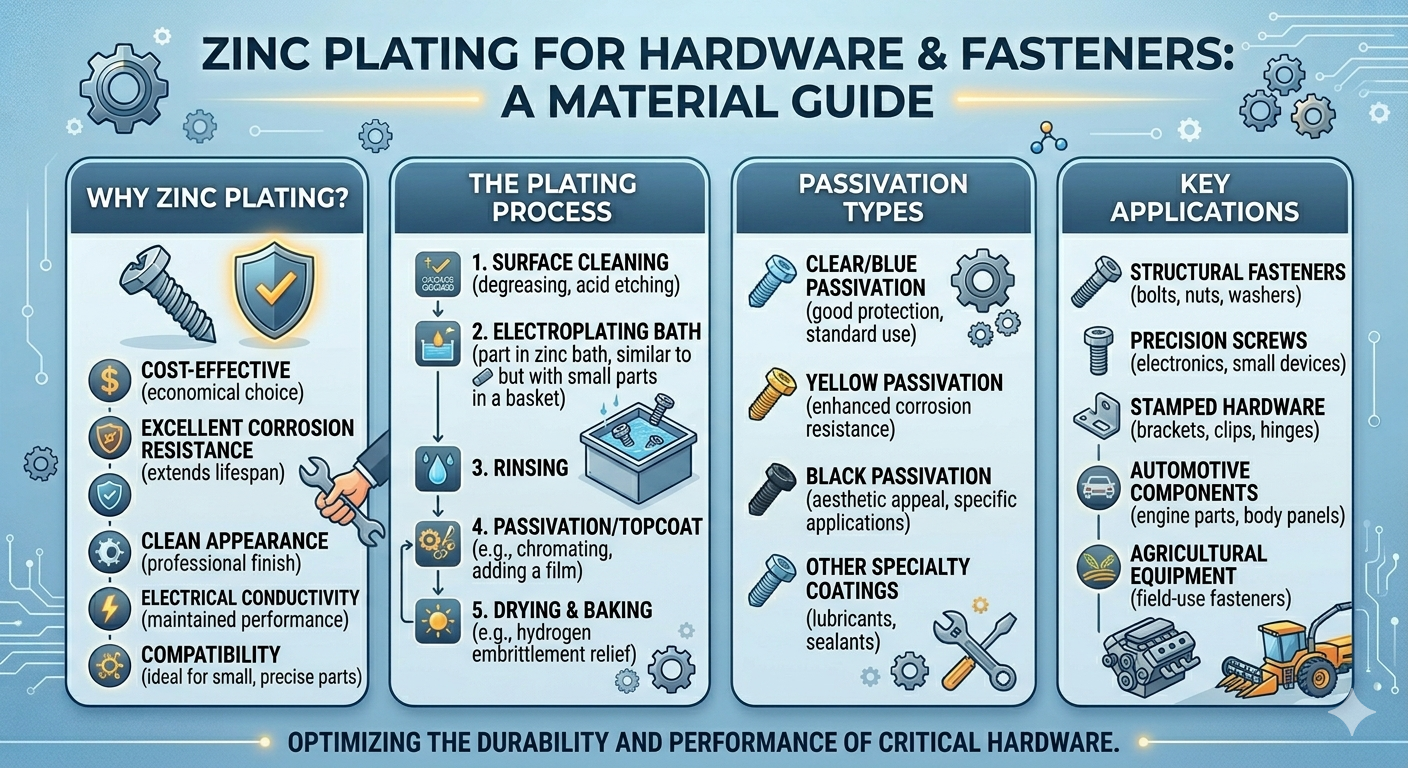
Trivalent passivate (chromate conversion coating): Applied chemically over the zinc, the passivate slows the rate at which zinc itself corrodes, extending performance significantly beyond what bare zinc alone would achieve. Passivates also determine the visual appearance of the finished part. Clear/blue passivate gives a clean, understated look. Yellow chromate provides enhanced protection with a golden appearance. Black trivalent delivers a specific aesthetic with good corrosion performance. The choice of passivate should be driven by the performance specification, not by convention or cost.
Wax or sealer: An optional topcoat applied over the passivate that adds a final barrier layer, further extending corrosion resistance. For fasteners that must meet aggressive salt spray specifications, a sealer is frequently required to reach the target. Sealers also add surface lubricity, which has practical relevance for fasteners: a lubricated fastener surface affects torque-tension relationships during assembly, and this must be accounted for in torque specifications.
Hardware and Fastener Types — and What Each Requires from Zinc Plating
Not all fasteners are identical, and not all zinc plating approaches serve every fastener type equally well. Understanding the characteristics of different hardware categories helps clarify why process selection matters.
Standard Fasteners: Bolts, Nuts, Screws, Washers
The core of most fastener inventories — hex bolts, cap screws, machine screws, nuts, and flat washers — are small, produced at high volumes, and typically specified to standard ASTM B633 service classes. They are the natural candidates for zinc barrel electroplating, which processes large quantities of small parts simultaneously at the lowest cost per unit while delivering reliable, uniform zinc coverage.
Barrel plating tumbles parts in a rotating perforated barrel immersed in the zinc electrolyte. The tumbling action provides several advantages specific to fasteners: it exposes all surfaces of threaded parts to the plating solution, allows solution to flow into and out of blind holes and thread recesses, and delivers consistent coverage across complex geometries that would be difficult or expensive to achieve with rack plating.
The one trade-off of barrel plating — part-on-part contact causing minor surface scratches in the zinc — is generally irrelevant for standard fasteners where the priority is functional corrosion protection rather than cosmetic perfection.
Clips, Stampings, and Small Structural Hardware
Sheet metal clips, spring clips, retaining rings, and stampings fall into the same barrel plating category as standard fasteners. They are produced at high volumes, their geometries are compatible with tumbling, and the cost economics of barrel plating align well with their low unit values.
Stampings with very thin cross-sections require attention to barrel loading density — excessive part-on-part impact can distort thin material. This is a process engineering consideration that competent plating operations account for when establishing barrel rotation speeds and load limits for specific part types.
Large Structural Hardware: Lag Bolts, Anchor Bolts, Heavy Connectors
Hardware that is too large for barrel processing — heavy lag bolts, anchor bolts, structural hex head cap screws, and large connector plates — moves into either zinc rack electroplating or zinc mechanical galvanizing territory, depending on the specific performance requirements.
Rack electroplating handles large parts by mounting them individually on specialized fixture racks. This eliminates part-on-part contact, allows precise control of coating thickness, and is appropriate for parts where dimensional control matters — for instance, large bolts that will be torqued to precise specification and where the plating thickness affects the torque-tension relationship.
Zinc mechanical galvanizing is increasingly the specified choice for structural hardware that requires heavy coatings and faces severe corrosive environments. Anchor bolts for concrete construction, foundation hardware, and heavy connectors for outdoor structures are typical mechanical galvanizing applications.
High-Strength Fasteners: Grade 8 Bolts and Structural Bolts
High-strength fasteners introduce a complication that changes the process selection calculus entirely: hydrogen embrittlement.
During electroplating, the electrochemical process generates hydrogen ions that can absorb into the steel substrate. In standard-strength steels this is generally not a concern — the hydrogen dissipates over time without causing damage. In high-strength steels — typically those with core hardness above Rockwell C 39, or tensile strengths above 150,000 psi — absorbed hydrogen can become trapped in micro-cracks and create internal stress concentrations. Over time, these concentrations can cause sudden brittle fracture under load — a failure mode that is particularly dangerous because it can occur without visible warning at loads well below the nominal rated capacity of the fastener.
This is hydrogen embrittlement, and it is a genuine engineering concern for Grade 8 bolts, high-tension structural bolts, spring-hardened clips, and similar high-strength hardware.
There are two primary approaches to managing this risk in a zinc plating context:
Hydrogen embrittlement relief baking: Electroplated high-strength fasteners are subjected to a controlled heating process — typically 375°F (190°C) for a minimum of four hours — within four hours of plating, before passivate is applied. The heat drives absorbed hydrogen out of the steel substrate. Plateco offers this service through a distinctive approach: rather than a standard industrial oven with doors, they use a conveyor belt oven over 90 feet in length. This ensures all parts are brought fully to temperature, held at temperature for the complete required duration, and cooled in a controlled manner — addressing a known limitation of batch oven processes where parts at the center of a large load may never reach full temperature.
Mechanical galvanizing: The alternative that eliminates the hydrogen problem entirely. Because mechanical galvanizing does not use electrical current, no hydrogen is generated during the process. Zinc powder is mechanically bonded to the steel surface through tumbling with glass bead media — a purely physical process. The mechanically galvanized zinc deposit can be as thick as 0.003 inches, and it naturally relieves any incidental hydrogen within 24 to 48 hours of processing without requiring a separate bake cycle. For manufacturers producing high-strength fasteners at volume, mechanical galvanizing is often the cleaner engineering solution.
Reading a Zinc Plating Specification for Hardware
Purchasing hardware without understanding the plating specification is a common source of unexpected field failures. “Zinc plated” written on a purchase order is not a specification — it is a description that leaves every meaningful performance parameter undefined. Here is what a complete specification actually controls.
ASTM B633: The Primary Standard for Zinc Electroplating
ASTM B633 is the foundational standard for electrodeposited zinc coatings on iron and steel. It defines four service condition classes based on environmental severity:
- SC1 (Mild): 5 microns minimum zinc thickness. Indoor use, no moisture exposure. Office equipment, interior hardware, protected assemblies.
- SC2 (Moderate): 8 microns minimum. General outdoor exposure with moderate corrosive risk. Light outdoor hardware, general industrial.
- SC3 (Severe): 12 microns minimum. Harsh outdoor exposure. Agricultural equipment, construction hardware, automotive.
- SC4 (Very Severe): 25 microns minimum. Very aggressive environments — continuous moisture, chemical exposure, direct road salt contact.
The appropriate service class is determined by where the fastener will actually live in service — not by what is cheapest to specify. Specifying SC1 for hardware that will be used outdoors is not cost savings; it is a deferred field failure.
ASTM B695: Mechanical Galvanizing Standard
For mechanically galvanized fasteners, ASTM B695 defines corresponding thickness classes. The equivalent thickness classes run from Class 5 (5 microns) through Class 105 (105 microns), with Class 25 and Class 50 being most common for general structural hardware.
Plateco meets both ASTM B633 and ASTM B695 as baseline specifications and additionally complies with demanding OEM-specific standards including CAT 1E0397, JDM F15, JDM F22, JDM F23, Toro M-300, Toro M-310, JLG specifications, and JS-500 — which requires a minimum of 500 hours of exposure to red rust in standardized salt spray testing. These OEM specifications represent the corrosion performance that major equipment manufacturers have determined through field experience is necessary for their products to meet service life expectations.
Passivate Type in the Specification
A complete specification includes the passivate type. This matters because passivate chemistry directly determines how long the zinc itself remains intact before red corrosion begins. A zinc coating tested without passivate fails to white rust far faster than the same thickness with passivate. The difference in hours to red rust between a clear passivate and a yellow chromate on the same zinc thickness can be significant — a relevant variable when comparing supplier quotes that may be using different passivate systems to meet the same nominal specification.
Hydrogen Embrittlement Relief Requirements
For high-strength fasteners, the specification should explicitly require hydrogen embrittlement relief baking when electroplating is used. ASTM F1941 and SAE/USCAR-5 define baking requirements for electrodeposited coatings on fasteners. If the specification does not address this for hardened components, the engineer needs to add it — or switch to mechanical galvanizing.
The Cleaning Variable That Determines Whether Plating Sticks
A zinc plating system that is perfectly specified can still fail in service if the zinc does not adhere properly to the steel. And the single largest driver of adhesion failure is inadequate surface preparation before plating.
Zinc electroplating works because zinc bonds to the iron in the steel surface. Anything on that surface that is not iron — oil from machining or forming operations, cutting fluids, heat treat scale, weld flux and slag, rust, and other manufacturing residues — physically prevents zinc adhesion. The result is plating that appears acceptable on first inspection but blisters, peels, or develops bare spots under service conditions.
This is not an obscure failure mode. It is the most common quality problem in zinc plating, and it typically manifests not at the plater’s facility but in the field — after the hardware has been shipped, assembled, and installed.
Two aspects of how a plating operation handles cleaning determine whether this is a chronic problem or a non-issue:
The cleaning capability itself. Cleaning for zinc plating is not a rinse and a dip in acid. Heat treat scale, baked-on oils, and weld flux are genuinely difficult to remove — they are literally baked into the steel surface during manufacturing. Effective cleaning requires multiple stages using heated alkaline soaks, acid pickling, and in some cases proprietary cleaning chemistries developed specifically for the most stubborn contaminants. Plateco operates seven cleaning stages integrated directly into their production lines, including heated soaps, acids, and proprietary steps developed over decades of working with heavily contaminated industrial fasteners and hardware.
Whether precleaning is required. Many plating operations cannot handle heavily contaminated parts and require customers to pre-clean hardware before shipping it in for plating. This transfers the cleaning burden to the manufacturer — adding cost, logistics complexity, and a new source of variability, since different batches arriving in different conditions will clean differently at the customer’s facility. Plateco’s integrated cleaning eliminates the precleaning requirement. Parts arrive from manufacturing. The cleaning happens as part of the plating process. The customer’s lead time shortens and the consistency of the cleaning improves because it is happening under controlled conditions in a dedicated system rather than as a variable external step.
Process Selection Guide: Matching the Process to the Hardware
Choosing the right zinc plating process for a specific type of hardware is a decision that affects cost, performance, lead time, and quality. The following framework covers the most common hardware categories.
When to Specify Zinc Barrel Electroplating
Barrel electroplating is the right choice for the vast majority of standard fastener and hardware applications. Use it when:
- Parts are small to medium in size (generally those that can be tumbled without damage)
- Production volumes are high — hundreds or thousands of parts per run
- ASTM B633 SC1 through SC3 performance is the target
- Cosmetic finish quality is a secondary consideration to functional protection
- Cost efficiency is a priority
- Parts do not have features that concentrate stress from part-on-part contact (very thin stampings or delicate features may require rack plating)
Plateco’s barrel electroplating systems are fully automated, capable of processing up to 800 pounds per barrel load, and can handle parts as small as a nail. Automated chemistry monitoring maintains consistent bath parameters across production runs, so the 10,000th part in a batch performs the same as the first.
When to Specify Zinc Rack Electroplating
Rack electroplating is the appropriate process when:
- Parts are too large or heavy for barrel processing
- Cosmetic finish quality is a specified requirement
- Coating thickness must be controlled to tight engineering tolerances — particularly for assemblies where plating thickness affects fit, torque, or clearance
- Parts have delicate features, thin sections, or surface finishes that cannot tolerate part-on-part contact
- Individual part traceability is required for quality documentation
Plateco operates rack plating systems capable of handling parts up to 14 feet 5 inches in length and up to 1,000 pounds. Custom rack fixtures are designed by Plateco’s engineering team for each part type, ensuring consistent electrical contact, uniform current distribution, and repeatable coating results.
When to Specify Zinc Mechanical Galvanizing
Mechanical galvanizing is the specified choice when:
- Fasteners are high-strength (Rockwell C 39 or above) and hydrogen embrittlement is a concern
- Thick coatings are required for very aggressive service environments
- Parts are structural hardware — anchor bolts, heavy connectors, foundation hardware — requiring maximum corrosion protection
- ASTM B695 compliance is specified
- The application involves burial, submersion, or continuous moisture exposure
The mechanical galvanizing zinc deposit at Plateco can reach 0.003 inches in thickness — significantly heavier than standard electroplated coatings — and naturally relieves hydrogen within 24 to 48 hours of processing without a separate baking step.
Salt Spray Testing: How Corrosion Performance Is Verified
For many buyers, corrosion resistance is an abstract concept — until a field failure happens. Salt spray testing makes it concrete. ASTM B117 defines a standardized accelerated corrosion test in which parts are exposed to a continuous spray of 5% sodium chloride solution at 35°C (95°F). The test runs until specified corrosion stages — first white rust, then red rust — appear on the part surface.
Salt spray hours are the lingua franca of corrosion specification for fasteners and hardware. A specification requiring 96 hours to red rust means the part must survive 96 hours of continuous salt spray exposure without red corrosion appearing. JS-500 means 500 hours. Knowing which salt spray threshold your application requires — and verifying that your plating supplier can consistently meet it — is the practical due-diligence step that separates informed buyers from those who find out after the field failure.
Plateco maintains an in-house salt spray testing chamber set up per ASTM B117 and ISO 9227, checked daily by certified lab personnel. Critically, Plateco tests product as-processed at their facility rather than waiting for it to be shipped and tested as-received at the customer’s location. This matters because material handling after plating — shipping, unloading, stacking — can cause surface damage that makes salt spray results unreliable as a measure of the plating process quality. Testing at the source gives accurate data about what the plating process actually achieved.
Monthly testing is conducted on Plateco’s most requested processes across all production lines to verify that plating chemistry performance remains within parameters over time — not just at commissioning or on special request.
What Leaded Steel Does to Zinc Plating — A Material Caution
One hardware material variable that catches manufacturers by surprise is leaded steel. Leaded steel — a steel alloy containing lead additives for improved machinability — is common in turned parts, precision screw machine products, and some fastener grades where dimensional accuracy from machining is critical.
The problem is that lead interferes profoundly with zinc plating. Lead is not iron. It does not allow zinc adhesion. Lead smears across the steel surface during machining, creating a coverage layer of lead that physically prevents zinc from bonding to the underlying steel. The result is blister-prone, poorly adherent plating that can flake under minimal service stress.
This is not a problem that can be cleaned away with standard cleaning processes — the lead is embedded in the surface during machining, not deposited on it. Specialty cleaning approaches exist for leaded steel, but they are complex, add cost, and do not always achieve the same adhesion quality as plating on clean steel. When specifying zinc-plated hardware, confirming that the steel grade is plating-quality and does not contain lead is a worthwhile step — particularly for turned or precision machined fasteners.
Common Zinc Plating Questions from Hardware Buyers
Does zinc plating affect fastener torque specifications?
Yes. The zinc coating and any sealer add to the fastener’s effective diameter at thread contact points and change surface friction. Most threaded fastener torque specifications are developed for a defined surface condition. Zinc plating with sealer typically reduces friction compared to bare steel, which means a given torque value produces higher clamp load. If torque specifications are critical to your application, confirm them against the plated condition, not bare steel.
What is the difference between trivalent and hexavalent chromate?
Historically, chromate conversion coatings used hexavalent chromium (Cr6+), which offered excellent corrosion performance but is a known carcinogen restricted under RoHS and REACH regulations. Modern practice — and Plateco’s standard approach — uses trivalent chromium (Cr3+) passivates, which are REACH and RoHS compliant while still delivering strong corrosion performance. Hexavalent coatings are increasingly restricted in automotive and consumer product supply chains and should not be specified for any new design unless a specific regulatory exemption applies.
Can I plate different steel alloys in the same barrel run?
Not advisably. Different steel alloys may require different cleaning chemistry aggressiveness, have different surface characteristics that affect zinc adhesion, and may have different dimensional sensitivities to coating thickness. Mixing alloy types in a barrel run optimized for one alloy degrades quality for all. Parts should be batched by material type.
How do I know if my current plating is meeting specification?
The most reliable verification is salt spray testing of as-processed samples. If your plating supplier cannot provide current salt spray data for your specific process — or if they can only provide data from parts tested at your facility after shipping — your quality picture is incomplete. Request that testing be performed at the plating facility on process samples, per ASTM B117, and reviewed against your specification targets.
What substrates can be zinc plated?
Steel and iron are the natural substrates for zinc plating. Plateco can also plate brass, nickel, castings, and other materials that have iron on the surface. Stainless steel and aluminum cannot be zinc plated — stainless steel lacks the magnetic surface characteristics that support zinc adhesion, and aluminum’s oxide layer prevents bonding. Stainless steel can, however, be passivated — a separate chemical treatment that Plateco offers per ASTM A967.
Closing Thoughts
Zinc plating for hardware and fasteners is not a decision that should be made by default or on price alone. The coating system — zinc thickness, passivate chemistry, sealer specification, and hydrogen embrittlement handling for high-strength parts — directly determines whether your hardware performs for years or fails prematurely in the field. The plating process — barrel, rack, or mechanical galvanizing — should be matched to the specific characteristics and requirements of each part type.
And the plating partner matters as much as the specification. A supplier that treats fastener plating as a commodity, that cannot clean heavily contaminated parts without requiring precleaning, that does not test as-processed product, or that cannot provide documented compliance with the specifications that govern your supply chain is not a partner who will help you avoid field failures — they are a source of them.
Plateco, Inc. has focused exclusively on zinc plating since 1974. ISO 9001:2015 certified. ASTM B633 and B695 compliant. A documented reject rate of 0.13% in the second quarter of 2025. On spec. On time. Or it is on them.
To discuss your hardware and fastener zinc plating requirements or request a quote, reach Plateco at plateco.net or call (608) 524-8241.
This article is intended for informational and educational purposes. Always reference applicable engineering specifications and consult with a qualified zinc plating specialist for your specific application.