
Why Steel Alone Is Never Enough
Steel is the backbone of modern manufacturing. From the bolts holding your car’s engine together to the anchors keeping a bridge in place, steel components are everywhere. But here’s the problem: steel, on its own, is terribly vulnerable. Expose it to moisture, road salt, humidity, or even ordinary air over time, and it begins to rust. That rust — technically called red corrosion — weakens the metal, shortens its lifespan, and ultimately leads to component failure.
For engineers, procurement managers, and manufacturers, corrosion isn’t just a cosmetic inconvenience. It’s a costly, safety-critical concern that demands a reliable solution. That’s where zinc plating comes in.
Zinc plated steel components have become one of the most widely adopted solutions in industrial manufacturing precisely because they address the corrosion problem head-on — efficiently, affordably, and at scale. Whether you’re producing thousands of small fasteners or a handful of large hydraulic tubes, zinc plating delivers protection that bare steel simply cannot offer.
This guide is designed as a comprehensive introduction to zinc plated steel components. We’ll walk you through what zinc plating is, how it works, why it’s so effective, and which industries rely on it most. By the end, you’ll have a clear picture of why zinc-plated components are specified across so many demanding applications — and what to look for in a zinc plating provider.
What Is Zinc Plating? A Clear Definition
Zinc plating — also called zinc electroplating — is a metal finishing process in which a thin, protective layer of zinc is deposited onto the surface of a steel or iron component. This is typically achieved through electroplating: the steel part is submerged in a zinc solution and an electrical current is applied, causing zinc ions to bond to the surface of the metal.
The result is a tightly adhered zinc coating that forms a protective barrier between the steel substrate and the surrounding environment. But zinc plating is more than just a barrier. It’s an active protection system — and that distinction matters enormously.
At its core, a fully finished zinc plated component may feature up to three protective layers:
Layer 1 — Zinc: The primary layer deposited on the steel surface. Zinc provides the foundational corrosion protection and acts as a sacrificial metal (more on this below).
Layer 2 — Passivate (Trivalent Chromate): A chemical conversion coating applied over the zinc layer to protect the zinc itself from early oxidation. Passivates come in different formulations — clear, yellow, black — and significantly extend the part’s resistance to corrosion. Today’s industry-standard passivates are trivalent (RoHS and REACH compliant), meaning they avoid the environmental and health concerns associated with older hexavalent chromium coatings.
Layer 3 — Sealer or Wax (Optional): An additional topcoat that provides a final layer of protection, improving resistance to white corrosion and extending the total lifespan of the coating system.
Together, these layers create a multi-layered defense system that can be engineered to meet specific corrosion resistance standards — measured in hours of salt spray testing per established specifications like ASTM B633.
The Science Behind Zinc Plating: Galvanic (Sacrificial) Protection
To understand why zinc plating is so effective, you need to understand a concept called galvanic protection, or sacrificial protection.
When two different metals are in contact in the presence of an electrolyte (like moisture), one metal will corrode preferentially to protect the other. This is the galvanic effect. Zinc happens to be electrochemically less noble than steel, which means that when zinc and steel are in contact, the zinc corrodes first — it “sacrifices” itself to protect the underlying steel.
This has a profound practical implication: even if the zinc coating is scratched or damaged, it continues to protect the steel beneath it. The zinc surrounding the damaged area keeps corroding preferentially, preventing rust from spreading into the exposed steel. This is fundamentally different from barrier-only coatings like paint, which stop protecting as soon as they’re breached.
Here’s how the progression works in practice:
- White Corrosion (Zinc Oxidizing): When a zinc plated part is exposed to moisture and oxygen, the zinc begins to oxidize, forming zinc oxide and zinc carbonate — a white powdery residue. This is white corrosion, and it’s a sign the zinc is doing exactly what it’s supposed to do.
- Zinc Depletion: Over time, the zinc layer gradually sacrifices itself. As long as zinc remains, the steel is protected.
- Red Corrosion (Steel Beginning to Rust): Only after the zinc is fully consumed does the steel begin to rust. This is when red corrosion appears — and it signals that the coating has reached the end of its service life.
For manufacturers and engineers, understanding this sequence is critical. Seeing white corrosion on a zinc-plated part during salt spray testing is not a failure — it’s evidence the coating is performing correctly. Red corrosion, on the other hand, indicates the coating has been depleted.
The Zinc Plating Process: From Raw Steel to Finished Component
Quality zinc plating is not a simple “dip and done” operation. It’s a carefully engineered, multi-stage process that requires precise control at every step. Here’s a breakdown of the key stages:
1. Surface Preparation and Cleaning
This is arguably the most important step — and it’s where many plating operations fall short. For zinc to adhere properly to steel, the surface must be completely free of contaminants. During manufacturing, steel parts accumulate a range of surface contaminants: cutting oils, heat treat scale, weld flux, rust, oxide layers, and more. These contaminants must be fully removed before plating can begin.
Cleaning typically involves a combination of alkaline cleaning, acid pickling, and rinsing stages. Specialized facilities dedicate a significant portion of their tank capacity — often more than half — exclusively to cleaning and surface preparation. Without thorough cleaning, zinc will not bond properly, leading to adhesion failures, blistering, and inconsistent coverage.
The challenge is compounded by the fact that many contaminants — especially weld flux and heat treat scale — are chemically bonded to the steel surface and notoriously difficult to remove. This is why advanced cleaning capabilities are a genuine differentiator among zinc plating providers.
2. Electroplating
Once the surface is properly prepared, the parts move into the zinc plating bath. Here, an electrical current drives zinc ions from the solution onto the steel surface, building up the zinc layer. Key process parameters — current density, bath chemistry, temperature, and timing — must be precisely controlled to achieve the required coating thickness and uniformity.
Different plating methods are used depending on part geometry, size, and production volume:
Barrel Electroplating: Small parts are loaded into a rotating barrel that tumbles them through the zinc bath. This is ideal for high-volume production of small components like fasteners, bolts, clips, and stampings. The tumbling action ensures all surfaces are exposed to the plating solution, and automated lines can process hundreds of pounds of parts per batch.
Rack Electroplating: Larger, more complex, or more delicate parts are fixtured individually onto racks and submerged into the plating bath. Racking provides superior control over coating thickness and surface finish, and is ideal for parts that could be damaged by tumbling, parts with complex geometry, or parts with tight dimensional tolerances. Advanced rack lines can handle components up to 14.5 feet in length and up to 1,000 pounds.
Mechanical Galvanizing: A barrel-based process that uses mechanical tumbling rather than electricity to bond powdered zinc to the part surface. Zinc particles are “cold welded” into the surface using glass bead media. This process creates a thicker, more porous deposit (up to 0.003 inches) and is particularly advantageous for high-strength fasteners because the mechanical process naturally relieves hydrogen, reducing the risk of hydrogen embrittlement without requiring a separate bake step.
3. Passivation
After plating, parts are treated with a chromate conversion coating — the passivate layer. This chemical treatment reacts with the zinc surface to form a protective film that significantly extends corrosion resistance. Passivates are available in multiple formulations:
- Trivalent Clear: Provides a bright, clean appearance with solid corrosion protection. RoHS and REACH compliant.
- Trivalent Yellow (Iridescent): Offers enhanced corrosion resistance compared to clear with a distinctive golden iridescent appearance.
- Trivalent Black: Provides an aesthetically dark finish while maintaining corrosion protection.
All modern, environmentally responsible zinc plating operations use trivalent passivates, which are free of hexavalent chromium — a substance classified as a carcinogen and heavily regulated in most markets.
4. Sealing
Some specifications call for an additional wax or sealer topcoat over the passivate. This final layer protects the passivate from early degradation and further extends the coating’s effective life. Sealers are particularly valuable in applications with severe environmental exposure.
5. Hydrogen Embrittlement Relief (When Required)
During electroplating, hydrogen can be absorbed into the steel substrate — a particular concern for high-strength steels (typically those with hardness above 40 HRC). This absorbed hydrogen can cause cracking under load, a condition known as hydrogen embrittlement. To mitigate this risk, high-strength parts are baked in a controlled oven after plating, driving off the absorbed hydrogen before it can cause damage. After baking, parts must return to the production line to receive a fresh passivate coating, as the elevated temperatures of baking degrade the existing passivate.
6. Quality Inspection
Finished parts undergo rigorous inspection before shipment. This includes visual inspection for surface defects, dimensional checks, coating thickness measurements (using methods like X-ray fluorescence or magnetic induction), and salt spray testing to verify corrosion resistance meets specified requirements. High-performing plating operations maintain detailed process records and quality documentation for each batch.
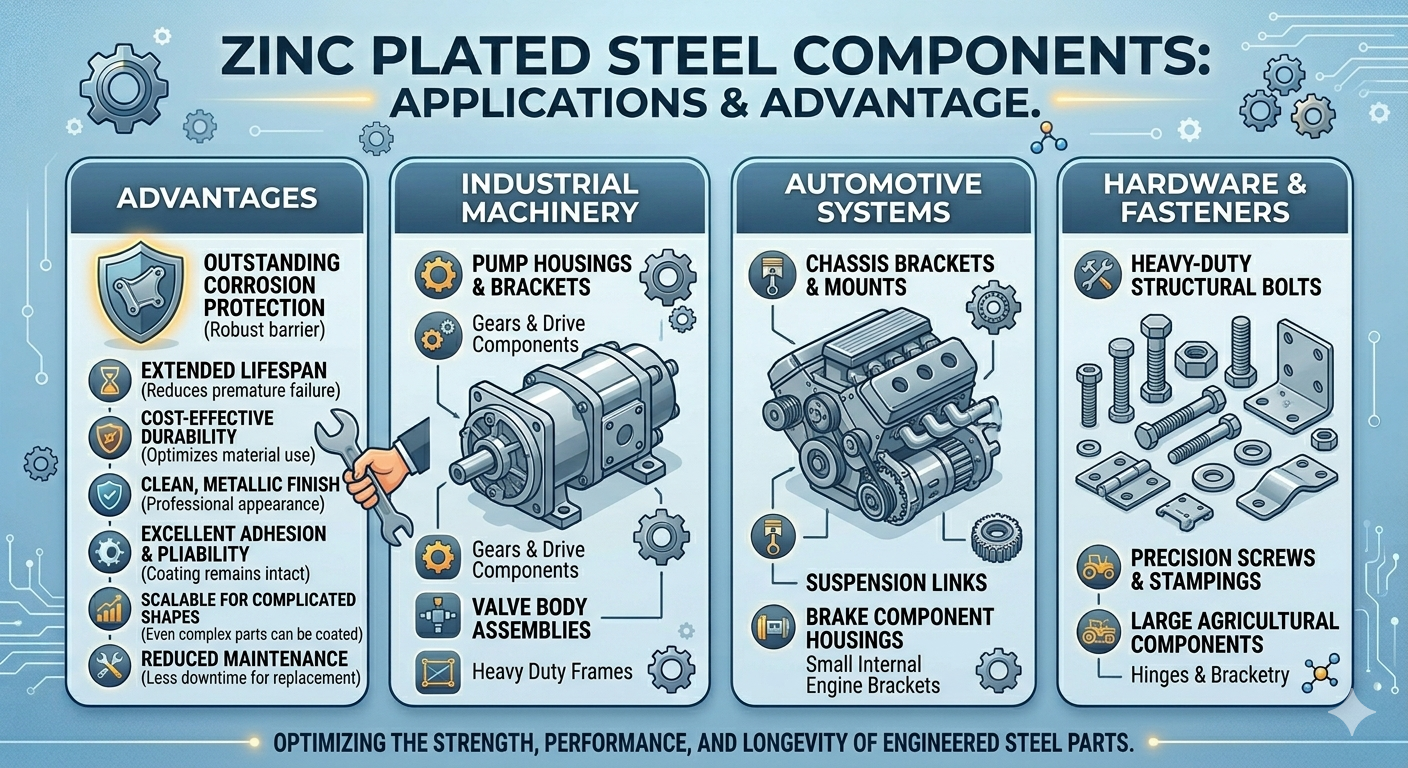
Advantages of Zinc Plated Steel Components
Understanding why zinc plating is so widely used across industries comes down to its unique combination of advantages. No other coating method delivers quite the same balance of performance, cost, versatility, and scalability.
1. Exceptional Corrosion Protection
The most obvious advantage is the one most people associate with zinc plating corrosion resistance. Through sacrificial galvanic protection, zinc plated steel components can resist rust and degradation even in harsh environments — humidity, outdoor exposure, chemical contact, and road salt. Coating thickness and passivate selection can be tuned to meet specific salt spray hour requirements, from basic protection for indoor applications to hundreds of hours for demanding outdoor or marine environments.
2. Cost-Effectiveness at Scale
Compared to alternatives like stainless steel, hot-dip galvanizing, or powder coating, zinc electroplating offers excellent corrosion protection at a relatively low cost per part — particularly for high-volume production runs. Barrel plating, in particular, makes zinc plating one of the most economical finishing options available for small components. For manufacturers producing millions of fasteners or hardware pieces per year, the cost differential is substantial.
3. Dimensional Consistency and Tight Tolerances
Zinc electroplating deposits a very thin, uniform layer of zinc — typically measured in thousandths of an inch. This precision is critical for components with tight dimensional tolerances, such as threaded fasteners or precision-machined parts that must assemble correctly with mating components. Unlike hot-dip galvanizing, which applies a much thicker and less controllable coating, electroplating maintains part geometry and thread fit.
4. Versatility Across Part Sizes and Geometries
Modern zinc plating operations can accommodate an enormous range of part sizes — from tiny nails and clips to 14-foot hydraulic tubes weighing hundreds of pounds. Different plating methods (barrel, rack, mechanical) can be matched to different part types. Advanced tooling allows complex geometries, deep recesses, and delicate features to be plated uniformly, with proper coverage on interior surfaces and hard-to-reach areas.
5. Aesthetic Appeal
While zinc plating is primarily a functional coating, it also offers a clean, attractive surface finish. A bright, clear-passivated zinc part has a professional, polished appearance that makes it suitable for cosmetic applications or visible components. Yellow and black passivate options provide additional aesthetic choices while maintaining corrosion protection.
6. Compliance with Environmental and Industry Standards
Modern trivalent zinc plating is RoHS and REACH compliant — free of hazardous hexavalent chromium. This makes zinc plated components suitable for export to markets with strict environmental regulations, including the European Union. Additionally, zinc plating can be specified to meet a wide range of industry-specific standards, including ASTM B633, and OEM specifications from companies like John Deere, Case (CNH), Caterpillar, and Parker Hannifin.
7. Scalability for High-Volume Production
Automated barrel plating lines can process enormous quantities of small parts per batch — making zinc plating one of the most scalable finishing solutions available. For manufacturers running high-volume production, consistent throughput and rapid turnaround are as important as coating quality. Advanced automation in plating facilities enables both.
Industries and Applications: Where Zinc Plated Steel Components Are Used
Zinc plated steel components appear across virtually every sector of manufacturing that depends on steel parts. Here are the major industries and applications where zinc plating plays a critical role:
Automotive Manufacturing
The automotive industry is one of the largest consumers of zinc plated steel components. Vehicles are exposed to some of the harshest corrosion conditions imaginable — road salt, moisture, temperature cycling, and chemical exposure from cleaning products and fluids. Key automotive applications include:
- Engine fasteners (bolts, nuts, studs)
- Brake system hardware
- Suspension components and brackets
- Body and chassis fasteners
- Electrical connectors and clips
- Spring assemblies
Automotive OEM specifications for zinc plating are among the most demanding in industry, with specific salt spray hour requirements and dimensional tolerances that must be met consistently across millions of parts.
Construction and Structural Hardware
Construction materials face persistent outdoor exposure. Structural fasteners, anchors, brackets, and hardware used in buildings, bridges, and infrastructure must resist corrosion across decades of service. Zinc plated steel components in this sector include:
- Anchor bolts and concrete anchors
- Structural bolts and nuts
- Joist hangers and framing hardware
- Roofing and cladding fasteners
- Window and door hardware
For construction applications, zinc plating provides reliable protection at a fraction of the cost of stainless steel, making it the standard choice for a wide range of structural hardware.
Agricultural Equipment
Farm equipment operates in some of the toughest environments of any industry — constant exposure to soil, fertilizers, moisture, pesticides, and outdoor weather conditions. Zinc plated components are essential in:
- Planter and seeder hardware
- Tillage implement components
- Hydraulic system fittings and tubes
- Structural brackets and mounting hardware
- Drive chain and linkage components
Major agricultural equipment manufacturers — including John Deere and CNH (Case) — specify zinc plating to defined OEM standards for components across their product lines.
Industrial Machinery and Equipment
Industrial machinery contains countless steel parts exposed to mechanical stress, vibration, lubricants, and environmental conditions. Zinc plating protects:
- Hydraulic cylinder components
- Pump and valve hardware
- Conveyor system components
- Tooling and fixture hardware
For industrial applications, consistency of coating quality is paramount — variation in plating thickness or adhesion can affect assembly tolerances or lead to premature component failure.
Electronics and Electrical Components
Electronic and electrical applications present a unique challenge: components need corrosion protection without compromising electrical conductivity. Zinc plating provides a solution for:
- Electrical enclosure hardware
- Connector housings and brackets
- Ground straps and bonding hardware
- Panel fasteners and rack hardware
The thin, uniform nature of zinc electroplating makes it compatible with precision electronic components where dimensional control is critical.
Hydraulic Systems
Hydraulic tubes, fittings, and components require robust corrosion protection both internally and externally. For hydraulic tubes in particular, zinc plating on the exterior combined with internal sealing solutions provides comprehensive protection — a common requirement for agricultural and construction hydraulic systems.
General Industrial Fasteners and Hardware
Beyond sector-specific applications, zinc plated steel fasteners and hardware are ubiquitous across manufacturing — from furniture and appliances to HVAC systems and consumer products. Any application requiring a corrosion-resistant steel fastener at a competitive cost is a natural fit for zinc plating.
Comparing Zinc Plating to Alternative Corrosion Protection Methods
To appreciate zinc plating’s position in the market, it helps to understand how it compares to alternatives:
Zinc Plating vs. Hot-Dip Galvanizing: Hot-dip galvanizing produces a thicker zinc coating (typically 1.4–3.9 mil vs. 0.2–0.5 mil for electroplating) and is well-suited for large structural steel sections. However, it’s less precise dimensionally, not suitable for threaded fasteners without post-processing, and less economical for small, high-volume parts. Zinc electroplating is preferred where dimensional control, thread compatibility, and cost efficiency matter most.
Zinc Plating vs. Powder Coating: Powder coating provides an excellent barrier coating with broad color options, but it lacks the galvanic sacrificial protection of zinc. Once powder coating is scratched, the substrate is exposed and begins to rust without any self-protective mechanism. Zinc plating offers active protection even when the surface is damaged.
Zinc Plating vs. Stainless Steel: Stainless steel components offer excellent inherent corrosion resistance without any surface treatment, but at a much higher material cost. For applications where cost efficiency matters, zinc-plated steel delivers comparable corrosion performance in many environments at a fraction of the price. Stainless steel cannot be zinc electroplated.
Zinc Plating vs. Chrome Plating: Decorative chrome plating offers an attractive bright finish but is primarily cosmetic rather than corrosion-protective on its own. Hard chrome plating provides wear resistance but is subject to increasing environmental regulation. Zinc plating offers a better functional corrosion protection profile and is more environmentally compliant.
Zinc Plating vs. Zinc-Rich Paint: Zinc-rich primers and coatings provide some galvanic protection but are generally less durable, less dimensionally controlled, and less suitable for precision components than electroplated zinc.
What to Look for in a Zinc Plating Provider
Not all zinc plating services are created equal. The quality of a zinc plated component depends heavily on the expertise, equipment, and quality systems of the plating provider. Here’s what manufacturers should evaluate when selecting a zinc plating partner:
Specialized Focus: Providers who specialize exclusively in zinc plating — rather than offering a broad menu of finishing services — tend to develop deeper expertise and tighter process control. Specialization drives mastery.
Cleaning Capabilities: As noted earlier, surface preparation is the foundation of quality zinc plating. Look for providers with robust, integrated cleaning systems capable of handling difficult contaminants like weld flux and heat treat scale. Asking about a provider’s cleaning process is a revealing question.
Process Breadth: The ability to offer barrel plating, rack plating, and mechanical galvanizing gives a provider flexibility to select the right method for each part type — ensuring optimal coverage, thickness, and surface quality for every component.
OEM Specification Experience: If your components need to meet specific OEM or industry specifications (ASTM B633, John Deere, CAT, Parker Hannifin, etc.), verify that the provider has documented experience with those specs and can provide certificates of conformance.
Quality Systems and Certifications: ISO 9001:2015 certification is the baseline standard for quality management in manufacturing. Additionally, look for RoHS and REACH compliance for all passivate coatings — this is essential for components destined for regulated markets.
Hydrogen Embrittlement Relief: For high-strength steel components, verify that the provider offers hydrogen embrittlement relief baking and understand their process — including how they handle re-passivation after baking.
Rejection Rate and On-Time Delivery: Quality plating operations track and publish their reject rates and on-time delivery performance. Providers who are confident in their processes aren’t afraid to share these metrics. A low customer return rate (below 0.5%) is a meaningful indicator of consistent quality.
Capacity and Scalability: Consider whether the provider has sufficient production capacity to support your current and future volume requirements, with turnaround times that fit your production schedule.
The Enduring Value of Zinc Plated Steel Components
In a world of complex surface treatment options, zinc plating has earned its place as one of the most proven, versatile, and cost-effective corrosion protection solutions available for steel components. Its unique combination of barrier protection and sacrificial galvanic protection, multi-layer coating systems, dimensional precision, scalability, and environmental compliance makes it the go-to choice across automotive, construction, agricultural, industrial, and electronics manufacturing.
Understanding zinc plating — what it is, how it works, and why it’s specified across so many demanding applications — is the first step to making informed decisions about corrosion protection for your steel components. Whether you’re engineering new products, sourcing components for high-volume production, or evaluating the lifespan and reliability of existing parts, zinc plating is a technology worth understanding deeply.
When you’re ready to move from understanding to action, the quality of your zinc plating provider matters as much as the process itself. Look for a provider with specialized expertise, advanced cleaning capabilities, rigorous quality systems, and a documented record of delivering consistent results — because at the end of the day, a zinc plated component is only as good as the plating that protects it.
Plateco, Inc. is a specialized zinc plating company dedicated exclusively to zinc finishing — including barrel electroplating, rack electroplating, and mechanical galvanizing. With a focus on precision, advanced automation, and rigorous quality control, Plateco serves manufacturers across a wide range of industries who demand consistent, high-quality zinc plated components. Learn more at plateco.net.