

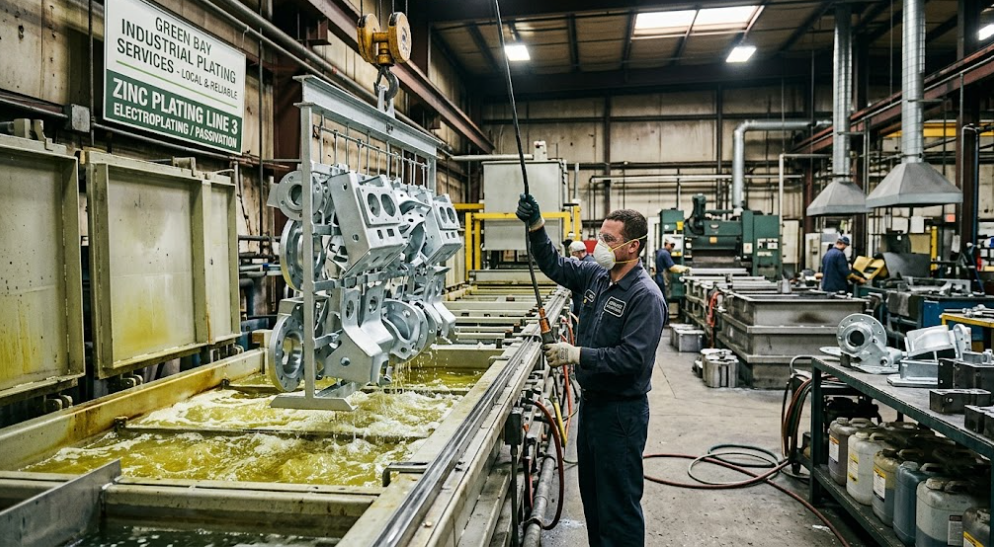
A production planner at a Green Bay metal fabrication shop is running the numbers on a new order a batch of brackets that need to ship to an assembly customer in three weeks, with zinc plating somewhere in the middle of that timeline. The parts get stamped and welded locally, the finishing has to happen somewhere, and the planner is staring at two very different options on the map a plater across the state line, adding a full day of transit each direction to an already tight schedule, or a plater close enough to Green Bay that a truck can make the round trip without eating into the production window at all. That choice not the chemistry, not the equipment, just the distance on the map is one of the most underrated variables in how reliably a Northeast Wisconsin manufacturer can hit its own delivery commitments.
This piece is written for exactly that planner, and for the purchasing managers, quality engineers, and shop owners across Green Bay, Ashwaubenon, De Pere, and the broader Fox Valley who are evaluating zinc plating vendors and trying to separate what actually matters for their operation from what’s just marketing language on a website. We’ll walk through what zinc plating actually does, why proximity to a Green Bay manufacturing operation is a real operational factor and not just a convenience, what to look for in a plating partner serving this region specifically, and how Plateco fits into that picture for manufacturers across Wisconsin, including those based in Green Bay and the surrounding Fox Valley corridor.
Why Green Bay Manufacturers Need to Think About Zinc Plating Differently Than a Generic Buyer Guide Suggests
Most articles about zinc plating are written as if every manufacturer’s situation is identical same volume, same part complexity, same shipping distance, same urgency. Green Bay’s manufacturing base doesn’t fit that generic mold particularly well, and it’s worth being specific about why.
Green Bay and the surrounding Fox Valley region carry a genuinely diverse manufacturing footprint paper and packaging equipment, metal fabrication and stamping operations, agricultural and food processing equipment manufacturers, and a meaningful base of automotive and industrial component suppliers feeding both regional assemblers and national supply chains. That diversity means the zinc plating needs coming out of this region aren’t uniform. A packaging equipment manufacturer’s structural brackets have very different thickness and corrosion requirements than a fastener supplier’s high-volume, tightly toleranced hardware, and both are meaningfully different again from a custom fabrication shop’s low-volume, high-mix job work. A plating vendor that’s genuinely useful to Green Bay’s manufacturing base has to be able to serve that range competently, not just specialize narrowly in one part category and hope everything else fits reasonably well into the same process.
There’s also a practical geography factor that’s easy to underweight until it’s cost a shop a missed delivery. Northeast Wisconsin sits far enough from the state’s more plating-vendor-dense southern corridor that a manufacturer defaulting to “whichever plater we’ve always used” without reconsidering distance can be adding meaningful transit time, and meaningful transit risk, to every single production cycle involving plated parts. For a shop running tight production schedules, that added transit time isn’t a minor inconvenience it’s a recurring, compounding cost in freight, in schedule buffer, and in how much flexibility the shop has left when a customer needs something expedited.
Since 1974
Plateco has served Wisconsin manufacturers with zinc plating services, including operations across the Green Bay and Fox Valley region
Multiple Alloys
Zinc plating capability across steel, including high-strength and hardened steel substrates common in Green Bay’s fabrication and equipment manufacturing base
0.1%
Current defect rate across Plateco’s production lines, the result of automated bath chemistry monitoring and in-process thickness verification
What Zinc Plating Actually Does, in Practical Terms
For manufacturers newer to specifying plated finishes, or teams bringing on a new quality engineer who hasn’t worked with plating specs before, it’s worth grounding this in plain terms before getting into vendor selection.
Zinc plating is an electrochemical process that deposits a thin, controlled layer of zinc onto a steel or iron substrate, primarily to protect the base metal from corrosion. Zinc is more chemically reactive than the steel underneath it, which means the zinc layer corrodes sacrificially, protecting the base metal even if the coating gets scratched or the surface is otherwise compromised, up to the point where the zinc layer itself is fully consumed. This is the core reason zinc plating is specified so widely across fasteners, brackets, automotive components, and structural hardware it’s a cost-effective, reliable way to extend a steel part’s service life in environments where uncoated steel would rust.
The process itself involves several controlled stages cleaning the part thoroughly to remove oils, scale, and contaminants that would prevent proper adhesion running the part through an electroplating bath where an electrical current drives zinc ions onto the part’s surface rinsing and, in many applications, applying a chromate conversion coating on top of the zinc layer, which adds further corrosion resistance and can be specified in different colors, clear, yellow, black, or olive drab, depending on the application’s requirements. Each of those stages has to be controlled precisely, because a shortcut or an inconsistency at any single stage, an under-cleaned part, a bath that’s drifted out of chemical balance, an under-timed dwell period, can produce a part that looks acceptable but doesn’t actually meet the coating thickness or adhesion standard on the print.
For most Green Bay manufacturers specifying zinc plating, the relevant technical benchmark is ASTM B633, the governing specification for electrodeposited zinc coatings on iron and steel, which defines coating thickness classes based on the severity of the service environment the part will face. A part destined for a mild indoor environment has a different thickness requirement than one that will see outdoor exposure or road salt, and getting that classification right at the design stage is what determines whether the plated part actually performs as expected once it’s in service.
Have Questions About Your Parts? – (608) 524-8241
Why Proximity Actually Matters for a Green Bay Manufacturer
It’s worth making the case for local or regional plating directly, because “buy local” can sound like a soft, sentimental argument when what a purchasing manager actually needs is a hard operational one.
Transit time directly compresses or expands your own production schedule. Every hour a part spends in transit to and from a plating vendor is an hour it’s not available for the next step in your process, whether that’s assembly, packaging, or shipping to your own customer. A plater within reasonable driving distance of Green Bay adds meaningfully less transit time to a production cycle than a vendor located across the state, which translates directly into either faster overall lead times or more schedule buffer available for the parts of the process you actually control.
Freight cost compounds with volume in a way that’s easy to underestimate. A modest per-shipment freight cost difference between a nearby vendor and a distant one becomes a significant, recurring line item once multiplied across regular production volume over a year. For a manufacturer running plated parts through their process on any kind of regular cadence, that freight differential is a real, quantifiable cost that belongs in any honest vendor comparison, not just the quoted plating rate per pound.
Problems get resolved faster when a conversation can happen quickly, and sometimes in person. When a lot comes back with a question about thickness, an unusual finish requirement, or a rush order that needs same-week turnaround, proximity to a vendor changes how quickly that conversation can actually happen. A plater within a reasonable drive of Green Bay can accommodate site visits, direct part reviews, and faster response to production emergencies in a way that’s structurally harder for a vendor located much further away, regardless of how responsive that distant vendor’s customer service team genuinely tries to be.
Rush capability depends partly on geography, not just on a vendor’s stated willingness to expedite. A plater that’s already positioned to serve Northeast Wisconsin efficiently is in a fundamentally better position to accommodate a genuine rush order for a Green Bay manufacturer than a vendor whose standard logistics already assume a longer transit window as the baseline for every order, rush or not.
None of this means a Green Bay manufacturer should automatically disqualify every plating vendor located outside the immediate region. It means proximity is a legitimate, quantifiable factor that deserves real weight in a vendor evaluation, not an afterthought considered only if two vendors are otherwise tied on price and quality.
What Green Bay Manufacturers Should Actually Evaluate in a Plating Vendor
Beyond geography, the fundamentals of evaluating any plating vendor apply fully to Green Bay manufacturers, and they’re worth walking through directly.
Process control and documentation. Ask specifically how bath chemistry is monitored continuous automated monitoring catches drift long before it becomes a defective lot, while manual, periodic titration leaves real gaps where inconsistency can develop undetected. Ask whether thickness verification happens in-process or only as an end-of-run sample check, since the latter can let an entire lot run out of spec before anyone catches it. And ask what documentation actually accompanies a shipment lot-specific, time-stamped process data is a meaningfully stronger signal of real process control than a general certificate of conformance.
Capacity and part-type experience relevant to your product mix. A vendor that primarily runs simple, high-volume fastener work may not have the rack-building expertise to handle a complex bracket geometry with tight internal corners, and the reverse is also true a vendor focused on complex custom work may not have the throughput to handle a large, price-sensitive fastener order efficiently. Green Bay’s manufacturing diversity means it’s worth confirming a prospective vendor has genuine, demonstrated experience with your specific part category, not just a general claim of broad capability.
Turnaround reliability under real production pressure, not just quoted lead time. Ask directly how a vendor handles bath maintenance scheduling, volume spikes, and rush orders, and whether committed delivery dates function as firm operational constraints. A vendor’s quoted lead time only matters if it’s actually held consistently, including during the busy periods when it’s most tempting for a vendor to let commitments slip.
Environmental compliance and regulatory standing. Zinc plating involves regulated chemical processes, and a vendor’s environmental compliance history is a legitimate diligence item, both because it reflects operational discipline more broadly and because a vendor facing regulatory disruption is a genuine supply chain risk for any manufacturer depending on them.
Industries Around Green Bay That Depend on Reliable Zinc Plating
Metal fabrication and stamping shops. Green Bay’s fabrication base regularly produces brackets, mounting hardware, and structural components that need consistent corrosion protection before shipping to assembly customers, and for these shops, plating turnaround reliability directly determines how tightly they can run their own production schedule against customer deadlines.
Packaging and processing equipment manufacturers. Northeast Wisconsin’s strong presence in paper, packaging, and food processing equipment manufacturing means a steady demand for zinc-plated structural and mechanical components that need to hold up in industrial operating environments, often with specific thickness requirements tied to the equipment’s expected service conditions.
Agricultural equipment and component suppliers. Components destined for outdoor agricultural equipment face genuinely demanding corrosion environments, exposure to moisture, soil contact, and temperature swings, which makes correct thickness classification and consistent process control particularly important for suppliers serving this segment of the regional economy.
Automotive and Tier 2/3 component suppliers. Suppliers feeding automotive assemblies, whether directly or through a Tier 1 intermediary, generally face the most demanding documentation and consistency requirements of any segment, since a plating inconsistency traced back to their parts becomes a supply chain risk visible well beyond their own operation.
General industrial and custom fabrication job shops. Lower-volume, higher-mix custom work is common across the region’s smaller fabrication operations, and these shops benefit particularly from a plating vendor capable of handling varied part geometries competently without requiring large minimum order quantities that don’t fit a job-shop production model.
The Misconception We Hear Most Often From Green Bay Manufacturers
That the nearest plater is automatically the right choice, or that quality and consistency matter enough to justify working with a distant vendor regardless of the transit and freight cost involved. Neither extreme reflects how the decision should actually be made. The right vendor is the one that combines genuine process control and documentation with a location close enough that transit time and freight cost don’t quietly erode the value of that quality advantage. Evaluating both factors together, rather than treating proximity and quality as separate, competing considerations, is what actually produces the best outcome.
What Working With Plateco Looks Like for a Green Bay Manufacturer
Plateco has served Wisconsin manufacturers, fabricators, and OEMs with zinc plating since 1974, and that regional focus is a deliberate part of how the business operates, not an incidental detail. For a Green Bay manufacturer evaluating Plateco specifically, here’s what that relationship typically looks like in practice.
A quoting and RFQ process built around your actual prints and specs, not a generic price list. Send your prints, your specification requirements, and your expected volume, and get a quote built around your specific parts, not a one-size-fits-all rate that doesn’t account for your geometry, alloy, or thickness classification.
Automated bath chemistry monitoring and in-process thickness verification on every production run. The same process controls that drive Plateco’s current defect rate apply to every lot, regardless of whether it’s a large recurring order or a smaller job-shop batch, which matters particularly for Green Bay’s mixed manufacturing base of both high-volume and custom low-volume work.
Lot-specific process documentation with every shipment. Bath temperature, current density, and dwell time records tied to your specific lot number accompany your parts, giving your own quality team the documentation needed to reduce reliance on full incoming inspection over time, once that consistency has been demonstrated.
A production and logistics footprint built to serve Wisconsin manufacturers efficiently, including those in the Green Bay and Fox Valley region, meaning the transit time and freight cost considerations discussed earlier in this piece are a genuine part of how Plateco approaches serving manufacturers across the state, not an afterthought to a plating operation designed around a different part of the region entirely.
“A manufacturer in Green Bay shouldn’t have to choose between a plater who understands their process and a plater who’s actually positioned to serve their production schedule reliably. We built this business to be both, for manufacturers across Wisconsin, not just the ones closest to our front door.”
Jim Schweich, Chief Executive Perfectionist, Plateco, Inc.
Questions to Ask Before Choosing a Zinc Plating Vendor Near Green Bay
Whether or not you end up evaluating Plateco directly, these are the questions worth bringing to any plating vendor conversation if you’re manufacturing in or around Green Bay.
What’s the realistic round-trip transit time between our facility and yours, and how does that factor into your quoted lead time? A vendor’s quoted turnaround should already account honestly for transit, not treat it as a separate, unstated addition that surprises you once the relationship is underway.
Can you walk me through how you’d handle our specific part geometry, not just your general process? A vendor’s answer to a specific question about your actual parts tells you considerably more about their real capability than a general description of their equipment and certifications.
What does your documentation package actually include with each shipment, and can I see a sample? Reviewing an actual sample of a vendor’s lot documentation before committing volume is a reasonable, standard request, and a vendor confident in their process control should have no hesitation providing one.
How do you handle a rush order, realistically, and what’s your track record on holding to committed dates during your busiest periods? Ask for specifics, not just an assurance, since this is exactly the kind of commitment that’s easy to make in a sales conversation and harder to hold consistently once real production pressure arrives.
What’s your environmental compliance history, and how do you handle wastewater treatment and regulatory reporting? This is a legitimate diligence question for any plating vendor, and a vendor with nothing to hide on this front should answer it directly and specifically.
Frequently Asked Questions
Does Plateco serve manufacturers specifically located in Green Bay and the Fox Valley region?
Yes. Plateco serves manufacturers, fabricators, and OEMs across Wisconsin, including operations in Green Bay, De Pere, Ashwaubenon, and the broader Fox Valley corridor, alongside customers across the state and in neighboring Illinois, Michigan, and Iowa.
What’s the typical turnaround time for a zinc plating order from a Green Bay manufacturer?
Turnaround depends on part volume, complexity, and current production scheduling, and is best confirmed directly through a quote request that accounts for your specific parts and required delivery timeline, rather than a general estimate that doesn’t reflect your actual order.
Does distance from a plating vendor actually affect part quality, or only shipping logistics?
Distance itself doesn’t affect the plating process or the quality of the finish, but it does affect transit time, freight cost, and how quickly problems or rush requests can be resolved, all of which are legitimate operational factors that belong in a vendor evaluation alongside process quality.
What thickness classification should a Green Bay manufacturer specify for parts facing outdoor or agricultural exposure?
This depends on the specific service environment the part will face, and should be determined against ASTM B633’s classification system based on expected exposure severity, which is a specification conversation worth having directly with your plating vendor’s quality team rather than guessing at an appropriate class.
Can a smaller Green Bay job shop with lower, variable volume work with Plateco, or is the operation focused on large-volume customers only?
Plateco works with manufacturers across a range of volumes, from large recurring production runs to smaller, variable job-shop batches, which reflects the genuinely mixed nature of Wisconsin’s manufacturing base, including the diverse fabrication and equipment manufacturing operations common around Green Bay.
How does a manufacturer get started with a quote from Plateco?
The process starts with sending prints, specifications, and expected volume through Plateco’s RFQ process, which allows a quote to be built around your actual parts rather than a generic rate.
Ready to Work With a Plating Partner That Actually Understands Green Bay’s Manufacturing Base?
Tell Us About Your Project
Plateco has been zinc plating for Wisconsin manufacturers, fabricators, and OEMs since 1974, including operations across Green Bay and the Fox Valley region. If transit time, inconsistent quality, or unreliable turnaround from your current plating vendor is costing your production schedule more than it should, send us your prints and specs and let’s talk through what a closer, more consistent partnership could look like.