

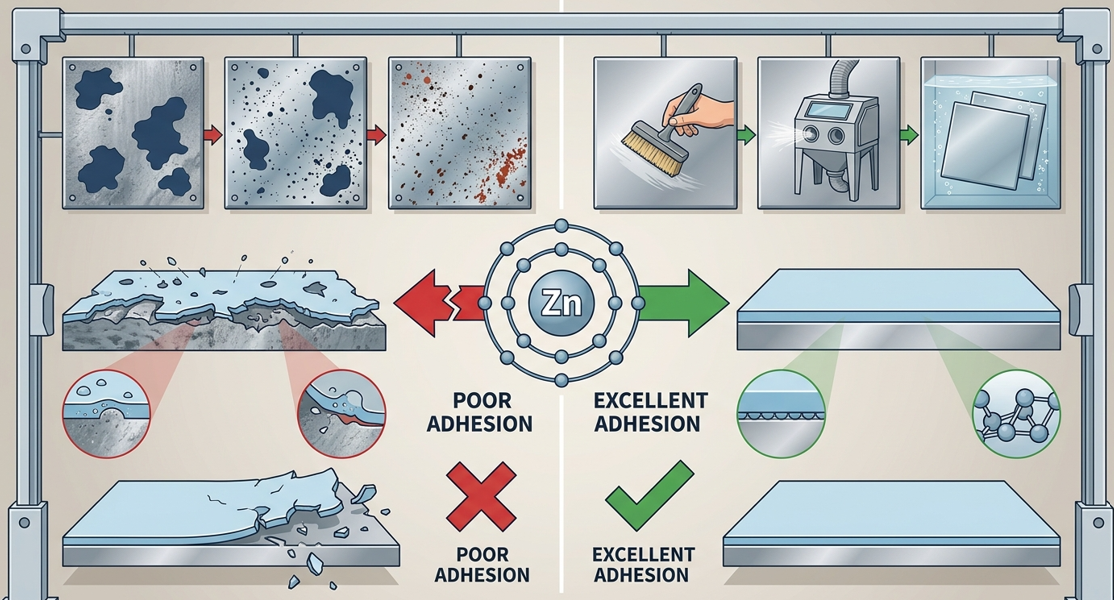
Ask most people outside the industry what determines whether zinc plating turns out well, and they’ll point to the plating bath, the current density, the time in the tank, the chemistry doing the actual coating. Ask anyone who has spent real time on a plating line, and they’ll tell you something different by the time a part reaches the plating tank, the outcome is already largely decided. Adhesion failures, blistering, flaking, dull or uneven coverage trace back to the plating step far less often than they trace back to what happened, or didn’t happen, during cleaning and surface preparation beforehand. This guide explains why cleaning is the part of the process that actually determines whether zinc plating holds, what a proper surface prep sequence includes, and what goes wrong when any part of it is rushed or skipped.
There’s a persistent misconception, understandable given how the industry is named and marketed, that “zinc plating” is fundamentally about the plating bath itself. In practice, a well-run plating operation spends more process time, more tank stages, and arguably more genuine technical attention on getting a part’s surface into the correct condition before plating than on the electroplating step itself. This isn’t an exaggeration for effect. A part with a flawless plating bath and a poorly cleaned surface will produce a flawed coating, reliably and predictably. A part with properly executed surface preparation and a competently run plating bath will produce a good coating just as reliably. The plating bath is necessary, but it isn’t where adhesion is actually won or lost.
This guide is built for manufacturers, engineers, and quality teams who want to understand what’s actually happening during surface preparation, why each stage exists, what specific contamination or surface condition each stage is designed to remove, and how to recognize when a plating defect actually originated upstream of the plating tank rather than within it. Understanding this sequence changes how you evaluate a plating partner, and how you diagnose a problem when one shows up.
60-70%
Approximate share of process tanks in a typical zinc plating line devoted to cleaning and preparation rather than plating itself
1 Failure
The number of contaminated or inadequate cleaning stages needed to compromise adhesion across an entire part
1974
Year Plateco began building its process discipline around surface preparation for Wisconsin manufacturers
Why Adhesion Is Won or Lost Before the Part Ever Reaches the Plating Bath
Zinc electroplating works by depositing zinc atoms onto a steel surface through an electrochemical reaction, and for that deposit to form a genuine, durable bond rather than simply sitting loosely on top of the part, the steel surface needs to be chemically clean and metallurgically active at the atomic level, free of oils, oxides, scale, and any other material that would sit between the zinc and the base steel and prevent true bonding from occurring.
This is a fundamentally different requirement than what most people mean by “clean” in an everyday sense. A part can look visually clean, no visible dirt, no obvious grease, and still carry a thin, invisible film of oil residue, oxide, or other contamination entirely sufficient to prevent proper adhesion. This is precisely why surface preparation in a plating operation isn’t a single wash step, it’s a sequence of distinct chemical and, sometimes, mechanical stages, each targeting a different category of surface condition that visual inspection alone cannot reliably detect.
Any single inadequately executed stage in this sequence can compromise adhesion across an entire part, or across specific regions of a part, regardless of how well every other stage and the plating bath itself perform. This is the core reason cleaning deserves more attention, not less, than the plating step itself it’s the more failure-prone part of the process, precisely because its success is harder to visually verify and its failure modes are more varied.
The Core Principle to Understand
Electroplating deposits zinc onto whatever surface condition it actually encounters, not the surface condition you assume is there. If that surface still carries oil, oxide, or scale invisible to casual inspection, the zinc bonds to that contamination layer rather than to the steel itself, producing a coating that may look acceptable initially but lacks the genuine adhesion strength a properly prepared surface would produce.
The Standard Surface Preparation Sequence, Stage by Stage
A properly executed zinc plating process moves a part through a specific sequence of preparation stages before it ever reaches the plating tank, and each stage exists to address a distinct type of surface contamination that the previous stage doesn’t remove.
Degreasing: Removing Oils, Cutting Fluids, and Organic Contamination
The first stage in most plating sequences addresses oils, cutting fluids, drawing compounds, and other organic residues left on a part from machining, forming, or handling. These contaminants are often invisible or barely visible to the eye but form a molecular barrier that prevents subsequent cleaning stages and the plating process itself from properly interacting with the actual steel surface.
Degreasing is commonly performed through vapor degreasing, solvent cleaning, or alkaline soak cleaning, and the correct method and duration depend heavily on the specific contamination a part carries, heavy-duty cutting fluid residue requires meaningfully more aggressive treatment than light handling oils. A part that proceeds to subsequent cleaning stages with residual oil still present will carry that contamination forward, often becoming progressively harder to remove as it interacts with subsequent process chemistry.
Alkaline Cleaning: Removing Remaining Organic Films and Light Soils
Following initial degreasing, alkaline cleaning, typically performed as either a soak or an electrocleaning process using an applied electrical current to enhance cleaning action, addresses remaining light oils, soils, and organic films that degreasing alone may not fully remove. Electrocleaning specifically uses the electrical current to generate a scrubbing action at the part’s surface, dislodging contamination that a simple soak process might leave behind, particularly in recessed features, threads, or complex geometries where fluid exchange is more limited.
This stage is particularly important for parts with complex geometry, since contamination trapped in blind holes, threaded features, or tight recesses is precisely the kind of surface condition that later shows up as localized adhesion failure specific to those features, even when the majority of a part’s more accessible surfaces plate correctly.
Acid Pickling: Removing Rust, Scale, and Oxide Layers
Steel exposed to atmospheric conditions, heat treatment, or welding develops oxide layers and scale on its surface, ranging from light surface rust to heavier mill scale from hot-rolled steel or heat treatment scale from thermal processing. Acid pickling, typically using hydrochloric or sulfuric acid, dissolves these oxide layers, exposing fresh, reactive steel underneath.
The specific acid, concentration, temperature, and dwell time required depend heavily on the type and thickness of scale present. Heavy mill scale requires meaningfully more aggressive treatment than light surface oxidation from short-term atmospheric exposure, and a pickling process calibrated for light rust will often fail to fully remove heavier scale, leaving a residual oxide layer that compromises subsequent plating adhesion in a way that’s easy to miss during visual inspection, since some residual scale can appear similar in color to properly prepared steel.
Rinsing Between Every Stage
Thorough rinsing between each of the stages described above is not a minor housekeeping step, it’s an essential part of the preparation sequence in its own right. Inadequate rinsing carries residual chemistry from one stage into the next, where it can react unpredictably with subsequent process chemistry, neutralize or contaminate the next tank, or simply dry onto the part’s surface and interfere with proper plating adhesion at that specific location. This is precisely why platers with genuine process discipline monitor rinse water quality and dragout control as carefully as they monitor the primary process tanks themselves.
Acid Activation: The Final Surface Preparation Step
Immediately before plating, a final, typically brief acid dip serves to activate the steel surface, removing any final light oxide film that may have formed even during the short time between pickling and plating, and leaving the surface in the specific chemically reactive state the plating bath needs to form a proper bond. This step is deliberately brief and closely timed relative to the plating step itself, since a freshly activated steel surface begins to re-oxidize from ambient air exposure almost immediately, and excessive delay between activation and plating can undermine the benefit of the activation step entirely.
A Complete Preparation Sequence at a Glance
Stage Purpose What It Removes Degreasing Remove bulk organic contamination Cutting fluids, oils, drawing compounds Alkaline cleaning Remove remaining light soils and films Residual oils, handling contamination, soap films Rinse Prevent cross-contamination between stages Residual alkaline chemistry Acid pickling Remove oxide and scale Rust, mill scale, heat treatment scale Rinse Prevent cross-contamination between stages Residual acid chemistry Acid activation Final surface reactivation Light oxide formed since pickling Plating Deposit zinc coating N/A this is the actual coating step
What Happens When a Preparation Stage Is Rushed or Skipped
Understanding the specific consequence of shortcutting each stage helps translate abstract process theory into the concrete plating defects a receiving inspection or field failure would actually reveal.
Inadequate degreasing produces localized adhesion failure, often appearing as spotting, blistering, or flaking concentrated in specific areas rather than uniformly across a part, since oil contamination is rarely perfectly uniform to begin with. Parts with heavier original cutting fluid residue, or complex geometries where fluid pools or is trapped, are disproportionately affected.
Inadequate alkaline cleaning, particularly for parts with recessed features, threads, or blind holes, produces adhesion failure concentrated specifically in those hard-to-clean geometric features, while more accessible flat surfaces on the same part may show acceptable adhesion, creating a confusing, inconsistent defect pattern if the root cause isn’t understood.
Inadequate rinsing between stages can produce a range of effects depending on which stage’s chemistry carries forward, but commonly shows up as inconsistent, patchy coverage, unusual discoloration, or localized adhesion problems that don’t correspond cleanly to any single contamination source, since the residual chemistry is often reacting unpredictably with the next process stage rather than simply blocking adhesion outright.
Inadequate acid pickling, particularly on parts with heavier mill scale or heat treatment scale that wasn’t fully removed, produces the most visually dramatic failures significant blistering, flaking, or areas where the zinc coating separates cleanly away from an underlying oxide layer that was never actually removed, often more widespread and severe than contamination-related adhesion failures from earlier stages.
Excessive delay between acid activation and plating produces subtler, more marginal adhesion issues, since some re-oxidation occurs but not to the degree that heavier, unaddressed scale would produce. This failure mode is often the hardest to diagnose after the fact, since it doesn’t leave an obviously identifiable contamination signature the way oil residue or unremoved scale does, and often only becomes apparent through adhesion testing or downstream mechanical stress rather than visual inspection alone.
Why Inconsistent Defect Patterns Are a Genuine Diagnostic Clue
A plating adhesion problem that’s uniform across an entire lot often points toward a systemic issue, a genuinely depleted or contaminated tank, an incorrect process parameter. A plating adhesion problem that’s inconsistent, appearing on some parts but not others, or in specific features but not elsewhere on the same part, often points toward a surface preparation issue tied to part geometry, original contamination level, or handling variation between individual parts, rather than a uniform bath or process failure. This distinction is genuinely useful when working with a supplier to diagnose a recurring problem.
Seeing Inconsistent Adhesion Across a Recent Order?
Send us details about the defect pattern, uniform or spotty, specific features or across the whole part, and we’ll help you figure out which stage of the process it’s likely pointing back to.
How to Verify Surface Preparation Is Actually Working
Because surface preparation failures are often invisible to casual inspection, understanding how a plating operation actually verifies cleanliness, rather than simply trusting that a process ran on schedule, is genuinely useful for evaluating a supplier’s real process discipline.
The water break test. This is one of the simplest, most widely used, and genuinely effective methods for verifying that a surface is properly clean before proceeding to the next stage. A properly cleaned steel surface is hydrophilic, meaning water spreads evenly across it in a continuous, unbroken film. A surface still carrying any oil or organic contamination is hydrophobic in those specific areas, causing water to bead up or break into discontinuous droplets rather than spreading evenly. This test is fast, requires no special equipment beyond a rinse station, and provides an immediate, visual pass-fail indication of whether degreasing and cleaning stages have actually achieved a properly clean surface.
Visual inspection for residual scale or discoloration after pickling. While not as definitive as the water break test for organic contamination, experienced operators can often visually identify areas of residual scale or incomplete pickling based on subtle color or texture differences compared to properly activated steel, particularly on parts with known heavier original scale conditions like hot-rolled or heat-treated components.
Periodic bath chemistry monitoring across every stage, not just the plating tank itself. A plating operation with genuine process discipline monitors concentration, contamination level, and temperature not just in the plating bath, but across every degreasing, alkaline cleaning, and acid stage in the sequence, since a depleted or contaminated preparation stage tank compromises the entire process just as surely as a depleted plating bath would, even though it’s further upstream from the visible coating step.
Adhesion testing on production parts, not just visual acceptance. Beyond verifying that preparation stages ran correctly, direct adhesion testing, methods like bend testing, tape testing, or more rigorous quantitative adhesion testing depending on the application’s requirements, provides direct confirmation of the actual outcome surface preparation was meant to achieve, rather than relying entirely on process compliance as a proxy for the result.
A Question Worth Asking Any Plating Supplier
“Do you perform water break testing or an equivalent cleanliness verification before parts enter the plating bath?” A supplier with genuine process discipline will describe this or an equivalent verification method specifically and matter-of-factly, as a routine part of their process. A supplier who seems unfamiliar with the concept, or describes verification purely in terms of “the process ran on schedule” without any actual surface condition check, represents a meaningful process control gap.
Substrate Condition Variables That Affect Required Preparation
Not every part requires the same intensity or duration at each preparation stage, and understanding what drives these differences helps explain why a plating supplier’s process needs genuine flexibility and technical judgment, rather than a single fixed recipe applied uniformly to every job.
Hot-rolled versus cold-rolled steel. Hot-rolled steel typically carries heavier mill scale requiring more aggressive pickling than cold-rolled steel, which generally arrives with a cleaner, more consistent surface condition requiring comparatively lighter preparation.
Machined versus as-received surfaces. Freshly machined surfaces often carry meaningful cutting fluid residue requiring thorough degreasing, while as-received bar stock or sheet material may carry different contamination, mill oils, light surface oxidation from storage and handling, requiring a differently calibrated preparation approach.
Heat-treated components. Parts that have undergone heat treatment frequently develop heavier, more tenacious oxide scale than non-heat-treated steel, often requiring meaningfully more aggressive or extended pickling to fully remove, and in some cases, mechanical scale removal methods in addition to acid pickling.
Welded assemblies. Weld areas and adjacent heat-affected zones frequently carry weld scale, spatter, and localized oxide conditions distinctly different from the base material’s surface condition elsewhere on the part, sometimes requiring targeted additional preparation attention specifically at and around weld locations rather than a uniform treatment across the entire assembly.
Cast versus wrought components. Cast steel and iron components can carry surface porosity, sand inclusion residue, or casting-specific surface conditions that wrought (rolled or forged) steel doesn’t share, sometimes requiring different or additional preparation approaches to achieve a genuinely clean, plateable surface.
Why This Matters for How You Source Plating
If your parts vary across these substrate conditions, hot-rolled versus cold-rolled, machined versus as-received, heat-treated versus not, a plating supplier with genuine technical depth should be adjusting their preparation process accordingly, rather than running every job through an identical, fixed sequence regardless of the specific substrate condition in front of them. This is a reasonable, direct question to ask during supplier evaluation.
Not Sure Why Adhesion Varies Across Different Parts in Your Product Line?
If some of your components plate reliably while others show recurring adhesion issues, the difference may come down to substrate condition and how prep is calibrated for each. Let’s talk through what you’re seeing.
Why This Matters More Than Plating Bath Chemistry Itself
It’s worth returning directly to the claim in this guide’s title, because it’s easy to state as a slogan without actually explaining why it’s true. Plating bath chemistry, current density, and time absolutely matter, and a poorly controlled plating bath can certainly produce its own defects, thin coverage, poor thickness uniformity, brightness or appearance issues. But these plating-stage defects are, in a meaningful sense, more visible and more directly correctable than surface preparation failures.
A plating bath’s key parameters, concentration, pH, temperature, current density, are relatively straightforward to measure directly and continuously during production, and deviations tend to produce fairly predictable, diagnosable effects. Surface preparation failures are comparatively harder to detect in real time, since the actual outcome, whether a given part’s surface achieved true molecular-level cleanliness, isn’t something you can simply measure with a probe the way you can measure bath temperature or current. This is precisely why verification methods like the water break test matter so much they’re one of the few direct ways to confirm surface preparation actually achieved its goal, rather than simply trusting that a process ran for the correct duration.
This asymmetry, harder to verify, easier to accidentally compromise, easier to trace incorrectly back to the plating bath rather than the actual upstream cause, is exactly why surface preparation deserves more scrutiny during both process design and supplier evaluation than it typically receives. A buyer troubleshooting an adhesion problem who focuses exclusively on plating bath parameters while overlooking the preparation sequence that preceded it is very often looking in the wrong place.
What This Means for Evaluating a Plating Supplier
Given everything covered in this guide, a few practical takeaways are worth carrying into how you evaluate and work with a plating supplier, particularly for parts with known challenging substrate conditions or a history of adhesion problems.
Ask specifically about the preparation sequence, not just the plating process. A supplier who can walk through their degreasing, cleaning, pickling, and activation stages specifically, including how they adjust for different substrate conditions, demonstrates meaningfully more process depth than one who describes their capability purely in terms of the plating bath itself.
Ask how cleanliness is verified before parts proceed to plating. The water break test or an equivalent verification method should be a routine, expected part of a mature process, not an unusual or unfamiliar request.
When diagnosing an adhesion problem, consider the preparation sequence before assuming a plating bath issue. Given how much of a plating process’s genuine risk sits in the preparation stages rather than the plating tank itself, a defect pattern, particularly one that’s inconsistent, concentrated in specific features, or correlates with a specific substrate condition, deserves investigation starting from the cleaning sequence rather than defaulting immediately to plating bath chemistry as the likely cause.
Recognize that substrate condition genuinely matters, and communicate it clearly to your supplier. Providing accurate information about your parts’ condition, hot-rolled versus cold-rolled, heat-treated, welded, freshly machined versus stored inventory, helps a competent supplier calibrate their preparation process correctly from the outset, rather than discovering a substrate-specific challenge only after a defect has already occurred.
Cleaning as the Foundation, Not an Afterthought
The plating bath gets the name and the attention, but the cleaning and preparation sequence that precedes it is where the actual outcome of a zinc plating job is determined. Understanding this sequence, what each stage removes, how failures at each stage manifest, and how a genuinely disciplined operation verifies success along the way, gives you a real, practical framework for both evaluating a plating partner and diagnosing a problem when adhesion doesn’t hold up the way it should.
Plateco has built its zinc plating process around exactly this principle for Wisconsin manufacturers since 1974, treating surface preparation as the foundation the entire coating depends on, not a preliminary step to move through quickly on the way to the plating tank. If you’re evaluating a plating partner, or troubleshooting an adhesion issue on a current order, we’re glad to walk through exactly what our preparation process does and why.
Frequently Asked Questions
If a part looks visually clean, does that mean it’s actually ready for plating?
Not necessarily. Visual cleanliness and the molecular-level cleanliness required for proper plating adhesion are genuinely different things. A part can appear entirely clean to the eye while still carrying a thin film of oil, light oxide, or other contamination sufficient to compromise adhesion. This is exactly why verification methods like the water break test exist, to check for a specific, objective indicator of true surface cleanliness rather than relying on visual inspection alone.
Why does the same plating process sometimes produce good adhesion on one batch of parts and poor adhesion on another, seemingly identical, batch?
This is very often traceable to variation in the parts’ original surface condition entering the process, differences in cutting fluid residue, storage time and resulting light oxidation, or subtle differences in how parts were machined or handled before reaching the plater, rather than any change in the plating bath itself. Communicating consistent, accurate information about part condition and sourcing to your plating supplier helps them calibrate preparation consistently across batches.
Is the water break test a reliable way to check cleanliness myself, or is it something only a plater can perform?
The water break test itself is simple enough that a receiving quality team can, in principle, understand and even observe it during a supplier visit or audit, since it only requires rinsing a cleaned part with water and observing whether the water sheets evenly or beads up. That said, it needs to be performed at the correct point in the process, immediately after cleaning and before subsequent stages, to be meaningful, which is why it’s primarily a plater’s own in-process verification tool rather than something typically performed on finished, already-plated parts.
Does heavier mill scale always require a completely different pickling process, or just more time in the same acid?
It depends on the severity and type of scale. In many cases, heavier scale can be addressed with the same pickling chemistry but requires longer dwell time, higher acid concentration, or elevated temperature to fully dissolve within a practical process window. In cases of very heavy or tenacious scale, particularly from certain heat treatment processes, mechanical scale removal methods may be used in combination with or instead of extended acid pickling to achieve reliable results without excessive acid exposure that could itself cause surface damage.
Can excessive or overly aggressive cleaning ever cause its own problems, or is more cleaning always better?
Yes, excessive or improperly controlled acid pickling in particular can cause its own issues, including hydrogen embrittlement risk on high-strength steel from prolonged acid exposure, or excessive base metal etching that affects dimensional tolerances on precision parts. This is why proper surface preparation is about correctly calibrated process control matched to the specific substrate condition, not simply maximizing cleaning intensity across the board.
How would I know if a recurring adhesion problem is actually a surface preparation issue versus a plating bath issue?
Look at the defect pattern adhesion problems concentrated in specific features (recessed areas, threads, weld zones) or affecting some parts in a lot but not others, especially when those differences correlate with known substrate condition variation, more often point toward surface preparation. Adhesion or coverage problems that appear uniformly across an entire lot regardless of individual part condition more often point toward a plating bath or process parameter issue. Sharing this pattern information directly with your supplier is one of the most useful things you can do to help them diagnose the actual root cause efficiently.
Ready to Talk Through Your Surface Preparation Process or an Adhesion Issue?