

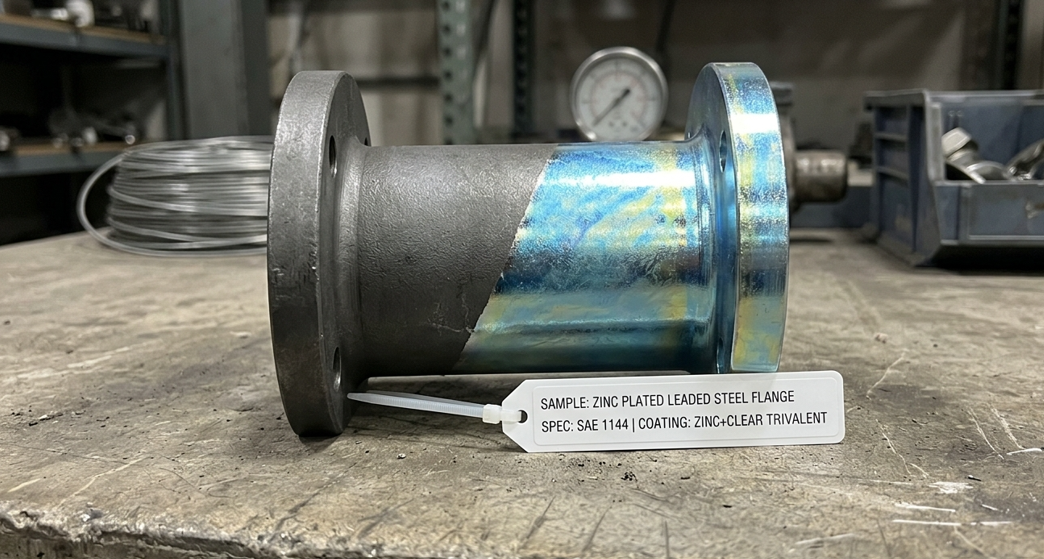
A machine shop chooses 12L14 leaded steel because it machines beautifully, faster cutting speeds, longer tool life, cleaner chips, and lower cost per part. Nobody on the machining side has any reason to think twice about it. Then the parts show up at the plater, and weeks or months later, after the parts have shipped, been assembled, or been formed into their final configuration, the zinc coating starts blistering, flaking, or peeling away entirely. What looks like a plating defect is very often a material compatibility problem that started at the machining stage, and it’s a problem some platers will quietly work around without ever explaining to you why it happened, what it will cost to fix properly, or why it might come back on your next order if nothing changes.
Leaded steel is a genuinely useful material, and there’s nothing wrong with specifying it for the machinability benefits it offers. The problem isn’t the material itself, it’s that plating leaded steel correctly requires a specific process step that a meaningful share of plating shops either don’t perform consistently, don’t explain to their customers, or quietly skip under time or cost pressure, because the consequences of skipping it don’t show up immediately. They show up later, sometimes well after the parts have already been shipped, assembled, or put into service, which makes it easy for a corner-cutting plater to avoid ever connecting the failure back to the decision that caused it.
This guide is built specifically for manufacturers, machine shops, and quality engineers working with leaded steel who want to understand exactly what’s happening at a material level when zinc plating fails on these parts, why it happens, what the correct process actually requires, and the questions worth asking any plater before you trust them with a leaded steel order.
0.15-0.35%
Typical lead content by weight in 12L14 free-machining steel
~25%
Approximate machinability improvement leaded steel can offer over comparable non-leaded grades
1
The single process step most commonly skipped that causes the majority of leaded steel plating failures
Why Leaded Steel Exists, and Why It’s So Common in Machined Parts
Free-machining leaded steels, 12L14 being the most common grade in North America, with equivalents like 11SMnPb30 used under European standards, contain a small but deliberate percentage of lead, typically in the range of 0.15 to 0.35 percent by weight, added specifically to improve machinability. During cutting, the lead particles distributed through the steel act as an internal lubricant, smearing across the tool-workpiece interface as the material is cut. This produces meaningfully faster cutting speeds, longer tool life, cleaner chip formation, and better surface finish compared to non-leaded equivalents, which is exactly why leaded steel shows up so frequently in high-volume machined components, fasteners, fittings, and precision turned parts where machining efficiency has a direct, significant impact on production cost.
None of this makes leaded steel a flawed material choice. For parts that will be machined extensively and don’t require plating, or for applications where plating adhesion risk has been properly addressed, leaded steel remains a genuinely sound engineering decision. The issue arises specifically at the intersection of leaded steel and electroplating, where the same lead content that makes the material so machinable creates a real, well-documented compatibility problem with standard plating processes if it isn’t specifically accounted for.
The Important Distinction to Hold Onto
Leaded steel isn’t inherently a bad substrate for plating, it’s a substrate that requires a specific, additional process step that non-leaded steel doesn’t. The material choice and the plating outcome are two separate decisions, and a properly managed leaded steel plating process can produce entirely reliable results. The risk isn’t in choosing leaded steel, it’s in working with a plater who doesn’t treat it as requiring anything different from standard steel.
What Actually Happens at the Surface: The Real Mechanism Behind Plating Failure
Understanding why leaded steel causes plating problems requires understanding two specific properties of lead that make it fundamentally incompatible with a standard electroplating process, both of which are simple to state but have real, practical consequences.
Lead is a poor conductor relative to steel in the context of electroplating current distribution, and more importantly, it doesn’t participate in the electrochemical plating reaction the way the surrounding steel does. During machining, lead particles within the steel smear across the machined surface, becoming exposed and concentrated at the surface itself, particularly on turned surfaces where the cutting action spreads lead more extensively than a grinding operation would. This means the surface a plater is actually trying to coat isn’t uniformly steel, it’s steel with a thin, uneven smear of lead sitting on top of it in varying concentrations depending on how the part was machined.
Lead is essentially insoluble in the acid cleaning and activation solutions typically used to prepare steel for plating. Standard pre-plating surface preparation relies on acid cleaning, commonly hydrochloric or sulfuric acid, to remove surface contamination and activate the steel surface so the plating bath can form a proper metallurgical bond. These standard acids are effective at cleaning steel, but they don’t meaningfully dissolve or remove the smeared lead sitting on the surface, because lead simply isn’t reactive with these particular acid chemistries in the way iron and steel are.
The practical result of these two properties together is that a standard acid cleaning and plating process leaves a layer of lead sitting between the plating bath and the actual steel substrate underneath. Zinc deposits onto and around this lead layer rather than bonding directly and uniformly with the steel itself, and because that bond is fundamentally weaker and less consistent than a direct zinc-to-steel bond, the coating is left vulnerable to separating from the surface, sometimes immediately, and sometimes only after the part experiences mechanical stress later in its life.
Why Standard Acid Cleaning Isn’t the Fix
A common misconception is that a longer or more aggressive standard acid dip, more time in hydrochloric or sulfuric acid, will adequately deal with surface lead. It generally won’t, because the issue isn’t insufficient cleaning time, it’s that these acids simply aren’t effective at dissolving lead in the first place. Addressing this properly requires a different chemistry entirely, covered in the next section, not just more of the same process.
The Failure Modes: Blistering, Flaking, and Delayed Adhesion Loss
Leaded steel plating failures show up in a few specific, recognizable patterns, and understanding which one you’re looking at helps confirm whether lead contamination is actually the root cause.
Blistering visible immediately or shortly after plating. This is the most straightforward failure mode small blisters, sometimes only visible under magnification initially, form across the plated surface where the zinc has failed to properly bond to the underlying lead-contaminated steel. These blisters often become more visible over time or after any handling stress, and their gray or dull coloration under the surrounding chromate finish is a recognizable diagnostic sign specific to this type of adhesion failure.
Flaking or peeling during subsequent forming, assembly, or handling operations. This is arguably the more dangerous failure mode from a quality-escape perspective, because the plating can look entirely acceptable at the time of initial inspection and only reveal its adhesion problem later, when the part undergoes cold forming, rolling, crimping, or another mechanical operation downstream. A coating with marginal adhesion due to surface lead contamination may survive gentle handling and even basic inspection, but fail visibly the moment it’s subjected to real mechanical stress, precisely the kind of stress many machined leaded steel parts are specifically designed to undergo during assembly.
Localized pitting or bare spots concentrated on turned surfaces specifically. Because turning operations smear lead across the surface more extensively than grinding does, plating failures on leaded steel parts frequently show a pattern where turned surfaces exhibit noticeably worse adhesion than ground or otherwise machined surfaces on the same part, a useful diagnostic clue when investigating an inconsistent failure pattern across a single component.
Dark spots or discoloration appearing during or shortly after the activation and plating process itself, sometimes concentrated in low-current-density areas like thread minor diameters or recessed features, which can indicate the lead removal process is incomplete or the activation bath has become saturated with previously dissolved lead and lost effectiveness, a maintenance issue covered further below.
A Diagnostic Pattern Worth Recognizing
If plating failures on a leaded steel part are concentrated specifically on turned or lathe-machined surfaces, while ground or milled surfaces on the same part show better adhesion, that pattern strongly points toward lead smear as the root cause, since turning spreads surface lead more extensively than other machining operations. This is a genuinely useful diagnostic clue when investigating an otherwise puzzling, inconsistent failure pattern.
The Correct Process Fix: Fluoride-Based Activation
The established, well-documented solution to plating leaded steel reliably is a fluoride-containing acid treatment, most commonly fluoboric acid, though sulfamic acid-based approaches are also used, applied as a specific pre-plating dip step, distinct from and in addition to standard cleaning and activation. Fluoride chemistry is specifically effective at addressing surface lead in a way that hydrochloric or sulfuric acid alone is not, allowing the plating process to reach and properly bond with the actual steel substrate rather than depositing onto a residual lead layer.
This isn’t an obscure or experimental technique, it’s the standard, widely documented approach used across the plating industry specifically for leaded free-machining steels, and it requires several things a plater needs to get right for it to actually work reliably.
The fluoride dip needs to occur immediately before plating, without significant delay. Allowing a part to sit for any meaningful time after the fluoride treatment and before entering the plating bath can allow the surface condition to degrade before plating occurs, undermining the treatment’s effectiveness even if the chemistry itself was applied correctly.
Bath concentration and dip time need to be actively maintained and monitored, not just initially set correctly. As parts are processed through a fluoride activation bath over time, dissolved lead accumulates in the solution. A bath that becomes sufficiently saturated with previously dissolved lead can lose effectiveness even while its overall acid concentration reads within normal range on a standard titration, since the specific issue is lead loading rather than general acid strength. This is why platers with genuine process discipline for leaded steel work perform periodic lead-specific testing, sometimes atomic absorption (AA) analysis, on their fluoride activation baths, not just standard concentration checks.
Mechanical surface preparation can serve as an alternative or complement in specific cases. For hardened leaded steel parts where acid exposure risks producing carbon smut, a separate and equally difficult-to-remove surface contamination issue, glass bead blasting or other mechanical surface preparation immediately before plating is sometimes used instead of, or in addition to, chemical fluoride treatment, physically removing the smeared surface lead layer rather than dissolving it chemically.
What Correct Process Documentation Should Show
A plater genuinely equipped to handle leaded steel should be able to describe their specific fluoride activation step, confirm how frequently they test the bath specifically for lead saturation (not just general acid concentration), and explain how quickly parts move from that dip into the plating bath itself. Vague reassurance that “we handle leaded steel fine” without this level of process specificity is a meaningful gap worth probing further.
Dealing With Blistering or Flaking on a Leaded Steel Order Right Now?
Send us photos and details about the substrate and process used, we’ll help you figure out whether lead contamination is the root cause and what it will take to fix it going forward.
Why This Step Gets Skipped, and Why You Often Don’t Find Out Until Later
This is the part of the story that gives this guide its title, and it’s worth being direct about it. Fluoride-based activation chemistry is more expensive, more hazardous to handle, and more demanding to maintain than standard acid cleaning, and a plater under cost or schedule pressure has a real, if not always openly acknowledged, incentive to treat leaded steel the same as standard steel and hope the adhesion holds up well enough to pass inspection.
Fluoride-based chemistries, including fluoboric acid, are more hazardous to handle and dispose of than standard hydrochloric or sulfuric acid processes, requiring more careful worker safety protocols and often more involved wastewater treatment and regulatory compliance around fluoride-bearing effluent. A shop without the infrastructure or willingness to manage this properly has a direct incentive to avoid the step altogether rather than invest in doing it correctly.
Lead entering rinse water and process wastewater is itself a regulated hazardous substance requiring proper treatment before discharge. A plating shop processing meaningful volumes of leaded steel needs wastewater treatment capability specifically suited to capturing and properly disposing of dissolved lead, not just standard metal finishing wastewater treatment. This is a genuine capital and operational cost that creates pressure to either invest properly or quietly cut corners on both the activation process and the resulting waste stream.
The failure often doesn’t appear until well after the part has left the plating facility. As covered above, marginal adhesion from inadequate lead removal frequently survives initial visual inspection and basic handling, only revealing itself during downstream forming operations, assembly, or actual field service. This delay creates a genuine accountability gap by the time the failure is visible, it’s often disconnected in time and location from the specific plating decision that caused it, making it easy for a plater to avoid ever having to explain why it happened.
Some platers genuinely don’t understand the mechanism well enough to explain it, rather than deliberately concealing it. It’s worth being fair here not every instance of this problem reflects a deliberate corner-cutting decision. Some shops simply lack the specific technical depth in leaded steel activation chemistry to recognize why their standard process is inadequate for this particular substrate, and default to their normal process without realizing the material itself requires something different.
Why This Matters for How You Evaluate a Plater
Whether a plater skips proper leaded steel activation deliberately to save cost, or simply doesn’t know the standard process is inadequate for this substrate, the practical result for you is the same parts that may pass initial inspection and fail later, in a way that’s genuinely difficult to trace back to its root cause once time has passed. This is exactly why asking specific, technical questions about leaded steel process during supplier qualification, rather than accepting general reassurance, matters so much for this particular material.
Standard Steel vs. Leaded Steel Plating Requirements at a Glance
| Factor | Standard (Non-Leaded) Steel | Leaded Steel (e.g., 12L14) |
|---|---|---|
| Standard acid activation | Generally sufficient | Generally insufficient alone |
| Additional process step required | No | Yes, fluoride-based activation (or mechanical prep) |
| Process cost and complexity | Standard | Higher, due to additional chemistry and monitoring |
| Bath maintenance | Standard concentration monitoring | Standard monitoring plus lead-saturation testing |
| Wastewater treatment considerations | Standard metal finishing wastewater | Additional lead-specific treatment and compliance |
| Risk of delayed adhesion failure | Low, with properly controlled process | Meaningful, if fluoride activation step is skipped or inadequate |
| Failure visibility timing | Typically visible at or shortly after plating | Often delayed until forming, assembly, or field service |
Questions to Ask a Plater Before Sending Them a Leaded Steel Order
Given how easy this problem is to miss during a standard supplier qualification conversation, a few specific, direct questions during sourcing reveal whether a prospective plating partner genuinely has the process discipline this material requires.
“Do you use a fluoride-based activation step specifically for leaded steel, and can you describe it?” A supplier with genuine experience will answer specifically, referencing fluoboric or sulfamic acid activation as a distinct step from their standard process, rather than describing a single generic cleaning process used across all substrates.
“How do you monitor your fluoride activation bath for lead saturation over time, not just general acid concentration?” This question distinguishes a supplier who understands the specific failure mode of an aging fluoride bath from one who’s simply following a documented procedure without understanding why the specific monitoring matters.
“What’s your typical time between the fluoride dip and the parts entering the plating bath?” A supplier who has genuinely optimized this process will have a specific, controlled answer, since delay between activation and plating is a known factor in whether the treatment actually holds up.
“How do you handle lead-bearing wastewater from this process?” This question reveals whether a supplier has actually invested in the infrastructure required to run this process responsibly and in regulatory compliance, or is potentially cutting corners on the waste handling side even if the plating process itself is nominally correct.
“Can you show me an example of successfully plated leaded steel parts, ideally including some that underwent post-plating forming or assembly operations?” Since delayed failure after forming is one of the most common and most consequential failure patterns for this material, evidence that a supplier’s leaded steel work has held up through downstream mechanical operations, not just initial inspection, is genuinely meaningful.
What a Confident, Experienced Answer Sounds Like
A plater with real leaded steel expertise will typically volunteer detail without much prompting, referencing specific chemistry, monitoring practices, and known failure patterns like the turning-versus-grinding surface difference covered earlier in this guide. Vague reassurance, “we plate leaded steel all the time, no problem”, without any of this specific detail is worth treating as a gap, not a confidence signal.
When Specifying Non-Leaded Steel Is the Better Answer
For some applications, the most reliable solution to this entire category of risk is avoiding leaded steel altogether, particularly for parts that will undergo significant post-plating forming, face demanding corrosion protection requirements where adhesion margin matters, or are produced by a supply chain where verifying a plater’s specific leaded steel process discipline isn’t practical. Non-leaded, standard machinable steel grades sacrifice some of the machinability advantage leaded steel offers, but eliminate this specific compatibility risk entirely, which can be the more cost-effective choice once the full cost of potential plating failures, rework, field returns, and investigation time, is factored in against the machining efficiency leaded steel provides.
This isn’t a universal recommendation against leaded steel, for high-volume, precision-turned parts where machining efficiency has a significant real cost impact, and where a plating partner has genuinely demonstrated proper fluoride activation process discipline, leaded steel remains a sound, reliable choice. The decision should be made deliberately, weighing the machining benefit against the plating risk and the specific plating partner’s demonstrated capability, rather than defaulting to leaded steel purely for machining convenience without considering the downstream plating implications at all.
Getting Leaded Steel Plating Right the First Time
The hidden risk in plating leaded steel isn’t a mysterious or poorly understood phenomenon within the metal finishing industry, it’s a well-documented material compatibility issue with an established, reliable process solution. The actual risk to a manufacturer sourcing plated leaded steel parts is entirely about whether the specific plating partner handling the job has the process discipline, the fluoride-based activation chemistry, the bath monitoring, the wastewater infrastructure, to execute that solution consistently, and whether they’re transparent about what that process actually requires rather than treating leaded steel the same as any other substrate and hoping it holds up.
Plateco has plated leaded steel components for Wisconsin manufacturers since 1974, with the specific fluoride activation process, bath monitoring, and wastewater treatment infrastructure this material genuinely requires. For more detail specifically on how lead in the substrate interacts with the plating process, our companion piece, More Lead, More Problems, goes deeper into the mechanism itself. If you’re sourcing plating for leaded steel parts, particularly ones that will undergo forming or assembly after plating, we’re glad to walk through exactly what our process does differently for this specific material.
Frequently Asked Questions
Is 12L14 the only leaded steel grade that causes plating adhesion problems?
No, any steel alloy containing meaningful lead content for machinability purposes, including European equivalents like 11SMnPb30, carries the same fundamental compatibility issue with standard plating processes, since the root cause is the lead content itself, not something specific to the 12L14 designation. Any leaded free-machining steel should be treated as requiring the fluoride activation process discussed in this guide, regardless of the specific grade designation on your material certification.
Can zinc plating on leaded steel ever be as reliable as plating on non-leaded steel?
Yes, with the correct fluoride-based activation process properly executed and maintained, leaded steel can achieve reliable, robust plating adhesion suitable for demanding applications, including parts that undergo post-plating forming. The reliability gap between leaded and non-leaded steel plating isn’t inherent to the material, it’s entirely a function of whether the plating process actually accounts for the material’s specific surface chemistry.
Why does turning cause worse plating adhesion problems than grinding on the same leaded steel part?
Turning operations smear lead more extensively across the machined surface than grinding does, due to the different mechanics of how each process removes material and interacts with the lead particles distributed through the steel. This is why plating failures on leaded steel parts often show a pattern of worse adhesion specifically on turned or lathe-machined surfaces compared to ground surfaces on the same component.
If my current plater has never mentioned needing a special process for leaded steel, does that mean they’re handling it correctly?
Not necessarily, and it’s worth asking directly rather than assuming. Some shops handle leaded steel correctly as a standard part of their process without necessarily flagging it as a special conversation topic with every customer, while others simply aren’t accounting for it at all and haven’t yet encountered a failure serious enough to prompt the conversation. Asking the specific questions outlined in this guide is the reliable way to find out which situation you’re actually in, rather than inferring an answer from the absence of a conversation.
Does this same lead-related adhesion risk apply to coatings other than zinc electroplating, like powder coating or paint?
The specific mechanism described in this guide, lead interfering with electrochemical bonding during electroplating, is specific to electroplated finishes like zinc plating. Other coating types, powder coating, paint, and certain non-electrolytic processes like zinc flake coatings, rely on different bonding mechanisms and may be affected differently, or not significantly affected at all, by surface lead. If you’re specifying a non-electroplated finish for leaded steel, it’s worth confirming with your coating supplier whether any substrate-specific preparation is needed for that particular process.
How can I tell after the fact whether a plating failure on my leaded steel parts was actually caused by lead contamination versus some other issue?
The diagnostic patterns covered in this guide are genuinely useful starting points blistering with a grayish tint under the finish, failure concentrated on turned rather than ground surfaces, and adhesion failure that appears or worsens specifically during forming or mechanical stress rather than being visible immediately at inspection, all point toward lead contamination as the likely root cause. A plating supplier or independent lab can typically confirm this more definitively through surface analysis if a clear diagnosis is needed for a formal corrective action investigation.
Ready to Get a Leaded Steel Plating Process That Actually Holds Up?
Or Tell Us About Your Project Online
Plateco has plated leaded steel components for Wisconsin manufacturers since 1974, with the fluoride activation process, bath monitoring, and wastewater infrastructure this material genuinely requires. Send us your specification and we’ll walk through exactly what our process does for leaded steel substrates.