

Ask a procurement manager in Chicago, Milwaukee, or Rockford where they source their zinc plating, and there’s a reasonable chance the answer routes back to a facility in Racine, Wisconsin. That’s not an accident of geography alone, though geography helped. It’s the result of nearly a century of manufacturing density, a workforce that grew up around metal fabrication, and a handful of plating companies that built their reputations one exacting OEM specification at a time. If you’re evaluating where to source zinc plating for a supply chain that depends on consistency, this is the story of how one mid-sized Wisconsin city became a real answer to that question, and what that history actually means for the plater you choose today.
Most manufacturers don’t think much about the history behind their supply chain. A part needs to be plated, a supplier gets selected, parts ship, and the relationship either works or it doesn’t. But every regional manufacturing cluster, whether it’s furniture in North Carolina or tool and die work in southeast Michigan, developed for specific, traceable reasons. Understanding those reasons is genuinely useful when you’re deciding whether a regional hub’s reputation is something you can actually rely on, or just a marketing claim built on an old industrial legacy that’s since hollowed out.
Racine’s position as a precision zinc plating hub in the Midwest is the former, not the latter. This piece walks through how that happened, what still makes it true today, and what it should mean for how you evaluate a plating partner if you’re sourcing for a Midwest manufacturing operation.
1974
Year Plateco was founded in Racine, serving the region’s manufacturing base
90 min
Approximate drive time from Racine to both Milwaukee and Chicago manufacturing corridors
3
Major OEM industries anchored around Racine industrial equipment, automotive supply, and power tools
The Industrial Roots That Made Racine a Manufacturing City First
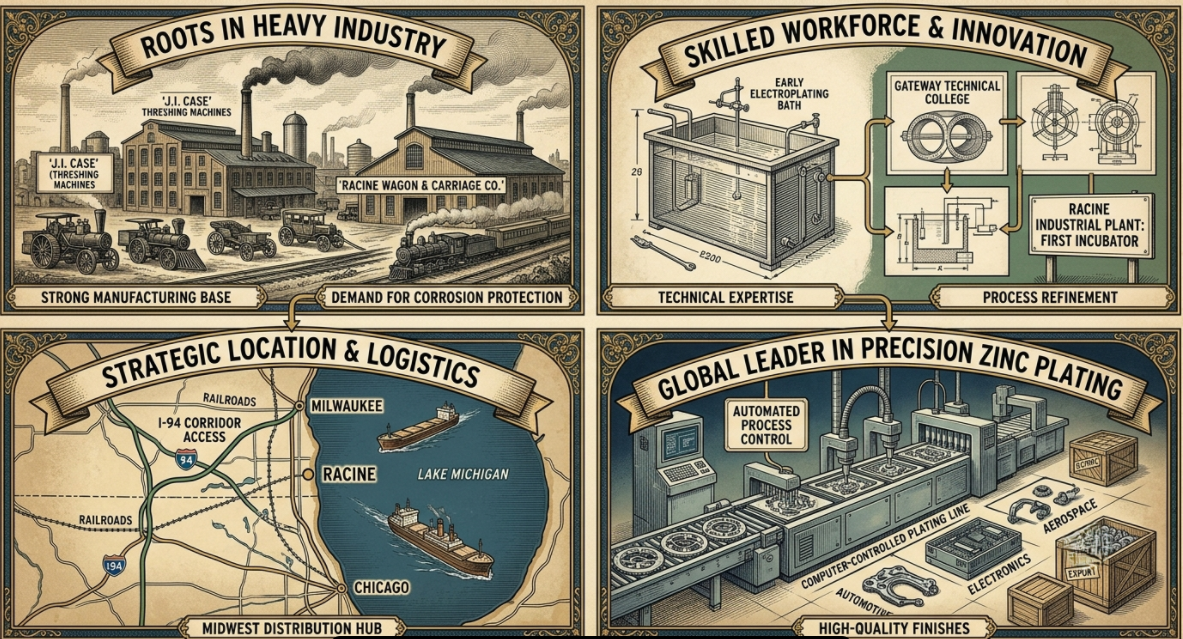
Racine’s manufacturing identity didn’t start with plating. It started with heavy industry that needed metal finishing as a downstream necessity, not as a standalone specialty. By the early 20th century, Racine had already established itself as a serious industrial city on the shore of Lake Michigan, home to major manufacturers producing everything from farm implements to precision tools to household products, many of which are still recognizable national and international brands today.
That density of manufacturing mattered enormously for what came next. A city full of companies producing steel components, mechanical assemblies, and precision hardware creates sustained, high-volume demand for the finishing processes those parts need before they ship, plating, painting, heat treating, and inspection. Manufacturing hubs don’t just need production capacity, they need the entire supporting ecosystem of processes that turn raw fabricated steel into a finished, corrosion-protected part ready for assembly or sale. Racine had that ecosystem forming around it decades before most of the country started thinking seriously about outsourced metal finishing as its own industry.
This is a pattern worth understanding for any manufacturer evaluating a regional plating cluster the strongest ones didn’t get built because a group of platers decided to open shop somewhere convenient. They got built because a genuine, sustained manufacturing base created the volume and the specification complexity that turned metal finishing into a specialized trade with its own dedicated companies, rather than a task handled inconsistently in-house by dozens of different manufacturers with varying degrees of expertise.
Why This History Actually Matters to a Buyer Today
A plating hub built on genuine, long-standing manufacturing density tends to produce platers with deep, practical fluency in the specifications that actually matter locally OEM requirements, ASTM standards common to the region’s dominant industries, and the process nuances specific to the parts that get made nearby. That’s a different, more reliable kind of expertise than a plater who set up shop somewhere purely for lower real estate costs with no surrounding industrial context to learn from.
Why Zinc Plating Specifically Took Hold in Racine
Manufacturing density alone explains why metal finishing in general became a serious local industry, but zinc plating specifically became the dominant finishing process in the region for reasons tied to what Racine’s manufacturers were actually producing.
A base of demanding OEM manufacturers. Racine and the surrounding Milwaukee-to-Chicago corridor developed a concentration of manufacturers producing industrial equipment, agricultural machinery, automotive components, and power tools, categories where corrosion resistance isn’t a cosmetic nice-to-have but a functional requirement tied directly to product performance and warranty exposure. That kind of demand rewards platers who can consistently meet exacting, well-documented specifications rather than platers offering a generic, one-size-fits-all coating.
A regional climate that makes corrosion protection non-optional. Wisconsin’s freeze-thaw winters, road salt exposure, and humid summers create genuine, unavoidable corrosion pressure on any exposed steel component. Manufacturers producing equipment that would actually be used in this climate, and shipped to other Midwest and northern states facing similar conditions, needed finishing partners who understood that pressure intimately rather than treating it as an abstract spec-sheet requirement.
Proximity to steel and fastener supply chains. The broader Milwaukee-Chicago-Racine industrial corridor has long been a center of steel production, fastener manufacturing, and precision machining. Zinc plating sits naturally downstream of that supply chain, and platers who located themselves within it gained a genuine logistics advantage, shorter transit times for both incoming raw parts and outgoing finished product, that compounds over thousands of orders a year.
A skilled, generationally rooted workforce. Metal finishing, done well, depends heavily on operator experience, understanding how a specific bath behaves as it ages, recognizing early signs of rectifier drift, knowing how a particular rack configuration affects coating uniformity on a complex part. Racine’s long manufacturing history means the workforce pool includes people who grew up around this kind of work, often with family members who worked in the same industry, which is a genuine advantage over a region trying to build plating expertise from scratch with a workforce new to the trade.
What “Precision” Actually Means in This Context
It’s worth pausing on the word precision, since it gets used loosely in a lot of industrial marketing. In the context of zinc plating, precision isn’t a vague quality claim, it refers to specific, measurable capabilities that separate a plater capable of serving demanding OEM supply chains from one that can only handle general commercial work.
Consistent coating thickness within tight tolerance bands. OEM specifications, particularly under ASTM B633’s service condition categories, require coating thickness to land within a defined range on every part, not just on average across a batch. Precision plating means a facility’s process controls, bath chemistry, current density, plating time, are dialed in tightly enough to hit that range reliably, run after run, rather than requiring frequent rework or producing wide variation between individual parts in the same lot.
Dimensional control on threaded and close-tolerance components. Many of the parts coming out of Racine’s manufacturing base, fasteners, precision brackets, machined components that mate with other assemblies, can’t tolerate a coating that meaningfully changes their dimensions. Precision plating means understanding exactly how much a given coating thickness will affect thread fit or a critical dimension, and controlling for it, rather than treating thickness purely as a corrosion-resistance number in isolation.
Traceability and documentation that survives an OEM audit. Automotive, agricultural, and industrial OEM programs increasingly require documented process control, batch traceability, and quality system certification as a condition of doing business, not just a good coating. Precision, in this sense, includes the paperwork and quality system discipline behind the plating line, not just the plating line itself.
Consistency across high-mix, variable-volume production. A lot of the demand coming out of a diverse manufacturing region like Racine isn’t one customer running a single part in enormous volume, it’s dozens of manufacturers each running smaller batches of many different parts, with different specifications, different base materials, and different geometries. Precision plating in this environment means the ability to switch between jobs without cross-contamination or process drift, maintaining tight quality on job one and job forty of the same week.
A Distinction Worth Making
“Precision zinc plating” is sometimes used as a marketing phrase without much behind it. When evaluating a Racine-area plater, or any plater claiming this capability, ask directly about coating thickness tolerance ranges they typically hold, how they handle dimensional control on threaded parts, and what traceability documentation they can provide per lot. A facility with genuine precision capability will answer these specifically; one using the term loosely will tend to answer in generalities.
Racine’s Geographic Advantage for Midwest Supply Chains
Beyond its manufacturing history, Racine occupies a genuinely useful position on the map for companies sourcing across the broader Midwest supply chain, and this geographic advantage is a real, practical factor rather than just a nice historical footnote.
Racine’s Position Relative to Major Midwest Manufacturing Centers
| Destination | Approximate Distance | Why It Matters |
|---|---|---|
| Milwaukee, WI | ~25 miles | Direct access to Milwaukee’s automotive and industrial supplier base |
| Chicago, IL | ~75 miles | Fast turnaround for one of the largest manufacturing corridors in the country |
| Rockford, IL | ~90 miles | Serves Rockford’s aerospace and precision machining cluster |
| Madison, WI | ~110 miles | Reaches Wisconsin’s state capital manufacturing and tech corridor |
| Green Bay, WI | ~150 miles | Extends coverage into northeastern Wisconsin’s paper and industrial base |
| Des Moines, IA | ~280 miles | Within practical range for agricultural equipment supply chains |
This positioning means a Racine-based plater can realistically serve as a same-region partner for manufacturers across a large stretch of the Midwest, not just companies located directly in Racine itself. For supply chains where transit time affects production scheduling, and where a rush order or a quality issue benefits from a plater who can turn parts around quickly or have a direct conversation with a customer’s quality team without a multi-day shipping delay in either direction, this geographic center-of-gravity is a genuine operational advantage, not just a convenience.
The Industries That Anchor Racine’s Plating Demand Today
Racine’s reputation as a plating hub isn’t sustained by nostalgia for its industrial past, it’s sustained by ongoing, active demand from specific industries that continue to require the kind of corrosion protection and dimensional precision the region’s platers have built their expertise around.
Industrial and power equipment manufacturing. Racine has long been associated with major producers of power tools, outdoor power equipment, and industrial machinery, industries where zinc plated fasteners, brackets, and structural components need to survive both manufacturing handling and years of field use in outdoor or harsh-environment conditions.
Agricultural equipment supply chains. The broader Wisconsin and Midwest region remains a major center of agricultural equipment manufacturing, and this industry places some of the most demanding corrosion resistance requirements on plated components of any sector, given the multi-decade service life expected of farm equipment operating in direct exposure to soil, moisture, and fertilizer chemicals.
Automotive and truck component suppliers. Southeast Wisconsin’s proximity to Milwaukee and the broader Midwest automotive supply base means Racine-area platers regularly serve tiered automotive suppliers who need documented process control and often IATF 16949 or OEM-specific certifications in addition to a baseline ISO 9001 quality system.
Construction and structural hardware fabricators. As covered in our companion piece on construction hardware specifications, Wisconsin’s building code environment and climate create sustained, serious demand for correctly specified zinc electroplating and hot-dip galvanizing across structural and semi-structural hardware used throughout the region’s construction industry.
What This History Means for Evaluating a Racine-Area Plating Partner
Understanding why Racine became a plating hub is useful background, but the practical question for a manufacturer sourcing plating today is what that history should actually change about how you evaluate a potential partner. A few things follow directly from everything above.
Regional history is a starting point, not a substitute for due diligence. A plater’s location in a historically strong manufacturing region tells you the surrounding ecosystem and talent pool exist, it doesn’t tell you that a specific company has kept pace with that ecosystem’s standards. Verify current ISO 9001 certification status, ask about specific OEM approvals relevant to your industry, and confirm the facility’s actual current capabilities rather than assuming regional reputation transfers automatically to any individual supplier.
Ask how a prospective partner’s history translates into current process discipline. A plater that’s operated in the region for decades has had time to accumulate genuine institutional knowledge about local OEM specifications and Wisconsin’s climate demands, but only if that knowledge has been actively maintained and passed down rather than lost to turnover. Ask directly about how long key quality and process staff have been with the company, and how the facility keeps pace with evolving OEM and ASTM standards.
Use geographic proximity as a genuine evaluation factor, not just a tiebreaker. If your supply chain runs through the broader Milwaukee-Chicago-Rockford-Madison corridor, sourcing from a centrally located Racine-area plater isn’t just a logistics convenience, it’s a meaningful factor in how quickly you can resolve a quality issue, accommodate a rush order, or have a direct, in-person conversation with a supplier’s quality team when something needs a closer look than a phone call allows.
Look for evidence of genuine industry-specific fluency, not general capability claims. A plater embedded in a region anchored by agricultural, automotive, and industrial equipment manufacturing should be able to speak specifically and confidently to the standards those industries actually require, ASTM B633 service conditions, OEM-specific approval programs, salt spray testing expectations, rather than offering only generic reassurances about quality and experience.
A Practical Checklist Before Committing to a Racine-Area Plater
Confirm current ISO 9001 (or IATF 16949, if applicable) certification directly, rather than relying on general reputation. Ask what specific OEM programs or industries make up the bulk of their current work, and whether that matches your own industry’s requirements. Request examples of the coating thickness tolerances and traceability documentation they typically provide. And ask how long their key quality and process personnel have been with the company, since institutional knowledge is only valuable if it’s actually been retained.
A History Still Being Written
Racine’s status as a Midwest precision zinc plating hub isn’t a static historical fact, it’s an ongoing outcome of decisions being made today by the manufacturers and platers still operating in the region. The manufacturing density that built this reputation a century ago is still present, if changed in its specific composition, and the climate, geographic, and industry pressures that made rigorous corrosion protection a serious local specialty haven’t gone anywhere either.
For a manufacturer evaluating where to source zinc plating for a Midwest supply chain, that ongoing history is genuinely useful context, it explains why a concentration of skilled, specification-literate platers exists in this specific region rather than being evenly distributed across the country. But it’s context that should inform your evaluation, not replace it. The right question isn’t simply “is this plater in Racine,” it’s “does this specific plater’s current certification, process discipline, and industry fluency actually match what my supply chain needs.”
Plateco has been part of that ongoing history since 1974, plating for Wisconsin and Midwest manufacturers across automotive, agricultural, industrial, and construction hardware supply chains, with the ISO 9001 certified process controls and regional specification fluency this piece has walked through. If you’re evaluating a Racine-area plating partner for your own supply chain, we’re happy to walk through exactly what our process, certifications, and OEM experience can back up rather than just tell you.
Frequently Asked Questions
Is Racine still an active manufacturing hub, or is this mostly historical reputation?
Racine remains an active manufacturing center today, with a continuing base of industrial equipment, power tool, and component manufacturers operating in and around the city, alongside strong ties to the broader Milwaukee and Chicago manufacturing corridors. The historical density is real, but it’s sustained by ongoing current demand, not just legacy reputation.
Does sourcing zinc plating from a Racine-area supplier actually save meaningful time compared to an out-of-state supplier?
For manufacturers located within the broader southeast Wisconsin, Milwaukee, or northern Illinois corridor, yes, transit time to and from a Racine-area plater is typically measured in hours rather than the multiple days often required for an out-of-state or overseas supplier. That difference compounds significantly across a year of regular orders and matters even more when a rush order or a quality issue requires fast turnaround.
What industries specifically drive demand for precision zinc plating in the Racine area today?
Industrial and power equipment manufacturing, agricultural equipment supply chains, automotive and truck component suppliers, and construction and structural hardware fabrication are the primary industries currently anchoring demand for precision zinc plating in the Racine region, each bringing its own specific corrosion resistance and documentation requirements.
Does a plater’s long history in Racine guarantee they’re ISO 9001 certified or capable of meeting OEM specifications?
No. Longevity in a historically strong manufacturing region indicates access to an experienced workforce and a surrounding industry ecosystem, but it doesn’t substitute for verifying a specific company’s current certification status, process capabilities, and OEM approvals directly. Always confirm these details independently rather than assuming regional history guarantees current capability.
How does Wisconsin’s climate specifically shape what “precision” means for platers in this region?
Wisconsin’s freeze-thaw cycling, road salt exposure, and humid seasonal swings create genuine, unavoidable corrosion pressure on exposed steel components, which means platers in this region have had to develop real expertise in specifying and hitting the higher end of ASTM B633 service conditions (typically SC3 and SC4) rather than defaulting to minimum coating thicknesses that might be adequate in a milder climate.
If I’m not located near Racine, does any of this still matter to my supply chain?
Yes, if your supply chain runs through or near the broader Milwaukee-Chicago-Rockford-Madison corridor, a Racine-area plater can realistically serve as a regional partner without requiring you to be located in Racine itself. Even for manufacturers further away, understanding what makes a plating hub genuine, versus a marketing claim, is useful for evaluating any regional supplier’s actual credibility.
Ready to Source From a Plater Rooted in This History?
Tell Us About Your Project
Plateco has been zinc plating for Wisconsin and Midwest manufacturers since 1974, with the ISO 9001 certified process controls and industry-specific specification fluency that Racine’s manufacturing history has built into the region. Send us your drawings and we’ll walk you through exactly what our facility can back up.