

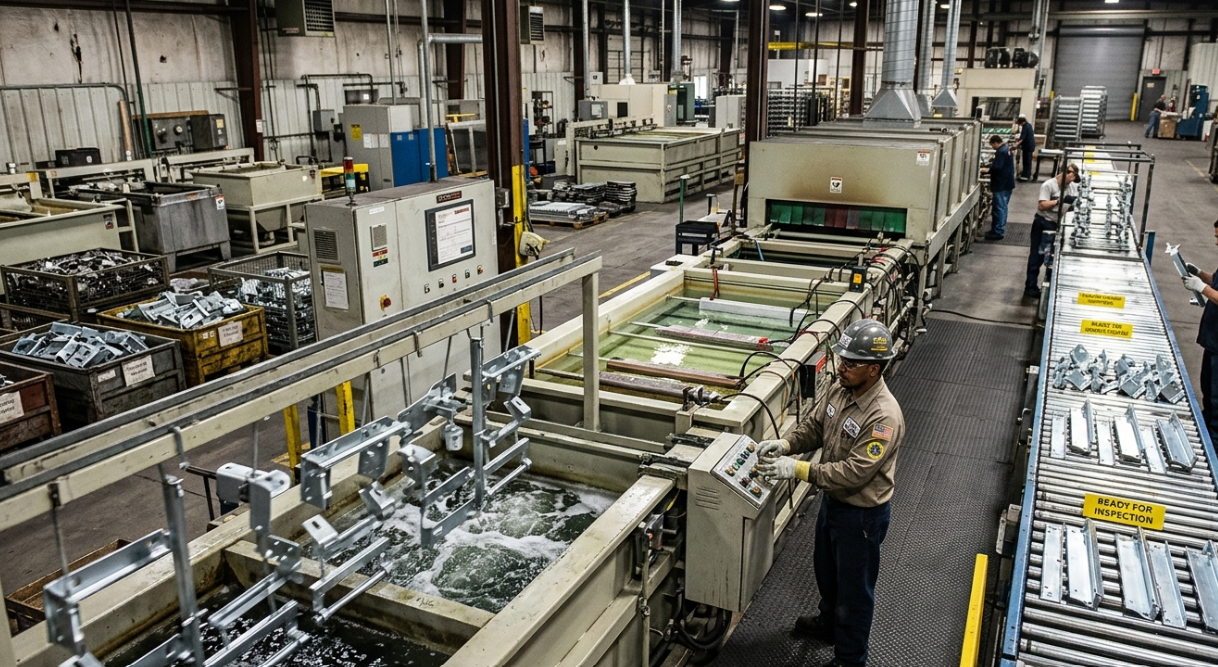
You approved the design, finalized the purchase order, and handed the parts to your plater. Now your production line is waiting. If you’ve ever found yourself in that position refreshing your inbox for a ship notification that hasn’t arrived this guide was written for you. Understanding what drives zinc plating lead times, and knowing exactly how to shorten them, is the difference between a smooth production schedule and a missed customer delivery.
At Plateco, we’ve been zinc plating parts for manufacturers across Wisconsin and the Midwest since 1974. Lead time is one of the most common questions buyers ask before placing an order and one of the most misunderstood. This guide gives you a complete, honest picture: what standard lead times look like, what causes delays, what you can do before you submit your order to minimize turnaround, and how to legitimately expedite a job when time is critical.
What Are Typical Zinc Plating Lead Times?
Lead times in zinc plating are not one-size-fits-all. They vary based on the plating method, job complexity, part volume, and how well the order is prepared when it arrives. Understanding the typical ranges and what puts a job at the fast or slow end of that range is the first step to building a production schedule that holds.
Standard Lead Time Ranges by Process
| Process Type | Typical Lead Time | Best For | What Can Extend It |
| Zinc Barrel Electroplating | 3–5 business days | High-volume small parts, fasteners, hardware | Incomplete specs, large batch backlogs, secondary processes |
| Zinc Rack Electroplating | 4–7 business days | Large parts, complex geometry, tight tolerances | Custom racking requirements, multiple passivate systems |
| Zinc Mechanical Galvanizing | 3–6 business days | Brittle parts, heat-sensitive metals, high-strength fasteners | Special certifications, post-process testing requirements |
| Rush / Expedited | 1–2 business days | Emergency production needs, line-down situations | Availability of capacity, completeness of submitted specs |
These are standard commercial lead times under normal shop load. They assume a complete, correctly specified order submitted with clean parts or raw stock that doesn’t require special pre-treatment. As you’ll see below, several common variables can push a job toward the longer end of these ranges or beyond them.
What Actually Drives Zinc Plating Lead Times?
When a buyer asks why their parts aren’t ready yet, the answer almost always falls into one of five categories. Understanding these factors gives you real leverage to shorten turnaround on your next order.
1. Order Completeness and Specification Clarity
This is the single biggest controllable driver of lead time. An order that arrives with a complete, unambiguous specification ASTM B633 service condition, passivate type, dimensional requirements, and any applicable OEM spec references goes directly into the production queue. An order with missing or contradictory information sits in a hold queue while someone at the plating shop calls or emails you for clarification.
Every hour spent resolving a specification question is an hour of lead time consumed before a single part touches a plating line. At Plateco, when we receive a vague spec, we contact the customer before we process anything because running parts to the wrong spec costs everyone more time than waiting for the right answer. But that communication cycle adds real days.
Real Cost of Vague Specs
A specification that says ‘zinc plate’ with nothing else can add 24–72 hours to your lead time before the job even starts just from the spec clarification cycle. Multiply that by the number of line items on your order and you’ll see why complete specs are the fastest thing you can do to shorten turnaround.
2. Part Condition and Pre-Treatment Requirements
Zinc plating is only as good as the surface it’s applied to. Parts that arrive with heavy rust, oil contamination, laser scale, welding slag, or heat treatment discoloration require additional pre-treatment steps cleaning, descaling, pickling, or blasting before they can enter the plating line. Each pre-treatment step adds time.
Parts that arrive clean, free of surface contamination, and without excessive oxidation go into the plating process fastest. If your parts come off a CNC machine, laser cutter, or press brake and go immediately into packaging for shipping to the plater, they’re almost always in good condition. Parts that have sat in a warehouse, outdoor storage yard, or shop corner for weeks may require more prep work.
3. Current Shop Load and Scheduling Position
Even a perfectly specified, clean order takes time if the shop is at capacity when it arrives. Zinc plating facilities run barrel lines and rack lines on production schedules driven by order volume, and a new order joins the queue behind existing commitments. This is why established customers with regular volume have an advantage their orders are anticipated and scheduled proactively.
If your order arrives Monday morning at a shop that’s processing a large automotive run, your parts may not enter the plating line until midweek. That’s not a failure of service it’s a math problem of finite capacity. Buyers who build relationships with their plating partner, communicate upcoming orders in advance, and provide volume forecasts get better scheduling positions than buyers who call on Monday afternoon needing parts by Wednesday.
4. Secondary Processes and Special Requirements
Standard zinc plating with a single passivate system is the fastest path through a plating shop. Anything beyond that takes additional time. Secondary processes that extend lead times include:
- Multiple passivate systems on a single order (clear on some parts, yellow on others)
- Baking for hydrogen embrittlement relief (typically adds 4–8 hours at temperature per ASTM F519)
- Post-plate inspection or dimensional verification on threaded components
- Salt spray testing to verify coating performance before shipment
- Certification documentation for OEM or military specifications
- Masking to protect specific surfaces from plating
Each of these is a legitimate and often necessary process step. The key is to identify which ones your parts require before you submit the order, so the lead time estimate you receive accounts for all of them.
5. Lot Size and Part Geometry
Volume affects scheduling position. A large lot of 50,000 fasteners occupies barrel line capacity for longer than a small lot of 500. Conversely, very small quantities sometimes require scheduling around larger runs to maximize line efficiency. Oversized parts that must be rack plated individually may have longer per-part processing times than comparable-sized parts that can be racked in groups.
Complex geometry deep blind holes, recessed cavities, internal threads may require slower bath entry and exit rates to ensure adequate coverage. Your plater should account for this in their quoted lead time, but if they quote without seeing the part, the geometry question is worth raising explicitly.
How to Shorten Your Zinc Plating Lead Times: Before You Submit the Order
The most effective lead time reduction happens before you pick up the phone or send an email. Every item on this list is something you can control completely and each one saves time that would otherwise be spent resolving issues after the order is placed.
Submit a Complete, Correct Specification
Your drawing or purchase order should specify, at minimum:
- The governing standard (e.g., ASTM B633)
- The service condition number (SC1 through SC4)
- The passivate system (Type I hexavalent note: being phased out; or Type II trivalent clear, yellow, or black)
- Any OEM specification references (e.g., John Deere JDM, Caterpillar CAT spec number)
- Any post-process requirements (baking, testing, inspection, certification)
- Thread class or dimensional tolerance requirements affected by coating thickness
If your parts are going to an OEM customer who has their own zinc plating specification, ask them for the complete spec document and pass it to your plater verbatim. Don’t translate it into your own words give them the original document and a reference number. This eliminates a full cycle of specification questions and reduces your lead time by a day or more on complex orders.
Send Clean Parts
Parts that arrive at the plating shop ready to plate are parts that don’t spend time in pre-treatment. If your machining or fabrication process leaves parts with oil, cutting fluid, or oxidation, ask your plater what they need to see on arrival. Most plating shops have a preference for how parts are packaged and what level of cleanliness they expect, and aligning with that preference upfront saves a pre-treatment step.
If your parts have been sitting in storage, inspect them before shipping. Light surface rust can often be addressed quickly, but heavy scale, weld spatter, or contamination from other processes can add significant pre-treatment time and cost.
Communicate Volume and Scheduling in Advance
If you’re a buyer with regular zinc plating volume, your best scheduling tool is advance communication. Letting your plating partner know that you have a 10,000-piece fastener order coming in three weeks even before you have a formal purchase order to send allows them to plan capacity around your job. Shops that receive advance notice schedule those orders at the front of the queue when they arrive. Shops that receive surprise orders fit them in wherever capacity exists.
For production programs with regular cadence weekly or monthly plating runs tied to a manufacturing schedule work with your plating partner to establish a standing schedule. This effectively reserves capacity for your orders and eliminates scheduling uncertainty entirely.
Consolidate Your Order Correctly
Splitting an order across multiple purchase orders, multiple specifications, or multiple shipments adds administrative processing time at the plating shop. If you need parts plated to two different service conditions, put them on one purchase order with two line items rather than two separate orders. This reduces order entry time and makes scheduling more efficient.
Conversely, don’t artificially combine parts that have meaningfully different specifications or processing requirements in ways that could cause confusion. The goal is clarity, not just consolidation.
How to Expedite a Zinc Plating Order That’s Already Running Late
Sometimes, despite best planning, you need parts faster than the standard lead time allows. Here’s how to approach expediting realistically and effectively.
Call Before You Email
If a job is genuinely urgent, the fastest way to communicate that urgency is a phone call to your sales or customer service contact at the plating shop. Email is asynchronous it sits in an inbox until someone opens it. A phone call gets immediate attention and allows real-time discussion of what’s possible.
When you call, be specific: tell them which job number or purchase order is at issue, what your hard delivery requirement is, and what the business consequence is if that date isn’t met. “I need it by Thursday” is much more actionable than “can you hurry this up?” The more context you give, the better your plating contact can advocate for your order internally.
Ask About Rush Availability — Not Just Rush Willingness
Not every shop has capacity to expedite every job at any given moment. A shop running at full capacity with committed delivery dates to other customers genuinely may not be able to move your order to the front of the line without compromising someone else’s delivery. Ask not just whether they’re willing to expedite, but whether they actually have the capacity to do so.
At Plateco, we work to accommodate legitimate expedite requests whenever shop capacity allows. We’re honest when it isn’t possible, because promising a date we can’t meet creates a worse outcome than giving you an accurate timeline to plan around. The question to ask is: “What’s the earliest you can realistically get this out the door?”
Plateco’s On-Time Commitment
We are 95% on time, all of the time. If we deliver a plated part to you that you reject for a quality problem that’s our fault, you won’t be charged for that part. We’ll be honest: whenever you receive information from us, it will be 100% accurate based on the information we have. We’ll work cooperatively with you, because your success is our #1 priority.
Split the Lot If Possible
If you need a portion of your parts immediately and the rest can follow on standard lead time, ask your plating shop whether they can process a partial lot first. Processing 2,000 pieces now and the remaining 8,000 on the original schedule may be easier to accommodate than moving the entire 10,000-piece job to the front of the line. Partial releases are a common expediting technique that works well for high-volume orders.
Pre-Position Your Parts
For recurring programs where expedited delivery is a periodic need, consider keeping a small buffer stock of plated parts. This is a supply chain decision, not a plating shop decision but it’s worth raising in the context of lead time management. If you always seem to be expediting the same part number, the most cost-effective solution may be increasing your safety stock rather than paying expedite premiums repeatedly.
Know What Rush Service Actually Costs
Expedited plating typically carries a premium over standard pricing, reflecting the rescheduling cost and opportunity cost to the shop. Ask for the expedite premium in advance so you can make a fully informed decision. In most cases, the cost of expediting is modest compared to the cost of a line-down situation or a missed customer delivery. But you should know the number before you commit.
Lead Times by Industry: What Buyers in Your Sector Should Expect
Different industries have different typical order profiles, and those profiles affect lead times in predictable ways. Here’s what buyers in common zinc plating markets should plan for.
| Industry | Typical Lead Time | Common Lead Time Drivers | Best Practices |
| Automotive & Tier 1/2 Suppliers | 3–5 days standard | OEM spec documentation, trivalent passivate requirements, PPAP or first-article inspection | Submit OEM spec documents with first order; establish recurring schedule for production runs |
| Agricultural Equipment | 4–6 days standard | JDM spec compliance, salt spray test requirements, outdoor-rated passivate systems | Pre-approve spec documents with Plateco; plan for test time in lead time estimate |
| Construction Hardware | 3–5 days standard | Volume variation (seasonal), dual passivate needs, large-part racking | Forecast seasonal volume in advance; confirm racking requirements for large parts |
| Industrial Fastener & MRO | 2–4 days standard | High volume, stock replenishment cycles, multiple SC levels on same order | Establish blanket orders; use standing schedule for predictable replenishment |
| General Manufacturing / Job Shop | 3–5 days standard | Specification completeness, part condition, mixed lot types | Always include complete ASTM B633 spec with SC number and passivate type on PO |
The Plateco Advantage: Why Lead Times Are Shorter Here
Not all zinc plating shops are equally capable of hitting lead time commitments. At Plateco, several operational investments directly translate into faster, more reliable turnaround for our customers.
Dedicated Barrel and Rack Lines
Plateco operates dedicated zinc barrel electroplating and rack electroplating lines. Having both processes under one roof means we can route your parts to the most efficient process for their geometry and volume without coordinating between shops or waiting for outside capacity. For customers with mixed orders some parts suited to barrel, others to rack this eliminates a scheduling bottleneck entirely.
Plateco Transfer: Solving the Critical Shortage Problem
Plateco Transfer is our emergency transfer service for customers facing a critical parts shortage. If your current plating supplier has failed to deliver on time and you’re facing a line-down situation or a missed customer commitment, Plateco Transfer allows you to move your job mid-stream to our facility for expedited completion. We’ll assess the situation, communicate realistic timelines honestly, and do everything within our capacity to get your parts plated and shipped.
This service exists because we know that supply chain disruptions don’t always come from the source you’re watching. Sometimes your plater fails you at the worst possible moment. When that happens, Plateco Transfer is a real option not just a marketing claim.
95% On-Time Delivery — Documented and Accountable
Plateco’s on-time delivery rate is 95% across all jobs. This isn’t a marketing number it’s a documented operational metric that reflects the planning discipline, process control, and customer communication that go into every order. When we quote a lead time, we meet it 95% of the time. When we can’t, we tell you in advance not after the fact.
Our commitment is simple: On spec, on time, or it’s on us. If we deliver a part that fails for a quality reason that’s our fault, you don’t pay for it. If we miss a committed delivery date due to our own scheduling failure, we own the consequence. This accountability structure isn’t just good customer service it’s what drives the operational discipline that makes 95% on-time performance possible.
ISO 9001:2015 Certification: Process Consistency That Reduces Variability
Plateco is ISO 9001:2015 certified. This certification isn’t a trophy on a wall it’s a documented quality management system that governs every step of order intake, specification review, process setup, production execution, inspection, and shipment. Consistent processes produce consistent lead times. When your order arrives at Plateco, it moves through a system that’s been engineered for repeatability, not improvised on the fly.
For buyers who supply parts to OEM customers requiring supplier quality certifications, Plateco’s ISO 9001 certification is a supply chain asset it satisfies audit requirements and reduces the quality oversight burden you’d otherwise need to manage yourself.
Frequently Asked Questions About Zinc Plating Lead Times
How far in advance should I submit a zinc plating order?
For standard orders, submitting 5–7 business days before your needed ship date gives adequate buffer for a 3–5 day lead time plus incoming inspection on your end. For orders with secondary processes like baking or salt spray testing, add 2–3 business days. For high-volume orders or orders tied to a production schedule, 2–3 weeks advance notice allows your plating partner to schedule capacity proactively. The earlier you communicate the need, the more scheduling flexibility you both have.
Does lot size affect how long plating takes?
Yes, in both directions. Very large lots tens of thousands of pieces take longer to process simply because of the volume of parts moving through the line. Very small lots may also take slightly longer per-piece because they need to be scheduled around larger runs. Standard commercial lots in the hundreds to low thousands of pieces are generally processed at the fastest rates. If you have a very large or very small order, ask your plater how that volume affects their lead time estimate for your specific job.
Can I pick up my parts directly to save shipping time?
Yes, and this is an underused option for local or regional buyers. If your facility is close enough to your plating shop for a direct pickup, eliminating one-way shipping transit time can reduce your total cycle time by 1–2 days. At Plateco’s Reedsburg, Wisconsin facility, pickup is available for customers who can arrange it. Call in advance to confirm the parts are ready before driving out.
What happens if my plater misses a committed delivery date?
If your plating supplier misses a committed date, you should first ask for an honest update a revised ship date and the reason for the delay. If the miss is due to a shop issue rather than something you caused, you’re entitled to know that and to have it reflected in any repricing or expedite arrangements. If your supplier won’t give you a straight answer or misses dates repeatedly, that’s a signal to look at alternatives. At Plateco, we call customers proactively if a delivery is at risk before the original date, not after it’s already missed.
Does Plateco offer rush or expedited plating?
Yes. Plateco accommodates legitimate expedite requests based on current shop capacity. We’re honest when rush service is possible and equally honest when it isn’t because committing to a date we can’t meet creates a worse outcome than giving you an accurate timeline. If you’re facing a genuine urgency a line-down situation, a missed customer commitment at risk call us directly at (608) 524-8241 and explain the situation. We’ll tell you immediately what’s possible and at what cost.
Does changing the passivate system affect lead time?
For standard trivalent passivate systems clear, yellow, or black the choice of system has minimal effect on lead time. These are all in-line processes at most commercial shops. What does add time is requiring multiple different passivate systems on the same order, requiring post-passivate sealer topcoats, or specifying a non-standard passivate chemistry that isn’t part of the regular production line. Specify your passivate system on the purchase order so the shop can plan accordingly.
Ready to Get Your Parts Plated — On Time?
Plateco has been delivering zinc plating on spec and on time since 1974. Submit your specifications and we’ll give you an accurate lead time and meet it.
Request a Quote: plateco.net/rfq | Call: (608) 524-8241
1375 Industrial Street, Reedsburg, WI 53959