
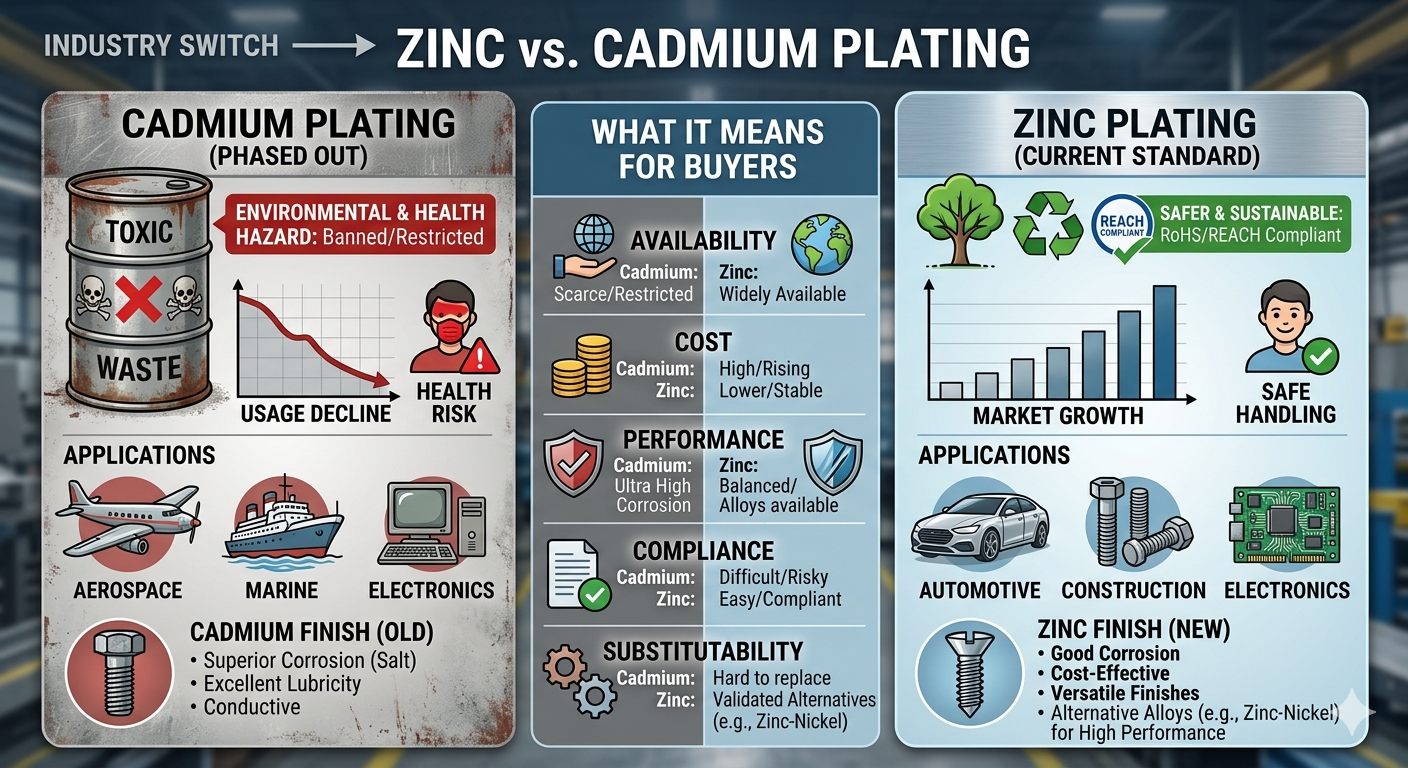
For most of the twentieth century, cadmium plating was the gold standard for corrosion protection in aerospace, defense, and marine hardware. Engineers trusted it. Militaries specified it. Factories ran it by the ton. Then, over several decades, the industry made one of its most consequential collective decisions: it switched — almost entirely — to zinc plating. Understanding that switch isn’t just industrial history. For procurement engineers, quality managers, and supply chain professionals who specify corrosion protection today, understanding why the switch happened — and what zinc plating has become as a result — is essential to making the right specification decisions.
What Cadmium Plating Actually Was
Cadmium is a soft, silvery-white metal that occupies a curious position in the periodic table — directly below zinc, in the same column, sharing many of zinc’s electrochemical properties. That chemical kinship is what made cadmium plating so attractive. Like zinc, cadmium protects steel through sacrificial galvanic protection: because cadmium is electrochemically less noble than steel, it corrodes preferentially, consuming itself to protect the substrate beneath. The steel doesn’t rust until the cadmium is entirely consumed.
What cadmium offered that zinc initially seemed unable to match was a combination of properties that made it uniquely suited to demanding environments. Cadmium plating adhered exceptionally well to steel, produced an aesthetically consistent silver-gray finish, and demonstrated outstanding resistance to saltwater corrosion — the critical failure mode for naval and marine hardware. It also had a relatively low coefficient of friction on fastener threads, which meant cadmium-plated bolts could be torqued to specification reliably, a quality that made it standard in aircraft assembly. The U.S. military specified it. Boeing specified it. For decades, “cadmium plated” was synonymous with premium corrosion protection.
The Hidden Cost of CadmiumCadmium is classified by the International Agency for Research on Cancer (IARC) as a Group 1 carcinogen — confirmed carcinogenic to humans. It is toxic to the kidneys, accumulates in biological systems, and does not break down in the environment. A single gram of cadmium can contaminate hundreds of thousands of liters of water. These facts were known long before regulations caught up to them.
The Industrial Switch: Regulation, Science, and Economics
The decline of cadmium plating as a mainstream industrial process was not a sudden event — it was a slow accumulation of regulatory pressure, scientific understanding, and economics that made its continued widespread use progressively untenable.
The Regulatory Wave Begins
The first serious restrictions on cadmium emerged in the early 1970s, driven by high-profile environmental disasters. The most significant was Japan’s Itai-itai disease outbreak in the Toyama Prefecture, where cadmium discharged from a mining operation contaminated rice paddies for decades, causing mass kidney failure and bone disease in the downstream population. The name translates roughly to “ouch-ouch disease” — a reference to the excruciating bone pain suffered by victims. It became one of the first recognized industrial pollution diseases and galvanized international awareness of cadmium’s toxicological hazards.
In the United States, the Clean Water Act of 1972 and subsequent EPA regulations began restricting cadmium discharge into waterways. For plating operations — which historically managed cadmium waste through rinse water discharge — this was operationally transformative. Cadmium waste treatment required expensive closed-loop water recycling systems, sludge handling facilities, and regulatory reporting. The cost of running a compliant cadmium plating line rose dramatically, and continued rising with each successive regulatory tightening.
The European Directives That Changed Everything
While U.S. regulations created operational headaches, the European Union’s directives created market-level exclusions. The RoHS Directive (2002/95/EC), restricting hazardous substances in electrical and electronic equipment, placed cadmium on the restricted list. REACH (Registration, Evaluation, Authorisation and Restriction of Chemicals), which followed, extended restrictions broadly across industrial chemical use. Annex XVII of REACH specifically restricts cadmium use in surface treatment — making it illegal to use cadmium plating in most industrial applications across EU member states.
For multinational manufacturers — automotive OEMs, agricultural equipment companies, industrial hardware suppliers — this created an immediate supply chain problem. A cadmium-plated fastener that was acceptable for a product sold in the U.S. military market was potentially non-compliant for the same product sold in Europe. Managing two separate supply chains for the same component type is expensive and error-prone. The rational solution was to transition entirely to compliant coatings — and zinc plating, already well-understood and widely used, was the natural alternative.
Zinc vs. Cadmium: Full Property Comparison
| Property | Zinc Plating | Cadmium Plating |
|---|---|---|
| Corrosion mechanism | Sacrificial galvanic — zinc oxidizes preferentially to protect steel | Sacrificial galvanic — cadmium oxidizes preferentially to protect steel |
| Salt spray performance (modern) | 500+ hours with trivalent passivate and sealer Industry standard | 200–500 hours (legacy systems, now rarely run) Mostly historical |
| Saltwater / marine resistance | Good; improved significantly with modern passivates | Excellent historically — cadmium’s key advantage |
| Regulatory status (EU) | Fully compliant — RoHS, REACH, ELV approved Compliant | Restricted under REACH Annex XVII; banned in most applications Restricted |
| Regulatory status (U.S.) | Fully compliant | Permitted in aerospace/defense with waivers; restricted in consumer products Limited use |
| Toxicity classification | Non-toxic; environmentally benign; zinc is an essential nutrient | IARC Group 1 carcinogen; kidney toxin; bioaccumulates in food chain Hazardous |
| Thread lubricity (fasteners) | Good with proper passivate; comparable to cadmium in modern formulations | Excellent — historically cadmium’s key advantage for threaded applications |
| Hydrogen embrittlement risk | Present in electroplating; mitigated with baking; eliminated in mechanical galvanizing | Same risk as zinc electroplating; similar mitigation required |
| Cost per component | Significantly lower — raw zinc cost and waste management are far cheaper | High — cadmium metal cost, regulatory compliance, and waste disposal all elevated |
| Availability | Widely available; major industrial process at hundreds of certified facilities | Severely limited — few facilities still run cadmium lines; long lead times |
| OEM approval status | Standard approval at Caterpillar, John Deere, Case/CNH, Parker, others | Progressively phased out in OEM specifications; exceptions shrinking |
| Passivate chemistry options | Clear, yellow, black, olive drab — wide range of finishes and performance tiers | Limited modern passivate development; chemistry largely frozen |
How Zinc Plating Closed the Performance Gap
The fair criticism of zinc plating — for much of its history — was that it simply couldn’t match cadmium’s performance in marine and high-salinity environments. That criticism was accurate in its time. The zinc plating processes of the 1960s and 1970s, using cyanide bath chemistry and simple chromate passivation, could not reliably achieve the corrosion resistance that cadmium offered as a matter of course. The regulatory pressure to switch arrived before the technology was fully ready. What followed was decades of intensive development that ultimately produced a zinc plating capability that, by virtually every practical measure, meets or exceeds what cadmium could deliver.
The Passivate Revolution
The single most important development in closing the zinc-cadmium performance gap was the maturation of chromate conversion coating chemistry — the passivate layer applied over bare zinc after electrodeposition. Bare zinc develops white corrosion products rapidly when exposed to moisture. Passivation seals the zinc surface with a dense, protective conversion layer that dramatically extends the time before corrosion appears. The development of progressively more effective passivate formulations — from basic clear chromate, to thick-film yellow chromate, to the high-performance trivalent systems required by RoHS compliance — transformed zinc plating’s achievable performance ceiling.
Modern trivalent yellow passivate systems, combined with optimized sealers, routinely achieve 500+ hours of neutral salt spray resistance on properly plated and post-treated zinc. This was a figure that seemed aspirational in the 1970s. It represents a genuine technological step-change driven largely by the commercial necessity of making zinc plating work well enough to replace cadmium across demanding industrial applications.
Alkaline Non-Cyanide Chemistry
The shift from cyanide-based zinc bath chemistry to alkaline non-cyanide formulations, which began in earnest in the 1970s and became dominant by the 1990s, also contributed significantly to improved zinc deposit quality. Alkaline zinc chemistry produces a finer-grained, more ductile deposit than cyanide chemistry — better suited to the post-plating bending and forming operations that many automotive and industrial components undergo. It also improved bath control and consistency, reducing the deposit thickness variation that had made early zinc plating performance unpredictable.
“The zinc plating of today bears approximately the same relationship to the zinc plating of 1970 as a modern fuel-injected engine does to a carburetor. The underlying principle is the same. The precision, reliability, and performance are not.”
— Plateco Engineering Archive
Where Cadmium Still Holds On — and Why It Won’t Last
Cadmium plating has not disappeared entirely. In narrow applications — primarily U.S. defense and aerospace hardware operating under MIL-SPEC QPL approvals — cadmium remains in use, protected by regulatory exemptions and the conservative qualification culture of the defense supply chain. The logic is straightforward: a material that is specification-qualified and has decades of real-world field performance data behind it is difficult to replace in systems where failure modes are catastrophic and requalification is expensive.
But even this last redoubt is shrinking. The U.S. Department of Defense has been actively working to substitute zinc-nickel and zinc-cobalt alloy plating for cadmium in military applications — driven both by the environmental and occupational health burden of running cadmium lines in defense facilities, and by the recognition that the performance of advanced zinc-alloy plating now meets military corrosion protection requirements. When the DoD — historically the most conservative adopter of any materials change — is actively moving away from cadmium, the trajectory is clear.
The Shrinking Case for CadmiumFewer than a handful of certified cadmium plating facilities remain operational in the U.S. Lead times are long, costs are high, and the regulatory burden continues to increase. Even applications with current exemptions are being re-examined as zinc-alloy alternatives mature.
Zinc’s Expanding CapabilityModern zinc electroplating with trivalent passivation and advanced sealers achieves 500+ hour salt spray performance. Zinc-nickel alloy plating pushes performance beyond 1,000 hours, closing the final gap with cadmium in the most demanding marine environments.
Hydrogen Embrittlement: The Issue Buyers Must Understand
One technical issue that frequently arises when buyers specify zinc plating for high-strength fasteners and structural components is hydrogen embrittlement — and it is worth addressing directly, because it is both genuinely important and frequently misunderstood.
Hydrogen embrittlement is a phenomenon in which hydrogen atoms, introduced during electroplating processes, diffuse into the crystalline structure of high-strength steel and reduce its ductility and fracture toughness. Under sustained tensile stress, an embrittled fastener or component can fail catastrophically at stress levels well below its rated tensile strength — sometimes hours or days after installation. The risk increases with steel hardness: parts with core hardness above Rockwell C34 (approximately 1100 MPa tensile strength) are generally considered at-risk and require post-plate embrittlement relief baking.
It is important to understand that hydrogen embrittlement is not a zinc-specific problem — it affects cadmium electroplating equally. The mechanism is the same: both processes introduce hydrogen into the steel through the electrochemical reduction of water during the plating reaction. The historical association with zinc rather than cadmium is largely a result of cadmium’s earlier dominance in high-strength fastener applications, and the less rigorous post-plate baking practices of earlier eras.
Hydrogen Embrittlement Relief — What ASTM SpecifiesASTM B633 and related standards require that steel parts with hardness of Rockwell C34 or higher, or those cold-worked to induce tensile stresses, be baked at 375°F (190°C) for a minimum of 3 hours within 4 hours of electroplating to allow hydrogen to diffuse out of the steel lattice.
For applications where even low residual embrittlement risk is unacceptable — such as high-strength structural fasteners — zinc mechanical galvanizing offers a complete solution: the process deposits zinc through mechanical impaction rather than electrochemistry, introducing no hydrogen into the substrate. This makes it the preferred specification for Grade 8 and higher fasteners in critical structural applications.
The Three Zinc Processes: Which One Is Right for Your Application?
Modern zinc plating is not a single process — it encompasses three commercially distinct methods, each with its own performance characteristics, geometry capabilities, and application sweet spots. Understanding which method is appropriate for a given component is the first decision a specifying engineer must make.
The workhorse of the zinc plating industry. Thousands of parts tumble simultaneously in a rotating perforated barrel submerged in electrolyte. Continuous rotation ensures every surface — including threads, recesses, and blind holes — receives current and deposits zinc uniformly. Best suited to high-volume production of small to medium parts: fasteners, stampings, springs, brackets, and hardware. Cost per part is lowest of any zinc method. The trade-off is part-on-part contact during tumbling, which can cause minor cosmetic contact marks — acceptable for most functional hardware, unacceptable for cosmetically critical surfaces.
Individual parts are fixtured on conductive racks and immersed through the plating sequence without contact with other parts. This eliminates the contact mark risk of barrel plating and allows precise control of current density at specific points on complex geometries. Rack plating can achieve coating thickness tolerances of ±0.0001 inch — essential for close-tolerance components where dimensional control is critical. Best suited to large parts, cosmetically sensitive parts, and components with complex geometry that would be damaged or produce inconsistent results in a barrel environment. Higher cost and lower throughput than barrel plating.
An entirely different process: parts, glass beads, water, and zinc powder are tumbled together in a rotating drum. The mechanical energy of the tumbling action drives the zinc powder into the steel surface through cold welding — depositing a thick, dense zinc coating without any electrochemical current. Because no hydrogen is generated in the process, mechanical galvanizing carries zero hydrogen embrittlement risk. This makes it the preferred specification for high-strength fasteners, grade 8 and higher bolts, and any application where hydrogen embrittlement is a disqualifying concern. Produces slightly less uniform deposit thickness than electroplating, and is generally more economical for thick coating requirements than thin ones.
Reading the Spec: What ASTM B633 Actually Means for Buyers
The governing standard for electrodeposited zinc on iron and steel is ASTM B633. For any buyer specifying zinc-plated components, understanding how this standard works — and how to match the service condition classification to the actual operating environment — is the single most consequential specification decision available to them.
ASTM B633 establishes four service condition classifications, each with a minimum zinc thickness requirement:
The most common specification error buyers make is under-specifying service condition — choosing SC 2 or SC 3 for components that will see SC 4 conditions because the thicker coating carries a higher unit cost. In the field, the cost of this decision is measured in premature corrosion failures, warranty claims, and equipment downtime — invariably more expensive than the incremental plating cost of the correct specification.
OEM Specifications: When ASTM Is Just the Starting Point
For buyers operating in automotive, agricultural equipment, or heavy machinery supply chains, ASTM B633 compliance is typically a floor, not a ceiling. Major OEMs maintain proprietary zinc plating specifications that layer additional performance requirements, documentation standards, and process control criteria on top of the ASTM baseline. Plateco holds active approvals under specifications from John Deere, Caterpillar, Case/CNH, and Parker Hannifin — each of which imposes requirements that go substantially beyond ASTM compliance alone.
John Deere’s plating specifications, for example, require specific salt spray performance minimums at each service condition tier, defined passivate types, hydrogen embrittlement test requirements for high-hardness parts, and formal material compliance documentation traceable to each production lot. Caterpillar’s specifications similarly require documented process capability data demonstrating statistical control of deposit thickness, not just compliance of sampled parts. These are not bureaucratic exercises — they are the mechanisms through which OEMs ensure that their supply chains deliver consistent, verified corrosion protection to the field.
What to Ask Your Zinc Plating Supplier
What the Switch Means for Buyers Today: A Practical Guide
The transition from cadmium to zinc plating as the industrial standard is, for virtually all practical buyers today, complete. The relevant question is no longer “should I specify zinc over cadmium?” — for most applications, the answer is simply yes, and may be legally required. The relevant questions for today’s buyers are about how to specify zinc plating correctly, and how to identify the suppliers capable of delivering it to specification consistently.
Match Service Condition to Real Operating Environment
As discussed above, the most consequential specification decision is matching the ASTM B633 service condition classification to the actual corrosion exposure the component will see. Coastal equipment, agricultural machinery exposed to fertilizers and irrigation, and components in industrial processing environments all require SC 4 specification and the thick zinc deposits and robust passivation systems that specification implies. Applying SC 2 specification to components that will see SC 4 conditions is false economy that reliably produces field failures.
Specify Passivate Type Explicitly
Not all zinc plating is the same thickness and not all passivation is equivalent. A specification that says only “zinc plated per ASTM B633 SC 3” leaves the passivate type undefined. For maximum corrosion resistance, trivalent yellow passivate with sealer should be explicitly specified. Where a black finish is required, confirm that the supplier’s black passivate formulation meets the salt spray requirement — black passivates vary significantly in performance between suppliers.
Address Hydrogen Embrittlement Explicitly for High-Strength Parts
For parts with core hardness above Rockwell C34, specify post-plate embrittlement relief baking per ASTM F519 or the applicable OEM specification. For Grade 8 fasteners and above, strongly consider zinc mechanical galvanizing as an alternative to electroplating — the process eliminates the embrittlement risk entirely, not merely mitigates it.
Audit Your Supplier’s Quality System, Not Just Their Quote
The zinc plating industry is stratified. At one end are commodity plating operations with minimal process documentation, informal chemistry management, and no formal quality management system. At the other are precision finishing operations with ISO 9001 certification, OEM approvals, automated production lines, and documented quality metrics. The price difference between these tiers is real but modest — typically cents per part. The performance difference in the field can be substantial. A supplier who cannot provide ISO certification, OEM approval documentation, and a specific defect return rate is not a precision plating operation, whatever their quote says.
The Future of Zinc Plating: What’s Coming Next
The transition from cadmium to zinc is complete — but zinc plating technology itself continues to evolve. Three developments are shaping its near-term trajectory.
Zinc-Nickel Alloy PlatingZinc-nickel alloy electroplating, with 12–15% nickel content, delivers corrosion resistance exceeding 1,000 hours of neutral salt spray — closing the final performance gap between zinc and cadmium in the most demanding marine and chemical environments. Now actively displacing cadmium in defense and aerospace applications.
Advanced Sealer SystemsNanoparticle-reinforced organic sealers applied over zinc passivate are pushing achievable corrosion performance beyond 1,000 hours even on standard zinc electroplate. These systems allow existing equipment and chemistry to achieve previously unattainable performance tiers.
Closed-Loop SustainabilityModern zinc plating operations are increasingly adopting closed-loop rinse water recovery, zero-discharge waste treatment, and energy-efficient rectification. The environmental profile of zinc plating — already orders of magnitude cleaner than cadmium — continues to improve.
Digital Quality TransparencyERP-integrated production records, real-time chemistry monitoring, and customer-facing batch traceability portals are becoming the expectation for OEM-tier supply chains. The era of the paper quality certificate as the endpoint of traceability is ending.
The shift from cadmium to zinc plating was not simply a regulatory compliance exercise — it was the catalyst for one of the most productive periods of process development in the metal finishing industry’s history. The need to make zinc plating work well enough to replace cadmium, across the full range of demanding industrial applications, drove decades of chemistry refinement, process automation, and quality system development that produced a coating capability genuinely superior to what cadmium ever offered.
For buyers today, the practical implication is both simple and consequential: specifying zinc plating correctly — the right service condition, the right passivate, from a supplier with the process discipline to deliver it consistently — provides corrosion protection that meets or exceeds what cadmium delivered, without the toxicological risk, regulatory burden, or supply chain fragility that cadmium carried. The switch the industry made was the right one. Knowing how to specify the result of that switch is the buyer’s job.
Plateco, Inc. has operated at the leading edge of zinc plating technology since 1974 — through the alkaline chemistry transition, the RoHS trivalent shift, and the full automation era. With two fully automated production lines, ISO 9001:2015 certification, OEM approvals from John Deere, Caterpillar, Case/CNH, and Parker Hannifin, and a documented customer return rate below 0.22%, Plateco represents the standard of precision zinc plating that the industry’s evolution has made possible.
“We treat zinc plating as an extremely complex process demanding state-of-the-art technology, painstaking planning, obsessive quality control, and a tremendous amount of talent. Because our customers don’t come to us for excuses — they come to us for perfection. And we’ll do whatever it takes to give them nothing less.”
— Jim Schweich, Chief Executive Perfectionist, Plateco, Inc.