

Introduction: You Got the Salt Spray Results. Now What?
You specified zinc plating for your steel parts. Your plater ran them through a salt spray chamber. The test report came back with hours to white corrosion and hours to red corrosion. And now you are staring at a table of numbers wondering whether those results are good, bad, acceptable, or cause for concern.
You are not alone. Salt spray testing is one of the most widely used quality control tools in metal finishing and one of the most commonly misunderstood. Engineers and procurement professionals who specify zinc plating regularly receive salt spray data without a clear framework for interpreting what it actually means about their parts’ real-world performance.
This guide is written to change that. Whether you are new to zinc plating specifications or a seasoned engineer trying to make sense of test data from your plating vendor, this article will walk you through exactly what salt spray testing is, how it works, what the results mean, and how to use that information to make better decisions about your parts.
What Is Salt Spray Testing?
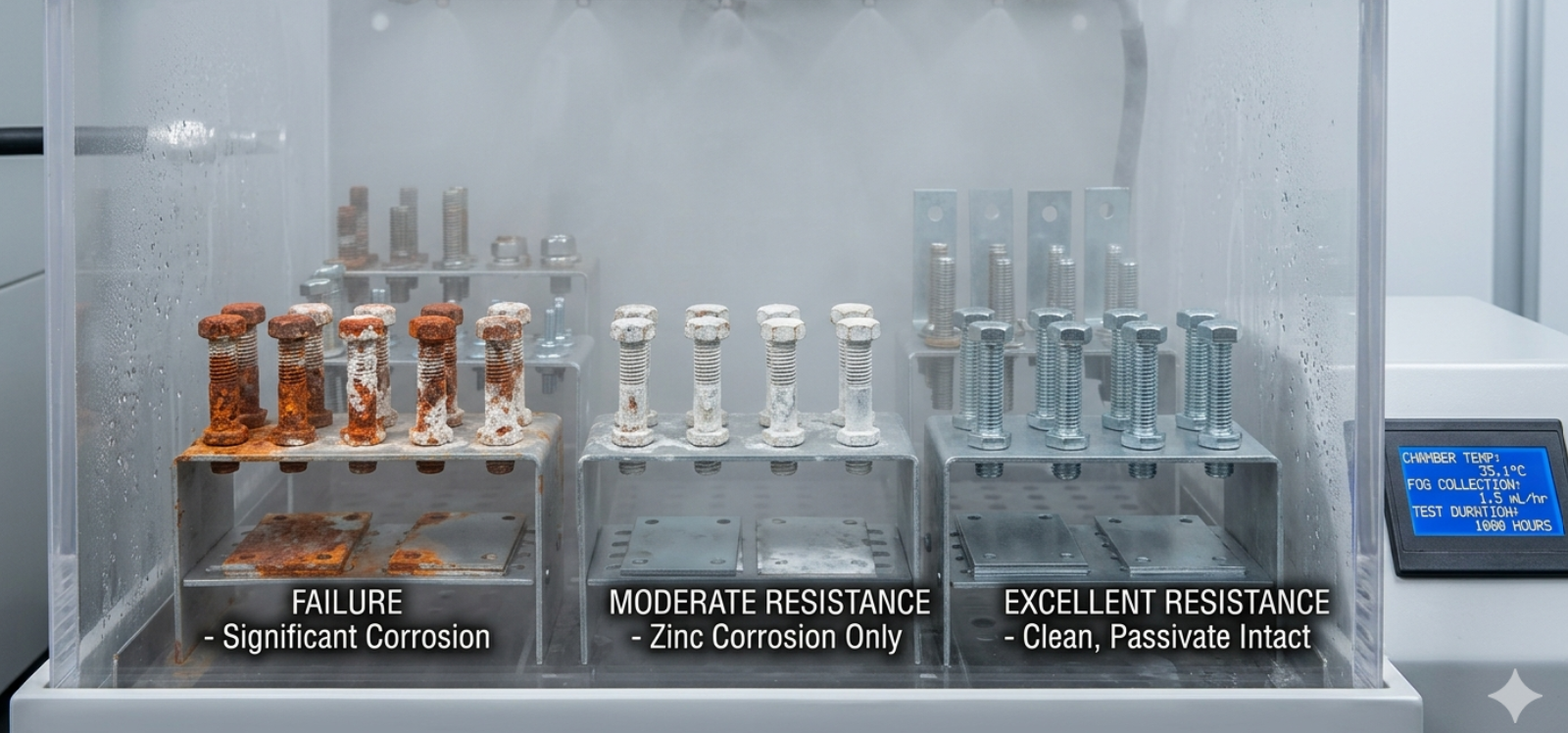
Salt spray testing also called salt fog testing or neutral salt spray testing is an accelerated corrosion test used to evaluate the protective performance of a coating or finish applied to metal parts. The test exposes parts to a highly concentrated, controlled environment of saline mist to simulate the kind of corrosion that parts would experience in real-world exposure over a much longer period of time.
The test is governed by two primary standards that you will encounter when working with zinc platers:
ASTM B117 is the most widely referenced standard in North America. It specifies the equipment, test conditions, and procedures for running a salt spray test, including the concentration of the sodium chloride solution (5%), the temperature inside the chamber (35°C / 95°F), and the angle at which parts must be positioned inside the chamber.
ISO 9227 is the international equivalent, used more commonly in European specifications and global supply chains. The two standards are very similar in their requirements and produce comparable results, though there are some procedural differences.
When a plating company says their salt spray chamber is “set up per ASTM B117 / ISO 9227,” that is a meaningful statement. It means the test conditions are controlled and calibrated to a recognized standard, which makes the data comparable and defensible. At Plateco, our salt spray chamber is set up per ASTM B117 / ISO 9227 and checked daily by certified lab personnel to ensure performance compliance which means when we give you salt spray data, you can trust it.
What Happens Inside the Salt Spray Chamber?
Parts are placed inside a sealed chamber where a fine mist of 5% sodium chloride solution is continuously sprayed throughout the test duration. The chamber maintains a precise temperature, and parts are positioned at a specific angle to ensure proper drainage of solution across all surfaces.
The parts are then monitored at regular intervals typically every 24 hours and inspected for two specific types of corrosion:
White corrosion (also called white rust): This is the first sign of degradation in a zinc-plated part. White corrosion is zinc oxide forming on the surface of the zinc coating itself. It appears as a chalky, white or gray powdery deposit. Importantly, white corrosion does not mean the underlying steel is corroding it means the zinc is doing its job, sacrificing itself to protect the base metal. However, once the zinc coating is significantly consumed, the underlying steel becomes exposed.
Red corrosion (also called red rust or base metal corrosion): This is the appearance of iron oxide classic rust on the surface of the part. The appearance of red rust indicates that the zinc coating has been depleted enough in that area that the underlying steel is now exposed to the corrosive environment. This is the critical failure point for a zinc-plated part.
Test results are reported as the number of hours it took for each type of corrosion to first appear: “hours to first white corrosion” and “hours to first red corrosion.” These are the two numbers you will see in a salt spray test report.
Understanding the Two Stages of Results
Stage 1: Hours to White Corrosion
The appearance of white rust marks the beginning of the zinc coating’s consumption. How quickly this happens depends on several factors:
- The thickness of the zinc deposit
- The presence and quality of a passivate (chromate) coating
- The type of passivate applied
- The quality of the plating process itself
A part with no passivate coating at all might begin showing white corrosion in as little as 12 to 24 hours. A part with a high-quality trivalent clear passivate might not show white corrosion until 72, 96, or even 120 hours. A part with a trivalent yellow passivate which provides stronger barrier protection can often push well past 200 hours to white corrosion.
White corrosion hours are particularly important for parts that will be visible or cosmetically inspected in service. Even if red rust never develops during the service life of a part, visible white corrosion can be aesthetically unacceptable in many applications.
Stage 2: Hours to Red Corrosion
This is usually the number that matters most from a structural and functional standpoint. Red rust means the steel itself is corroding. Depending on the application, this can mean loss of structural integrity, dimensional changes, seized fasteners, or warranty claims.
The hours-to-red-rust number tells you how effectively the complete coating system zinc plus passivate protects the base metal before being depleted. This is the number that most engineering specifications focus on when setting corrosion resistance requirements.
Common benchmark requirements for zinc-plated parts vary widely by industry and application:
- Automotive hardware and fasteners often require 96 to 200 hours to red rust
- Agricultural and construction equipment parts (John Deere, Case CNH, Caterpillar specs) frequently require 120, 200, or even 240 hours to red rust depending on the component
- General industrial hardware specifications may require as little as 48 to 96 hours
Understanding what your specific specification calls for and whether your plater’s results are meeting it is the core of salt spray data interpretation.
The Role of Passivates in Salt Spray Performance
One of the most important factors determining salt spray results and one that is frequently not well understood by engineers who specify zinc plating is the passivate or chromate coating applied over the zinc.
Zinc plating on its own provides a modest level of corrosion protection. The real performance gains come from the passivate layer that is applied on top of the zinc after plating. Passivates create a chemical conversion coating on the zinc surface that dramatically slows the rate of white corrosion and extends the time to red rust.
Here is a practical comparison of common passivate types and their general effect on salt spray performance:
Trivalent Clear Passivate: The most common passivate used in general industrial zinc plating. Produces a clear to slightly blue iridescent appearance. Provides meaningful improvement over bare zinc, typically targeting 72 to 120 hours to white corrosion and 120 to 200 hours to red corrosion depending on zinc thickness. This passivate is REACH and RoHS compliant.
Trivalent Yellow Passivate: Produces a yellow-gold iridescent appearance. Provides stronger barrier protection than trivalent clear, often targeting 200+ hours to white corrosion. Also REACH and RoHS compliant. Widely used in agricultural and construction equipment applications where higher corrosion resistance is required.
Trivalent Black Passivate: Used when a black aesthetic is required. Provides corrosion protection comparable to trivalent yellow passivates. REACH and RoHS compliant.
Hexavalent Black and Olive Drab Passivates: These passivates contain hexavalent chromium and generally provide the highest levels of corrosion resistance among passivate options. However, they are not REACH or RoHS compliant and are increasingly restricted or prohibited in many industries and markets, particularly automotive and electronics. These should only be specified where compliance is verified and permitted.
The passivate specification is not a cosmetic choice it is a corrosion performance decision. If your parts are not meeting salt spray requirements, the answer is often not more zinc thickness but a different or better-applied passivate.
How Zinc Coating Thickness Affects Salt Spray Results
Alongside the passivate, zinc coating thickness is the other major variable driving salt spray performance. Simply put, more zinc means more sacrificial material, which means more hours before the underlying steel is exposed.
Zinc coating thickness is specified and measured in different units depending on the standard being used. The most common references you will encounter:
Mils (thousandths of an inch): Common in American engineering specifications. One mil equals 0.001 inches.
Microns (micrometers): Used in metric and international specifications. One micron equals approximately 0.04 mils.
The ASTM B633 standard — which Plateco plates to, along with John Deere (JDM), Case (CNH), Caterpillar (CAT), Parker Hannifin, and numerous other OEM specifications defines four service conditions with corresponding minimum zinc thickness requirements:
- SC1 (Mild): 5 microns minimum for indoor use with minimal exposure to moisture
- SC2 (Moderate): 8 microns minimum for indoor or sheltered outdoor applications
- SC3 (Severe): 12 microns minimum for outdoor applications with significant exposure
- SC4 (Very Severe): 25 microns minimum for harsh outdoor or industrial environments
The relationship between coating thickness and salt spray performance is real but not perfectly linear. Doubling the zinc thickness does not exactly double the hours to red rust the passivate layer, plating uniformity, and surface preparation quality all interact with thickness to produce the final result. This is why experienced platers pay as much attention to process control as they do to the nominal thickness specification.
What Salt Spray Testing Does NOT Tell You
Here is something critically important that many engineers do not fully appreciate: salt spray test results are an accelerated simulation, not a direct prediction of real-world service life.
Salt spray testing compresses years of outdoor exposure into hours of chamber time by using an extremely aggressive corrosive environment much more aggressive than almost any real-world condition a part would actually encounter. This means that salt spray hours do not translate directly to months or years of field performance on a one-to-one basis. A part that achieves 200 hours in a salt spray chamber will not necessarily last exactly 200 hours outdoors.
The value of salt spray testing is comparative and specification-driven, not predictive. It tells you:
- Whether a coating system meets a defined minimum performance threshold
- Whether one coating system outperforms another under controlled conditions
- Whether your plating vendor’s process is consistent from batch to batch
- Whether a change in passivate, thickness, or process has improved or degraded corrosion performance
What it does not tell you is exactly how long your parts will last in the field. Field performance depends on actual environmental conditions temperature cycles, humidity, UV exposure, mechanical stress, contact with dissimilar metals, cleaning chemicals, and dozens of other variables that a salt spray chamber does not replicate.
Use salt spray data as a qualification and quality control tool, not as a direct field life prediction.
Common Reasons Salt Spray Results Fail to Meet Specifications
When a zinc-plated part fails to meet its salt spray requirement, the cause is almost always traceable to one of several root causes:
Inadequate surface preparation. This is perhaps the most frequent source of salt spray failures and the most preventable. Zinc adhesion depends entirely on clean, contaminant-free steel at the surface. Oil, weld flux, heat treat scale, drawing compounds, and other manufacturing residues left on parts before plating create areas where zinc does not adhere properly, which become early failure points in salt spray testing. A plater with superior cleaning capabilities as Plateco has developed through years of process refinement produces parts that achieve more consistent and predictable salt spray performance because the zinc is adhering to clean steel across the entire surface.
Insufficient zinc thickness. If the plating process is not consistently depositing the specified minimum thickness across all surfaces of the part, some areas will fail before others. Thickness variation is a process control issue that requires careful monitoring of bath chemistry, current density, and part positioning (in the case of rack plating) or barrel loading and rotation (in barrel plating).
Passivate application problems. The passivate layer must be applied correctly at the right concentration, temperature, and immersion time to develop full protective capability. A passivate that is under-applied or improperly rinsed will underperform in salt spray testing even when the zinc thickness is adequate.
Post-bake passivate degradation. Parts that require hydrogen embrittlement relief baking which involves exposing parts to elevated temperatures for extended periods present a particular challenge. The passivate layer cannot withstand baking temperatures and dehydrates during the bake cycle, which means parts must be returned to the plating line for a fresh passivate application after baking. Platers who do not manage this process correctly produce parts that appear properly plated but have compromised passivate coverage, which shows up immediately in salt spray testing. At Plateco, we address this directly through our conveyor belt baking process followed by re-passivation.
Edge and recessed area coverage. Zinc plating does not deposit uniformly on all surfaces of a complex part. Edges, threads, deep recesses, and blind holes receive less zinc than flat, exposed surfaces. These low-coverage areas are often where salt spray failures first appear. Process selection barrel vs. rack plating, chloride vs. alkaline bath significantly affects how well zinc reaches these challenging geometries.
How Plateco Approaches Salt Spray Testing
At Plateco, salt spray corrosion testing is integrated into our broader quality management system as both a customer service and an internal quality control tool.
Our salt spray chamber operates per ASTM B117 / ISO 9227, and it is checked daily by certified lab personnel to ensure that chamber conditions temperature, solution concentration, spray rate, and pH are consistently within specification. This daily verification matters because an uncalibrated or poorly maintained chamber produces data that is not reproducible or meaningful.
We offer salt spray testing for specific components as part of PPAP (Production Part Approval Process) submissions, which is a common requirement when qualifying a plated part for automotive, agricultural, or industrial OEM production programs. We also provide supplemental salt spray data for customers who need to validate coating performance for their own quality programs or customer requirements.
Because our entire focus is zinc plating we do not dilute our expertise across chrome, copper, iron phosphate, or other processes our lab team has deep, specialized knowledge of how zinc plating variables affect salt spray performance. When a customer brings us a part that is not meeting its corrosion requirement, we have the process knowledge to diagnose the root cause and recommend the right solution, whether that means a different passivate, a higher thickness specification, a different plating process, or a different cleaning approach.
Reading a Salt Spray Test Report: A Practical Walkthrough
When you receive a salt spray test report from your plating vendor, here is what to look for:
Test standard: Confirm the report references ASTM B117 or ISO 9227. If the standard is not specified, the data is not meaningfully interpretable.
Chamber calibration: Look for a statement that chamber conditions were verified. Solution concentration, temperature, and pH should be documented.
Part identification: The report should clearly identify the parts tested part number, finish specification, and the passivate type applied.
Sample size: How many parts were tested? A single part is not statistically meaningful. A sample of three to five or more parts gives you a more reliable picture of process capability.
Hours to white corrosion: Recorded when the first white rust appears on any tested part. Compare this to your specification’s minimum requirement if one exists.
Hours to red corrosion: Recorded when the first red rust appears on any tested part. This is the critical pass/fail criterion for most specifications.
Failure area description: A good test report notes where corrosion first appeared edges, flat surfaces, threaded areas which helps diagnose process issues if the results are not meeting requirements.
Pass/Fail determination: The report should explicitly state whether the results meet the applicable specification.
Salt Spray Data Is Only as Valuable as the Process Behind It
Salt spray test results are a window into the quality and consistency of a zinc plating process. When those results are strong and consistent batch after batch, they tell you that your plating vendor has the process under tight control from surface preparation through zinc deposition through passivate application. When results are erratic or falling short of specification, they signal a process that needs attention.
The numbers on a salt spray report do not generate themselves. They are the product of cleaning quality, bath chemistry control, thickness management, passivate selection and application, post-bake re-passivation, and dozens of other process variables that must all be executed correctly and consistently to produce parts that perform.
Understanding what salt spray results mean and what drives them puts you in a far stronger position to specify the right coating system for your application, evaluate the quality of your plating vendor’s work, and make informed decisions when results do not meet expectations.
At Plateco, we have been pursuing perfection in zinc plating since 1974. Our quality and lab teams approach salt spray testing with the same precision and meticulous mindset that we bring to every step of our plating process. Whether you need salt spray testing for a PPAP submission, supplemental corrosion data, or simply a plating partner whose process produces consistent, specification-meeting results we are ready to help.
Ready to Talk About Your Parts?
Get zinc plating and salt spray testing from a team that has specialized in zinc and only zinc since 1974. Contact the Plateco Team
Frequently Asked Questions
Q: What is the difference between white corrosion and red corrosion in a salt spray test?
White corrosion is zinc oxide forming on the surface of the zinc coating it means the zinc is sacrificing itself to protect the steel underneath, which is exactly what it is supposed to do. Red corrosion is iron oxide (rust) forming on the steel itself, meaning the zinc coating in that area has been fully consumed. White corrosion is a performance milestone; red corrosion is the primary failure criterion for most zinc plating specifications.
Q: How many salt spray hours should I specify for my zinc plated parts?
It depends on the application and the environment the parts will be used in. General indoor industrial hardware might only need 48 to 96 hours to red rust. Outdoor agricultural or construction equipment components are frequently specified at 120 to 240 hours. Automotive specifications vary widely by OEM. Your specification ASTM B633 service condition, John Deere JDM, Case CNH, Caterpillar CAT, Parker Hannifin, or another will typically define the minimum salt spray requirement. If you are setting your own requirement, consider the harshness of the end-use environment and the service life expectation for the part.
Q: Does a thicker zinc coating always mean better salt spray results?
Thicker zinc does generally extend time to red rust, but it is not the only factor. Passivate type and quality have an equally significant effect on performance. A thin zinc deposit with an excellent passivate can outperform a thick zinc deposit with a poorly applied or inappropriate passivate. Surface preparation quality also plays a major role zinc that adheres to a clean, properly prepared surface performs better than zinc on a contaminated surface, regardless of thickness.
Q: Can Plateco run salt spray testing for my PPAP submission?
Yes. Plateco’s quality and lab teams provide salt spray testing for PPAP submissions and supplemental corrosion data. Our chamber is set up per ASTM B117 / ISO 9227 and checked daily by certified lab personnel. While Plateco is not A2LA accredited, our testing data is accurate, consistent, and suitable for many customer quality program requirements. Contact our sales team to discuss your specific PPAP testing needs.
Q: What passivate should I use if my parts are not meeting salt spray requirements?
This is a process-specific question that depends on your current coating system, thickness, and target performance level. In general, upgrading from trivalent clear to trivalent yellow passivate provides a meaningful increase in corrosion resistance. Increasing zinc thickness to meet a higher ASTM B633 service condition may also be appropriate. The best approach is to contact your plating vendor with your current spec and test results a knowledgeable plater can diagnose the gap and recommend the right solution.
Plateco, Inc. is a family-owned, perfection-obsessed zinc plating company located in Wisconsin, serving manufacturers across the country since 1974. We specialize exclusively in zinc plating barrel electroplating, rack electroplating, and mechanical galvanizing — with salt spray testing, hydrogen embrittlement relief baking, and specialized packaging among our additional services. ISO 9001:2015 compliant. REACH and RoHS compliant on all trivalent passivate coatings.
Call us at (608) 524-8241 or reach out at sales@plateco.net