
When an automotive part fails in the field, the consequences extend far beyond a warranty claim. A corroded bracket, a seized fastener, or a degraded structural component can mean recalls, liability, and — most critically — safety risks. For engineers responsible for specifying surface finishes, zinc plating is one of the most important decisions in the entire parts development process.
Yet, for all its prevalence in automotive manufacturing, zinc plating is frequently misunderstood, underspecified, or left as an afterthought in the design phase. Engineers who treat it as a simple commodity process often encounter quality problems that trace back to that early oversight.
This guide is written specifically for automotive engineers — whether you're working in powertrain, chassis, body, or fastener engineering — who want to understand zinc plating at a level that makes them better specifiers, better suppliers, and better decision-makers.
Why Automotive Parts Are Uniquely Demanding
The automotive environment is one of the harshest any metal part can encounter. Consider the conditions a typical steel component faces across its service life:
Moisture exposure is constant. From road spray and rain to condensation inside door panels and engine bays, steel is perpetually at risk of oxidation. Add road salt — used extensively in cold climates — and the corrosive load multiplies dramatically. Salt accelerates electrochemical corrosion in ways that can destroy an unprotected steel surface in a matter of months.
Beyond moisture and salt, automotive parts endure thermal cycling, chemical exposure from fuels and fluids, mechanical vibration, and occasional abrasion. A surface finish that performs adequately in a benign industrial environment may fail rapidly under real-world automotive conditions.
For engineers, this means the surface finish specification is not a cosmetic decision — it is a functional one. The right zinc plating process, applied with the right thickness and post-treatment, is what stands between a durable component and a premature failure.
What Zinc Plating Actually Does (The Engineering Explanation)
Zinc plating deposits a thin layer of metallic zinc onto a steel substrate using an electrical process called electrodeposition. A direct current causes zinc ions from a plating bath to migrate to and bond with the surface of the part, forming a continuous, adherent coating.
The protection zinc provides operates on two levels:
Barrier Protection — The zinc layer physically separates the steel from moisture, oxygen, and corrosive agents in the environment. As long as the coating is intact, the underlying steel is shielded.
Galvanic (Sacrificial) Protection — This is where zinc plating becomes genuinely remarkable from an engineering standpoint. Zinc is anodic relative to steel in the electrochemical series, which means that when both metals are exposed to an electrolyte (such as moisture), zinc corrodes preferentially. It sacrifices itself to protect the steel. Even if the coating is scratched or damaged — as inevitably happens in assembly, handling, and service — the zinc surrounding the damaged area continues to cathodically protect the exposed steel. The base metal does not rust immediately. It waits.
This sacrificial mechanism is why zinc plating outperforms many other coating methods in real-world automotive conditions. Paint and powder coatings provide excellent barrier protection but offer no galvanic protection. Once the coating is scratched, the steel beneath is unprotected. Zinc continues to protect even after damage, which explains its dominance in fastener and chassis applications.
White rust — the white powdery oxidation that appears on zinc surfaces over time — is not a sign of failure. It is zinc oxide forming a passivation layer that slows further corrosion. It indicates the coating is actively doing its job.
The Core Zinc Plating Processes: What Engineers Should Specify
Understanding which plating method is appropriate for a given part is one of the most important specification decisions an engineer makes. There are three primary processes used in automotive applications:
Zinc Barrel Electroplating
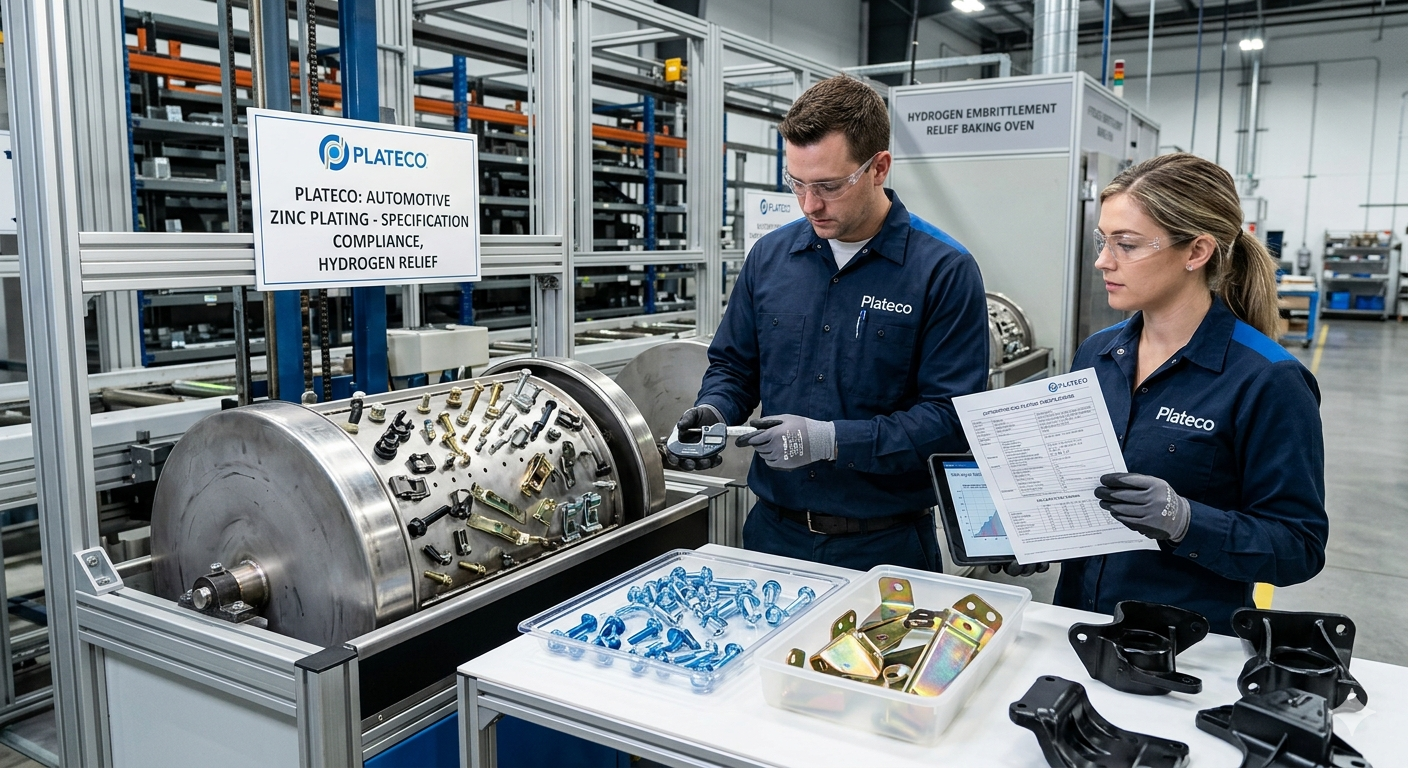
Barrel plating is the workhorse of automotive zinc plating. Parts are loaded into a rotating perforated barrel that is submerged in the plating bath. As the barrel rotates, parts tumble through the solution, achieving zinc coverage on all exposed surfaces.
Barrel plating is ideal for high-volume, small-geometry parts: bolts, nuts, washers, clips, springs, retaining rings, and similar fasteners. It is highly cost-effective and suited for components where minor cosmetic variation is acceptable. Because parts tumble against one another in the barrel, it is not appropriate for parts with critical surface finishes, close-tolerance threads that cannot accept contact damage, or thin-wall parts susceptible to deformation.
For the vast majority of automotive fasteners — which are produced in enormous quantities and must meet strict corrosion performance requirements at a competitive cost — barrel electroplating is the right answer.
Zinc Rack Electroplating
In rack plating, individual parts are mounted on conductive racks and immersed in the plating bath. Because each part hangs independently without contact with other parts, the process delivers superior surface uniformity, tighter thickness control, and a higher-quality cosmetic finish.
Rack plating is specified for larger components (brackets, stampings, housings), parts with complex geometries requiring uniform coverage, components with tight dimensional tolerances, and parts where surface appearance is a functional requirement — such as visible exterior hardware.
The trade-off is cost and throughput. Rack plating requires more labor per part and runs at lower volume than barrel plating. For high-value, large, or geometrically complex components, however, it is clearly the correct choice.
Zinc Mechanical Galvanizing
Mechanical galvanizing uses an entirely different mechanism. Instead of electrodeposition, zinc powder is tumbled with parts in the presence of glass beads and chemical promoters. The mechanical impact causes the zinc particles to cold-weld to the surface, building a coating layer by layer.
Mechanical galvanizing produces thicker coatings than most electroplating applications and has a significant engineering advantage: it is essentially free of hydrogen embrittlement risk. Because no electrical current is used, there is no hydrogen absorption during the process. For high-strength fasteners — Grade 10.9 or 12.9 bolts, for example — mechanical galvanizing is often the safest choice, eliminating the need for post-plate baking and its associated logistical complexity.
It is widely used for structural fasteners in automotive chassis, suspension, and powertrain applications where hydrogen embrittlement is a primary concern.
Hydrogen Embrittlement: The Critical Engineering Risk
No discussion of zinc plating for automotive applications would be complete without addressing hydrogen embrittlement — one of the most serious quality risks in the entire process.
During electroplating, the electrochemical reactions that deposit zinc also produce hydrogen gas. Some of this atomic hydrogen diffuses into the steel substrate. In high-strength steel (typically defined as steels with tensile strength above 1,000 MPa or hardness above approximately 32 HRC), the absorbed hydrogen can cause delayed fracture under stress. The part may appear fine immediately after plating, pass all incoming inspections, be installed in a vehicle — and then fail catastrophically hours, days, or weeks later under load.
This is not a theoretical risk. Hydrogen embrittlement failures in automotive fasteners have caused significant recalls and serious incidents. Engineers specifying zinc plating for high-strength components must understand the risk and the mitigation.
The standard mitigation for electroplated high-strength parts is hydrogen embrittlement relief baking: heating parts to a specified temperature (typically 375–400°F / 190–205°C) within a defined time window after plating (typically within four hours), and holding them at that temperature for a minimum duration (typically eight to twenty-four hours). This thermal treatment drives absorbed hydrogen out of the steel before it can cause damage.
This is governed by industry standards including ASTM F1941 (electrodeposited coatings on threaded fasteners) and SAE J157 (performance requirements for automotive zinc plating). When specifying zinc plating for high-strength automotive fasteners, engineers must ensure their plating supplier has ovens capable of meeting the required bake cycle and a documented process control system to verify compliance.
For components at or above the strength threshold, mechanical galvanizing should be seriously evaluated as an alternative, precisely because it avoids the embrittlement risk at the source.
Coating Thickness: Getting the Specification Right
Coating thickness is the single most important variable determining how long a zinc-plated part will survive in service. The relationship is direct: thicker zinc means more sacrificial material available to protect the steel, which means longer corrosion protection life.
Automotive zinc plating specifications typically express thickness in microns (µm) or mils. Common specifications include:
5–8 µm — Light-duty applications, interior fasteners protected from direct environmental exposure. Offers basic corrosion protection.
8–12 µm — Standard automotive specification for most exterior fasteners and components. Typically provides 96–200+ hours of salt spray resistance per ASTM B117 before red rust appears on the steel substrate.
12–25 µm — Heavy-duty automotive applications, underbody and chassis components with significant exposure to road salt and moisture.
These thickness ranges are often paired with passivation treatments (trivalent chromate in modern automotive specifications, as hexavalent chromate is now restricted under automotive industry environmental requirements such as EU ELV directive and REACH). Passivation significantly extends salt spray performance — often by a factor of three to five times — by adding a second layer of chemical protection over the zinc.
When writing a zinc plating specification, automotive engineers should define not just the minimum thickness, but also the test method, acceptance criterion, and salt spray requirement (typically expressed as minimum hours to first red rust per ASTM B117). This gives the plating supplier the performance target, not just a dimensional requirement.
Automotive Industry Standards Engineers Must Know
Zinc plating for automotive parts is governed by a web of standards. Engineers specifying surface finishes should be familiar with the most commonly referenced:
ASTM B633 — Standard specification for electrodeposited coatings of zinc on iron and steel. Defines service condition classifications from SC1 (mild) through SC4 (very severe) and corresponding minimum coating thicknesses.
ASTM F1941 — Electrodeposited coatings on threaded fasteners, covering threading requirements and dimensional considerations after plating.
SAE J157 — Performance requirements for electrodeposited zinc coatings on automotive fasteners, including salt spray and embrittlement relief requirements.
ISO 4042 — International standard for threaded fasteners — electroplated coatings, widely referenced by OEM specifications.
OEM-Specific Standards — Most major automotive OEMs (GM, Ford, Stellantis, Toyota, Honda, BMW, VW) publish their own material and surface finish standards that layer specific requirements on top of the base industry standards. Engineers working in the supply chain must identify which OEM standards apply to their parts and ensure their plating suppliers can meet them.
Suppliers who carry ISO 9001 certification provide an important baseline assurance that their quality management system meets international standards — but automotive engineers should also look for IATF 16949 capability, PPAP documentation support, and IMDS material compliance for the coatings used.
Common Failure Modes and How to Prevent Them
Understanding how zinc-plated automotive parts fail helps engineers write better specifications and select better suppliers. The most common failure modes are:
Premature Red Rust — Corrosion of the base steel appears well before the end of the expected service life. Root causes include insufficient coating thickness, inadequate surface preparation before plating, poor passivation, or damage during handling and assembly. Prevention requires adequate thickness specification, strict surface prep process control, and attention to packaging and handling procedures.
Blistering or Flaking — The zinc coating separates from the substrate in blisters or flakes. Almost always caused by inadequate surface cleaning before plating. Oils, heat treat scale, or oxide layers prevent proper adhesion. A quality plating supplier will have robust, multi-stage cleaning systems and incoming part inspection to catch contamination before it causes failures.
Hydrogen Embrittlement Fracture — As discussed above, most likely for high-strength components. Prevention: proper bake relief, mechanical galvanizing for very high-strength parts, and supplier process verification.
Threading Problems After Plating — Zinc builds up on thread forms, potentially causing fit issues in assembly. Engineers specifying plating on threaded fasteners must account for coating thickness in their dimensional tolerances. Plating on threads must comply with requirements for thread go/no-go gauge acceptance after plating.
Leaded Steel Issues — Steel alloys containing lead (used for improved machinability) present significant challenges in zinc plating. Lead at the surface can prevent proper adhesion and cause blistering or incomplete coverage. Engineers should flag leaded steel materials to their plating supplier in advance so appropriate pre-treatment steps can be incorporated.
Choosing a Zinc Plating Partner for Automotive Work
Given the stakes — safety, quality, compliance, and supply chain reliability — the selection of a zinc plating supplier is a critical sourcing decision for automotive engineers. The lowest-cost bidder is rarely the right answer.
When evaluating a zinc plating supplier for automotive applications, engineers should assess:
Quality System Maturity — Does the supplier hold ISO 9001 certification or higher? What is their documented defect rate? Can they provide customer return rate data? Suppliers who are transparent about their quality metrics and committed to continuous improvement are far more reliable long-term partners.
Process Capability — Does the supplier have the right combination of barrel and rack plating capability, hydrogen embrittlement relief ovens, and passivation systems to handle your part mix? Can they meet your required specifications and OEM standards?
Cleaning and Surface Preparation — Ask directly about their cleaning system. The number of stages, the chemistry used, and the process controls around cleaning are among the strongest predictors of plating quality.
On-Time Delivery Performance — In automotive supply chains, delivery reliability is non-negotiable. A supplier who meets your specification but ships late is a production risk. Ask for documented on-time delivery performance data.
Technical Support — Can the supplier's team engage technically with your engineering team on specification questions, unusual materials, or process challenges? A partner who understands the engineering requirements of automotive applications — not just the plating chemistry — adds genuine value.
At Plateco, these principles are not aspirations — they are operational commitments. With a second-quarter 2025 return rate of 0.13% and a 95% on-time delivery performance, Plateco's numbers reflect a culture that treats zinc plating as the technically demanding, precision-driven process it truly is. That commitment matters when your parts end up in vehicles.
A Final Word for Automotive Engineers
Zinc plating is not a commodity. The difference between a well-plated automotive part and a poorly plated one may be invisible at incoming inspection — but it becomes very visible three years into a vehicle's service life when corrosion begins appearing on supposedly protected components.
Engineers who invest time in understanding zinc plating — the processes, the standards, the failure modes, and the supplier selection criteria — are investing in the durability and safety of the products they build. That knowledge pays dividends every time a part makes it through ten Wisconsin winters without a trace of red rust.
If you're specifying zinc plating for automotive components and want to work with a supplier who takes the process as seriously as you do, request a quote from Plateco or call us at (608) 524-8241. We're here to help you get it right — on spec, on time, every time.