

If you manufacture small metal components at scale — think bolts, fasteners, clips, stampings, or machine screws — you’ve probably heard the term zinc barrel electroplating. But what exactly does it mean, and why does it matter for your parts?
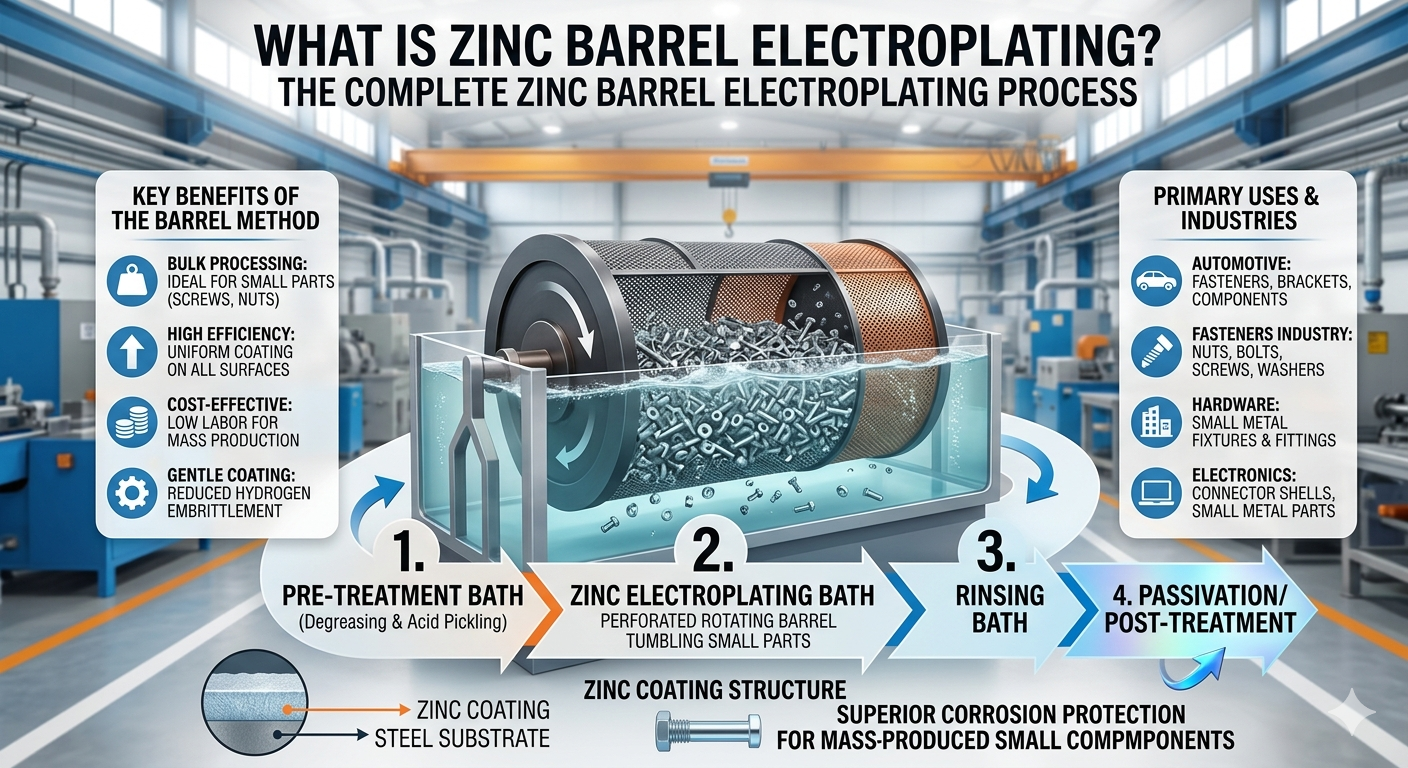
At its simplest, zinc barrel electroplating is an electrochemical process that coats steel parts with a thin layer of zinc for corrosion protection. What makes it “barrel” plating is the method of delivery: instead of hanging individual parts on racks, hundreds or thousands of small components are tumbled together inside a rotating perforated barrel submerged in a zinc electrolyte solution.
As electrical current flows through the solution, zinc ions deposit onto the surfaces of every part in the barrel simultaneously. The result is a durable, uniform zinc coating that acts as a sacrificial shield — protecting the underlying steel from rust and corrosion far longer than uncoated metal ever could.
In plain terms: Zinc barrel electroplating is the industry-standard method for giving small steel parts long-lasting corrosion resistance in a fast, cost-efficient, high-volume process.
Zinc barrel plating is not a new technology — it has been a cornerstone of metal finishing for decades. Yet it remains highly relevant today because of its unmatched ability to process massive quantities of small components without sacrificing coating quality. For manufacturers in industries like automotive, agriculture, construction, and industrial machinery, this process is practically indispensable.
How the Zinc Barrel Electroplating Process Works
Understanding the steps involved in zinc barrel electroplating helps manufacturers know what to expect in terms of quality, timing, and part specifications. Here’s a breakdown of the complete process from start to finish.
1 Bulk Part Loading
Large quantities of small steel components are loaded into a perforated rotating barrel. The perforated design allows plating solution to flow freely through the barrel while maintaining electrical contact between parts as they tumble. High-volume barrel lines like those at Plateco can process up to 800 pounds per barrel load.
2 Cleaning & Surface Preparation
Before any plating occurs, parts must be rigorously cleaned. This involves degreasing to remove oils and lubricants, acid pickling to strip surface oxides and mill scale, and thorough rinsing to eliminate any contamination. This step is critical — any residue left on the surface can compromise adhesion and cause plating defects that affect the entire batch.
3 Zinc Deposition in the Electrolyte Bath
Once cleaned, the barrel is lowered into a zinc electrolyte solution. Electrical current passes through the solution, causing zinc ions to migrate and deposit onto the negatively charged steel surfaces. The continuous tumbling motion ensures every surface — including threads, blind holes, and recessed features — gets consistent exposure to the solution, building an even zinc layer across every part.
4 Post-Plating Chromate Conversion Coating
After zinc deposition, parts typically receive a chromate conversion coating to significantly boost corrosion resistance and achieve a specific appearance. Common finish options include clear (blue), yellow, black, and olive drab. This post-treatment step can dramatically extend salt spray performance, pushing parts well beyond what bare zinc alone can achieve.
5 Quality Inspection & Final Rinse
Finished parts undergo quality checks for coating thickness, appearance, and adherence to customer or industry specifications. Automated chemistry monitoring throughout the process — controlling electrolyte balance, current density, temperature, and bath contamination — ensures repeatability from one barrel run to the next.
We treat zinc plating as an extremely complex process demanding state-of-the-art technology, painstaking planning, obsessive quality control, and a tremendous amount of talent. Because our customers don’t come to us for excuses; th`ey come to us for perfection.
— Jim Schweich, Chief Executive Perfectionist, Plateco, Inc.
Key Benefits of Zinc Barrel Electroplating
Why do so many manufacturers choose zinc barrel electroplating over other surface finishing methods? The answer comes down to a combination of protection, economy, and versatility that few other processes can match at scale.
Sacrificial Corrosion Protection
Zinc corrodes before steel. Even if the coating is scratched, the zinc around the damage will continue protecting the base metal through galvanic action — a feature called cathodic protection.
Outstanding Cost Efficiency
Processing thousands of parts simultaneously slashes labor costs per unit, reduces energy consumption, and shortens production cycles — making barrel plating the most economical choice for high-volume runs.
High-Volume Throughput
Barrel lines are designed for scale. Automated systems can process enormous quantities without sacrificing consistency or coating quality, supporting fast turnaround for OEM manufacturers.
Uniform Coverage on Complex Parts
The tumbling motion continuously reorients parts in the bath, ensuring plating solution reaches threads, recesses, undercuts, and blind holes that stationary methods might miss.
Flexible Finish Options
Chromate post-treatments offer multiple finish colors — clear, yellow, black, or olive drab — letting manufacturers meet aesthetic requirements or specific corrosion performance targets.
Meets Industry Standards
Quality barrel plating operations comply with widely recognized standards such as ASTM B633, ensuring documentation and traceability for audits, OEM approvals, and compliance reviews.
Beyond these core advantages, zinc barrel electroplating also provides a degree of engineered flexibility that is often underappreciated. By adjusting zinc thickness, chromate system, and post-treatment sealers, platers can dial in a precise level of corrosion resistance tailored to the specific environment where the parts will be used — from indoor industrial machinery to outdoor agricultural equipment exposed to harsh weather year-round.
Common Uses & Industries That Rely on Zinc Barrel Plating
Zinc barrel electroplating is a workhorse process used across virtually every sector of manufacturing that involves small steel components. Its combination of efficiency and protection makes it the default choice for countless applications.
Typical Parts Processed via Barrel Plating
Bolts & Nuts, Machine Screws, Washers, Clips & Clamps, Stampings, Brackets, Anchors, Spring Pins, Electrical Connectors, Automotive Fasteners, Agricultural Hardware, Construction Connectors
Automotive Suppliers
Automotive manufacturers rely on barrel-plated fasteners, clips, and mounting brackets throughout their vehicles. These parts face constant exposure to road salts, moisture, and temperature extremes — exactly the conditions zinc excels at resisting. A single vehicle may contain hundreds of barrel-plated components.
Agricultural Equipment
Farm equipment operates in some of the harshest environments imaginable — direct soil contact, constant moisture exposure, fertilizer chemicals, and seasonal freeze-thaw cycles. Zinc barrel plating gives agricultural hardware the durability needed to withstand years of field use without premature corrosion failure.
Construction Hardware
Anchors, bolts, connectors, and tie plates used in construction are permanently exposed to outdoor weather. Zinc barrel plating provides a cost-effective way to ensure these structural components meet corrosion resistance requirements without inflating project costs.
Industrial Machinery Producers
Machine screws, internal brackets, and mechanical fasteners inside industrial equipment may not face outdoor exposure, but they still need protection against humidity, lubricants, and the vibration stresses of continuous operation. Barrel plating delivers consistent, repeatable coating for these interior components at production scale.
Zinc Barrel Plating vs. Rack Plating: Which Is Right for You?
One of the most common questions manufacturers ask is whether their parts should be barrel plated or rack plated. The answer depends on part size, volume, cosmetic requirements, and cost targets. Here’s a clear comparison to help you decide.
| Factor | Barrel Plating | Rack Plating |
| Best part size | Small to medium components | Large or delicate parts |
| Production volume | High volume (thousands of parts) | Lower volume, individual handling |
| Cost per part | ✔ Lower — most cost-efficient | ✗ Higher — more labor intensive |
| Cosmetic finish | Functional; minor contact marks possible | ✔ Superior for decorative parts |
| Complex geometry | ✔ Good — tumbling aids penetration | ✔ Good — controlled positioning |
| Corrosion protection | ✔ Excellent for small parts | ✔ Excellent for all sizes |
| Turnaround time | ✔ Faster for large batches | Varies by part complexity |
| Ideal applications | Fasteners, screws, stampings, clips | Large castings, decorative hardware |
Rule of thumb: If your parts are small, you’re producing them in high volumes, and cosmetic perfection isn’t the primary requirement — barrel plating is almost always the better choice. It delivers equivalent corrosion protection at a significantly lower cost per part.
Corrosion Resistance Performance & Industry Standards
Zinc barrel electroplating doesn’t just look protective — it is measurably protective. The corrosion resistance of a barrel-plated part can be precisely engineered by controlling three variables: zinc coating thickness, the chromate conversion system applied afterward, and any additional post-treatment sealers.
How Zinc Coating Thickness Affects Performance
A thicker zinc deposit extends the service life of the part before the underlying steel is exposed to oxidation. Different application environments call for different thickness specifications. Parts destined for indoor use may require only minimal zinc thickness, while those exposed to coastal environments or road salts may need significantly heavier deposits.
Chromate Conversion Coatings
The chromate post-treatment is a second layer of protection applied over the zinc. Modern chromate systems come in multiple types — trivalent chromate is the environmentally preferred option — and they each offer different levels of salt spray resistance. A yellow chromate, for example, typically provides greater corrosion resistance than a clear chromate due to the thicker conversion layer it forms.
ASTM B633 and OEM Specifications
The primary industry standard governing zinc electroplating on iron and steel is ASTM B633. This specification defines service condition numbers (SC 1 through SC 4) that correspond to different corrosion exposure environments, along with minimum zinc thickness requirements for each. Reputable zinc plating specialists like Plateco can plate to ASTM B633 and to customer-specific OEM standards, with full documentation and traceability for quality audits.
Salt Spray Testing
Salt spray (or salt fog) testing is the standard laboratory method for evaluating corrosion resistance. Parts are placed in a chamber and exposed to a saline mist for a specified number of hours. The longer a part can resist the onset of red rust (corrosion of the base steel) or white rust (zinc corrosion), the higher its corrosion resistance rating. Well-executed zinc barrel plating with appropriate chromate treatment can achieve hundreds of hours of salt spray protection.
Frequently Asked Questions About Zinc Barrel Electroplating
Is zinc barrel electroplating suitable for threaded parts like bolts and screws?
Yes — this is actually one of barrel plating’s strengths. The continuous tumbling motion ensures the plating solution accesses threaded features from multiple angles, providing consistent coverage along threads that might be difficult to plate uniformly using other methods.
Can very small parts be processed through barrel plating?
Absolutely. Specialized barrel configurations with controlled rotation speeds and appropriate loading volumes allow even very fine, small-diameter components to be plated without damage. Experienced platers like Plateco can adjust barrel parameters to accommodate a wide range of small part sizes.
Will barrel plating damage my parts?
When properly controlled, barrel plating is safe for the vast majority of small components. Barrel rotation speed, loading volume, and part material are all variables that experienced platers manage carefully to minimize contact damage. Very delicate or brittle parts may be better suited to rack plating.
Is barrel plating as protective as rack plating?
For small components, barrel plating delivers corrosion protection that is fully comparable to rack plating when the process is properly controlled. The zinc deposit and chromate treatment provide the same sacrificial protection regardless of whether the part was tumbled or individually racked.
What finish colors are available with zinc barrel plating?
Common chromate finishes include clear (which gives a bluish appearance), yellow (the classic zinc look), black, and olive drab. Custom finishes can also be developed to meet specific customer or OEM requirements.
Does zinc barrel plating meet RoHS or environmental compliance requirements?
Modern zinc barrel plating operations use trivalent chromate systems (as opposed to older hexavalent chromium processes) that comply with RoHS and other environmental regulations. Plateco operates to current environmental standards and can provide documentation to support compliance reviews.
How to Choose the Right Zinc Barrel Plating Partner
Not all zinc plating companies are created equal. When your production schedule, product quality, and customer relationships depend on a plating partner, choosing the wrong one can mean excessive defect rates, missed deliveries, and costly rework. Here’s what to look for when evaluating a zinc barrel electroplating provider.
Specialization Over Generalism
A company that focuses exclusively on zinc plating will always outperform a general metal finisher that treats zinc as one of many services. Specialization means deeper process knowledge, more refined quality systems, and continuous optimization of the one thing they do. Plateco, Inc. is a zinc-only specialist — it’s not a side service, it’s the entire business.
Automation & Process Control
High-quality barrel plating depends on tight operational control: electrolyte chemistry balance, current density regulation, temperature management, and contamination prevention. Fully automated lines reduce human error and increase repeatability across every barrel run — essential for OEM production where consistency is non-negotiable.
Quality Certifications
Look for ISO 9001 certification, which indicates a documented quality management system with defined processes for defect prevention, corrective action, and continuous improvement. Plateco holds ISO 9001:2015 certification — a foundation for reliable, audit-ready quality control.
On-Time Delivery Track Record
A plating partner’s reliability is just as important as their coating quality. Ask potential partners about their on-time delivery rate. Plateco’s promise is direct: on spec, on time — or it’s on us. With a 95% on-time delivery rate and a defect rate below 0.2%, they back their commitment with accountability.
Capacity for Your Volume
Make sure your plating partner can handle your production volume without compromising turnaround time. Plateco’s automated barrel lines process up to 800 pounds per barrel, with capacity scaled for high-volume OEM runs across multiple industries in Wisconsin and the surrounding region.
The bottom line: When you need zinc barrel electroplating done right — on spec, on time, at scale — choose a zinc specialist with the automation, certifications, and accountability to back it up.