
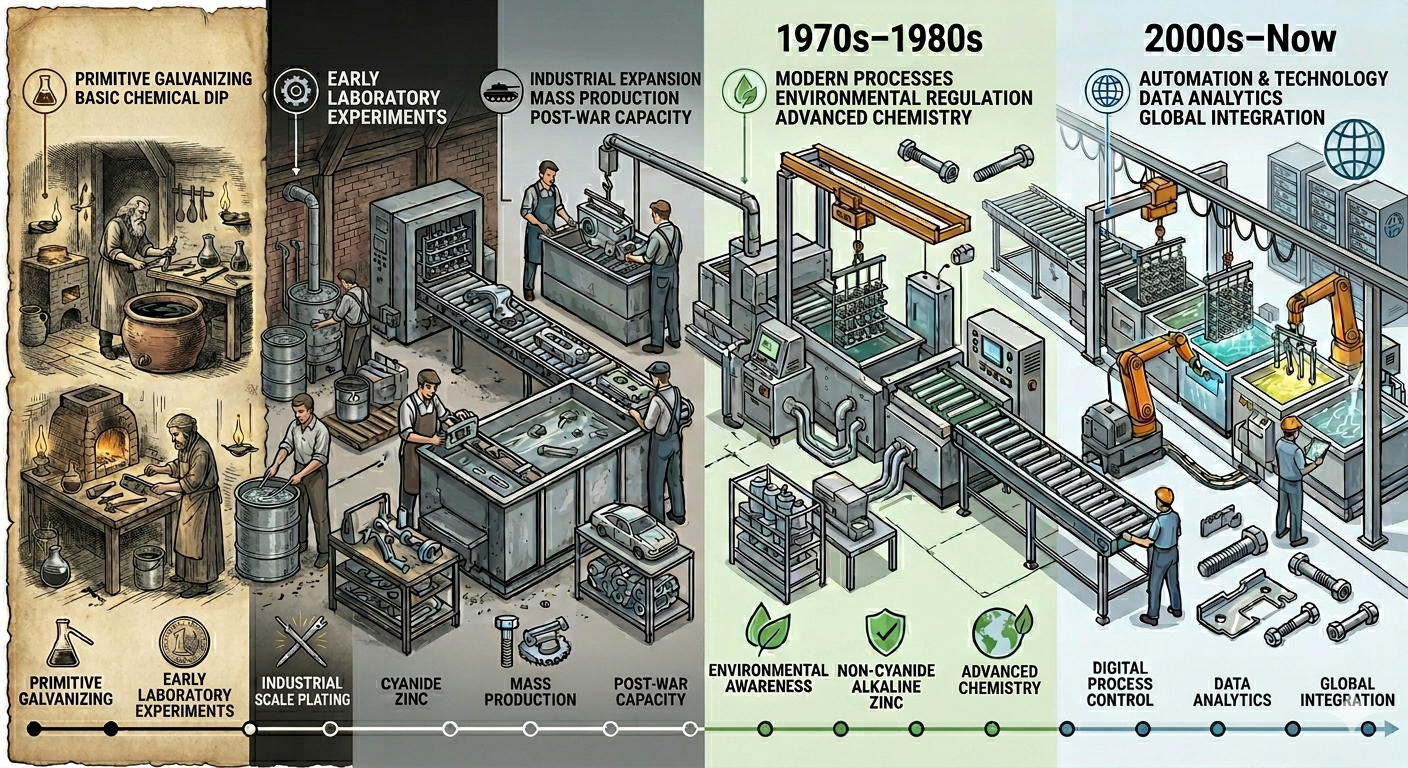
Zinc plating didn’t appear overnight. It emerged from more than a century of accumulated scientific discovery, industrial necessity, and relentless process refinement. From the rudimentary acid baths of the early 1900s to today’s fully automated electroplating lines operating to parts-per-million chemistry tolerances, the zinc plating industry has undergone one of manufacturing’s most consequential quiet evolutions.
Understanding that history isn’t academic. For engineers, procurement leaders, and quality professionals who rely on zinc-plated components every day, knowing where the process came from — and why each generation of development happened — sheds critical light on what separates a precision zinc plating operation from a commodity finisher. This is the story of how zinc plating became the industrial standard it is today.
100+
Years of Commercial Zinc Plating
$2.5T
Annual Global Cost of Corrosion
1974
Plateco Founded — Zinc Specialists
500+
Salt Spray Hours Achievable Today
The Foundations: Zinc and Corrosion Science Before 1920
The story of zinc plating begins not in a plating tank, but in the observations of eighteenth-century scientists who noticed something unusual about zinc’s relationship with iron. As early as 1742, French chemist P.J. Melouin demonstrated that iron dipped in molten zinc acquired a protective coating — the earliest recorded form of galvanizing. But it would be another century before the electrochemical principles that make zinc plating possible were understood well enough to be applied industrially.
In 1800, Alessandro Volta’s invention of the voltaic pile established that chemical reactions could generate electrical current. Within four decades, scientists including Michael Faraday had formalized the laws of electrolysis — the foundational science that makes electroplating possible. Faraday’s laws established precisely how much metal could be deposited per unit of electrical charge, giving future engineers the mathematical basis for controlling coating thickness.
The first commercial zinc electroplating patents appeared in England in the 1840s, largely in the context of decorative and protective finishing for hardware. Processes at this stage were crude by modern standards: cyanide-based zinc baths that were highly effective at depositing zinc but dangerously toxic and difficult to control. Bath chemistry was often managed by trial and error, and coating thickness uniformity was an aspiration rather than a guaranteed outcome.
By the late 19th century, industrialization had created an enormous demand for corrosion protection. The expansion of rail networks, bridge construction, and mechanical manufacturing meant that unprotected steel components were rusting and failing at scale. The economic cost was visible and significant — and the zinc plating industry began its first real period of commercial growth in response.
What the industry lacked at this stage was process control. Baths were mixed by eye. Current density was estimated. Cleaning was inconsistent. The result was zinc plating that worked reasonably well when conditions aligned and poorly when they didn’t — a variability problem that would define the industry’s challenge for the next four decades.
Industrialization and the Rise of Mass Production (1920s – 1940s)
The interwar period transformed zinc plating from a craft operation into an industrial process — driven almost entirely by the explosion of automotive manufacturing. Henry Ford’s assembly line had demonstrated that durable, corrosion-resistant hardware could not be an afterthought; it had to be produced reliably and at massive scale.
The automotive industry’s demand for zinc-plated fasteners, stampings, and brackets was the catalyst that forced the zinc plating industry to confront its process variability problem. When Ford required millions of identical bolts plated to consistent specification, the artisanal approach to bath chemistry became untenable. Systematic chemical measurement — pH monitoring, zinc concentration titration, temperature control — entered plating shops for the first time as operational necessities rather than scientific curiosities.
The Barrel Plating Revolution
The single most significant process innovation of this era was the development and commercial adoption of barrel plating — a method that would remain the dominant production technique for small parts a century later. Prior to barrel plating, components were plated on racks individually or in bulk stationary loads, with highly inconsistent results on threaded surfaces, recesses, and blind holes.
Barrel plating — tumbling thousands of parts simultaneously inside a rotating perforated drum submerged in electrolyte — solved this problem elegantly. The continuous rotation ensured that every surface presented itself to the current repeatedly, producing uniform zinc deposition even in complex geometries. It also slashed processing time and cost per part, making high-volume production economically viable for the first time.
The barrel plating innovation of the 1920s did for corrosion protection what Ford’s assembly line did for vehicle manufacturing — it made quality, repeatable at scale, the new baseline expectation rather than the exception.
— From the Plateco Engineering Archive
World War II accelerated the maturation of industrial finishing across the board. Military specifications for corrosion protection on equipment, ordnance hardware, and vehicles were exacting and non-negotiable. Manufacturers who could not reliably meet salt spray and adhesion requirements lost contracts. The wartime pressure for repeatable quality drove widespread adoption of standardized chemical management and process documentation that persisted into the postwar industrial economy.
Standards, Science, and Specialization (1950s – 1970s)
The postwar decades were the period in which zinc plating evolved from a production technique into an engineered discipline. Two parallel developments drove this transformation: the emergence of formal industry standards, and a deepening scientific understanding of the electrochemistry underlying the process.
ASTM and the Birth of Codified Specifications
Before the 1950s, “zinc plated” meant different things to different buyers and suppliers. There was no universally agreed-upon minimum thickness, no standardized adhesion test, and no formal classification of service environments. The result was a marketplace in which plating quality was essentially unverifiable without expensive in-house testing.
The American Society for Testing and Materials (ASTM) changed this with the development of what would eventually become ASTM B633 — the governing standard for electrodeposited zinc on iron and steel. By establishing four service condition classifications (SC 1 through SC 4), each with corresponding minimum zinc thickness requirements, ASTM B633 gave engineers a common language for specifying corrosion protection performance tied to actual operating environments.
For the zinc plating industry, this was transformative. A plater who could demonstrate ASTM B633 compliance had a verifiable, defensible quality claim. A buyer who specified SC 3 or SC 4 knew exactly what corrosion resistance they were procuring. The standard created accountability where previously there had been only ambiguity.
Key Standard
ASTM B633 defines four service conditions for zinc-plated steel: SC 1 (mild indoor) requiring 5 µm minimum, through SC 4 (severe outdoor/chemical) requiring 25 µm or more. Specifying the correct service condition for the operating environment remains the engineer’s most critical zinc plating decision — a principle established in the 1950s that holds unchanged today.
The Alkaline Non-Cyanide Era Begins
The same period saw the first serious industrial development of alkaline non-cyanide zinc plating chemistry — a process breakthrough that would not achieve full commercial dominance until later, but whose foundations were laid in the 1960s and 1970s. The motivation was straightforward: cyanide-based zinc baths, which had been the industry standard for decades, were highly toxic, subject to increasingly stringent regulatory oversight, and dangerous to handle in high-volume production environments.
Alkaline non-cyanide zinc chemistry offered similar plating performance with dramatically lower toxicity, improved waste treatment characteristics, and better compatibility with the environmental regulations that were beginning to reshape American manufacturing. By the late 1970s, forward-thinking plating operations were transitioning their barrel lines to alkaline chemistry — a shift that required investment in new bath formulations, adjusted current density protocols, and updated cleaning systems.
Plateco, Inc. was founded in 1974 at the midpoint of this chemical transition — entering the industry precisely when the shift from cyanide to alkaline chemistry was creating the first real differentiation between operations willing to invest in modern process chemistry and those content to operate legacy systems.
The Chromate Passivate Era and Quality Management (1980s – 1990s)
If the 1950s and 1960s were about establishing standards for the zinc deposit itself, the 1980s were about engineering the system of layers on top of the zinc. The development and commercial refinement of chromate conversion coatings — chemical treatments applied over the zinc layer after plating — represented the industry’s next major performance leap.
Bare zinc, while sacrificially protective, is relatively porous and will begin forming white corrosion products (zinc oxide) quickly when exposed to moisture. Chromate passivation seals the zinc layer with a thin, dense conversion coating that dramatically extends the time before corrosion — both white and red — begins. The performance gains were substantial: parts that achieved 24–48 hours of salt spray resistance with bare zinc could achieve 96, 200, or even 500+ hours with properly applied chromate passivation.
Yellow, Clear, and Black: The Passivate Palette Expands
During this period, the industry developed the range of passivate types that remain standard today. Yellow trivalent passivate, forming a thicker conversion layer with greater corrosion resistance, became the specification of choice for demanding outdoor and agricultural applications. Clear passivate offered a brighter cosmetic appearance for components where salt spray requirements were lower. Black passivate emerged as the solution for applications requiring both corrosion resistance and a non-reflective dark finish — particularly relevant to military and defense hardware.
The 1980s also brought the widespread adoption of ISO 9001 quality management systems to manufacturing — including metal finishing. The discipline of documented process recipes, batch traceability, statistical process control, and formal corrective action procedures transformed how serious plating operations were managed. The gap between quality-system-certified platers and those operating on experience alone began to widen measurably during this decade.
1840s
First Commercial Zinc Electroplating
Initial patents filed in England for cyanide-based zinc electrodeposition. Chemistry effective but toxic and highly variable in outcome.
1920s
Barrel Plating Commercialized
Rotating barrel plating lines introduced to meet automotive demand. Uniform coating of threaded fasteners and complex geometries becomes achievable at scale.
1940s
Military Specifications Drive Quality
WWII military finishing requirements force industry-wide adoption of process documentation and salt spray testing as production quality tools.
1950s–60s
ASTM B633 Published
First codified standard for electrodeposited zinc creates universal specification language for service conditions, thickness, and performance verification.
1970s
Alkaline Chemistry Transition
Industry begins shift from toxic cyanide baths to alkaline non-cyanide zinc chemistry. Plateco, Inc. founded (1974) during this critical transition period.
1980s
Chromate Passivation Refined
Yellow, clear, and black passivate systems commercially developed. Salt spray performance reaches 200–500+ hours with proper passivate and sealer specification.
1990s
ISO 9001 Quality Systems Adopted
Formal quality management systems enter the plating industry. Process recipe documentation, batch traceability, and statistical control become differentiating capabilities.
2000s
RoHS and the Trivalent Shift
European RoHS directive restricts hexavalent chromium. Industry transitions to trivalent chromate passivate systems that meet environmental requirements without sacrificing performance.
2010s–Now
Full Automation and Digital Process Control
Fully automated plating lines with real-time chemistry monitoring, automated rectifiers, and ERP-integrated quality documentation represent the current state of the art.
The RoHS Revolution: Environmental Compliance Reshapes Chemistry
The single most disruptive regulatory event in the zinc plating industry’s modern history arrived in 2003 with the European Union’s RoHS Directive — Restriction of Hazardous Substances — which placed strict limits on hexavalent chromium (Cr6+) in electrical and electronic equipment. This was followed by REACH regulations that extended similar restrictions across a wider range of industrial applications.
The challenge for the zinc plating industry was significant: hexavalent chromate conversion coatings were the performance standard. They produced excellent corrosion resistance, were well-understood chemically, and had decades of real-world validation behind them. The mandate to move to trivalent chromate systems — which contained no Cr6+ but were less chemically mature at the time — required substantial industry-wide investment in chemistry reformulation, process requalification, and customer re-approval testing.
Trivalent Chemistry Matures
What initially appeared to be a performance compromise turned out, over the subsequent decade, to be a genuine technological advancement. As trivalent chromate formulations matured — driven by the competitive pressure of RoHS compliance requirements — they achieved corrosion performance comparable to legacy hexavalent systems, particularly when combined with modern sealer and top coat technologies. Modern trivalent yellow passivate with an optimized sealer can achieve 500+ hours of neutral salt spray testing — performance levels that would have seemed extraordinary by mid-century standards.
The regulatory pressure of RoHS also forced a broader reckoning with process chemistry transparency. Customers — particularly OEMs in automotive, agricultural equipment, and industrial manufacturing — began requiring formal material compliance documentation as part of supplier qualification. A zinc plating operation that could not provide RoHS compliance certificates and material safety documentation was disqualified from consideration by major buyers. Chemistry management moved from an operational detail to a supply chain qualification criterion.
Automation, Data, and the Modern Zinc Plating Line
The current era of zinc plating is defined by a convergence of automation technology, digital process control, and data-driven quality management that would be unrecognizable to the platers of earlier decades. The fundamental electrochemistry hasn’t changed — zinc ions still deposit on steel substrates under electrical current. What has changed is the precision and repeatability with which every variable governing that deposition is monitored, adjusted, and documented.
What Full Automation Actually Means
01 Automated Chemistry Monitoring
Modern lines use inline titration systems and conductivity sensors to continuously measure bath chemistry — zinc concentration, brightener levels, pH, and temperature — triggering automatic replenishment before parameters drift outside specification.
02 Programmable Rectifiers and Current Control
Digital rectifiers allow current density to be programmed precisely for each work order — ramped up during initial deposition and adjusted mid-run if bath sensors detect chemistry variation. Eliminated the “set it and forget it” current management of earlier eras.
03 Automated Line Transfer
Computer-controlled hoists and transfer systems move barrels or racks through cleaning, activation, plating, passivation, and drying stages with precise timing — eliminating the human timing errors that caused bath drag-out problems and inconsistent passivate dwell times.
04 Digital Process Recording and Traceability
Every run parameter — bath chemistry readings, current density, time in each stage, operator ID, and quality inspection results — is logged in a production management system. Full traceability for every batch, audit-ready on demand.
05 Integrated Quality Inspection
X-ray fluorescence (XRF) coating thickness gauges provide non-destructive measurement of zinc deposit thickness on sampled parts in seconds. Combined with salt spray testing chambers, quality verification has become a production-floor activity rather than a laboratory exercise.
Plateco’s two fully automated zinc barrel electroplating production lines — capable of processing up to 800 pounds per barrel — represent exactly this convergence of chemistry management, mechanical automation, and digital control. The result is a defect return rate below 0.22% — not because of luck or exceptional individual skill, but because automation eliminates the process variation that generates defects in the first place.
The Three Methods That Define Modern Zinc Plating
A century of development has converged on three commercially dominant zinc application methods, each the product of distinct evolutionary paths and each suited to a specific category of component and application requirement.
| Method | Best For | Key Advantage | Limitation |
| Zinc Barrel Electroplating | High-volume small/medium parts, fasteners, stampings | Lowest cost per part; excellent thread/recess coverage | Part-on-part contact marks; not for delicate finishes |
| Zinc Rack Electroplating | Large, complex, or cosmetically critical parts | ±0.0001″ thickness precision; no contact damage | Higher cost; lower throughput |
| Zinc Mechanical Galvanizing | High-strength fasteners; embrittlement-sensitive steel | No hydrogen embrittlement risk; thick deposits achievable | Less uniform than electroplating; higher cost for thin deposits |
Each of these methods has been refined continuously since its commercial introduction. Barrel plating equipment today achieves chemistry uniformity that would have required manual correction every few hours in earlier decades. Rack plating systems use advanced anode configurations that optimize current distribution on complex geometries. Mechanical galvanizing has been refined to consistently meet the most demanding structural fastener specifications. The methods are mature — but the execution has never been more precise.
OEM Specifications: The Industry’s Highest Standard
Perhaps the clearest indicator of how far zinc plating has evolved as an engineered discipline is the development and expansion of OEM-specific plating specifications by major equipment manufacturers. For decades, ASTM B633 served as the de facto quality floor. But as OEMs in agriculture, construction, automotive, and heavy equipment grew more sophisticated in their quality systems — and as the cost of corrosion-related warranty claims became better quantified — ASTM compliance became necessary but not sufficient.
John Deere, Caterpillar, Case/CNH, and Parker Hannifin each maintain proprietary zinc plating specifications that layer additional requirements on top of ASTM B633: specific passivate types, minimum salt spray hours at each service condition, hydrogen embrittlement test requirements, adhesion testing protocols, and documentation standards that enable full supply chain traceability. Achieving and maintaining approval under these OEM specifications requires dedicated process investment, disciplined quality management, and the organizational infrastructure to maintain records that satisfy audit requirements.
The emergence of OEM specifications has effectively stratified the zinc plating industry. Commodity platers — those operating without quality systems, without formal process control, and without the ability to document traceability — are disqualified from the supply chains that generate the most volume and value. Certified, OEM-approved specialists who can demonstrate consistent performance across thousands of production runs occupy an entirely different market position.
The Next Chapter: Where Zinc Plating Is Heading
Zinc plating is not a technology in decline. If anything, the forces shaping its next evolution are more powerful than at any point in its history. Four trends are visible on the near horizon.
1. Expanded Top Coat Technologies
The combination of zinc electrodeposition with advanced organic sealers, nanoparticle-reinforced conversion coatings, and hybrid inorganic-organic top coats is pushing achievable salt spray performance beyond 1,000 hours for certain application specifications. For components in coastal, marine, and highly corrosive chemical environments, this performance tier is opening applications that previously required more expensive coating methods.
2. AI-Assisted Process Optimization
Machine learning models trained on years of bath chemistry data, current density records, and defect outcomes are beginning to be deployed for predictive chemistry management — flagging bath conditions that historically precede quality events before those events occur. In an industry where bath chemistry management is the most critical and complex operational variable, the potential for AI-assisted quality management is significant.
3. Sustainability and Closed-Loop Chemistry
Environmental compliance has always driven process chemistry investment in zinc plating — from the alkaline transition of the 1970s to the RoHS-driven trivalent shift of the 2000s. The next phase involves more comprehensive waste minimization, water recycling, and energy efficiency. Modern drag-out recovery systems already recapture a significant fraction of chemistry that earlier systems lost to rinse water. Closed-loop rinse systems, reduced-concentration bath formulations, and energy-efficient rectifiers are active areas of investment for leading operations.
4. Tighter Integration with Customer Quality Systems
As OEM quality systems increasingly demand real-time data exchange between suppliers and customers — not just documentation produced after the fact, but live process data visibility — zinc plating operations are investing in ERP systems and API integrations that can provide customers direct access to production records for their specific batches. The era of the quality certificate as the endpoint of traceability is giving way to continuous, digital quality transparency throughout the supply chain.
100 Years of Progress: What It Means for Your Components
The history of zinc plating is a history of compounding precision. Each generation of development — standardized chemistry, barrel automation, ASTM codification, chromate passivation, alkaline transition, RoHS chemistry, full line automation — built on the one before it. The result, today, is a manufacturing process capable of delivering engineered corrosion protection to millions of components per week, at specification tolerances that early practitioners would have considered impossible.
For engineers and procurement professionals relying on zinc-plated components, this history has a practical implication: not all zinc plating is equal. A process that has benefited from a century of development, and that operates at the leading edge of chemistry management, automation, and quality systems, produces fundamentally different results than one that has not. The difference isn’t visible at delivery — it shows up in the field, months or years later, in the corrosion performance of components under real operating conditions.
Plateco, Inc. has operated at the intersection of zinc plating science and manufacturing excellence since 1974. Two fully automated production lines, ISO 9001:2015 certification, OEM approvals from John Deere, Caterpillar, Case, and Parker Hannifin, and a defect return rate below 0.22% are not the outcome of a simple process. They are the outcome of 50 years of continuous investment in the most sophisticated version of a process that took more than a century to reach its current state of development.
We treat zinc plating as an extremely complex process demanding state-of-the-art technology, painstaking planning, obsessive quality control, and a tremendous amount of talent. Because our customers don’t come to us for excuses — they come to us for perfection. And we’ll do whatever it takes to give them nothing less.
— Jim Schweich, Chief Executive Perfectionist, Plateco, Inc.
The next time you specify a zinc-plated component for an industrial application, you’re drawing on more than 100 years of accumulated industrial knowledge. Choose a plating partner who has kept pace with every step of that development.