

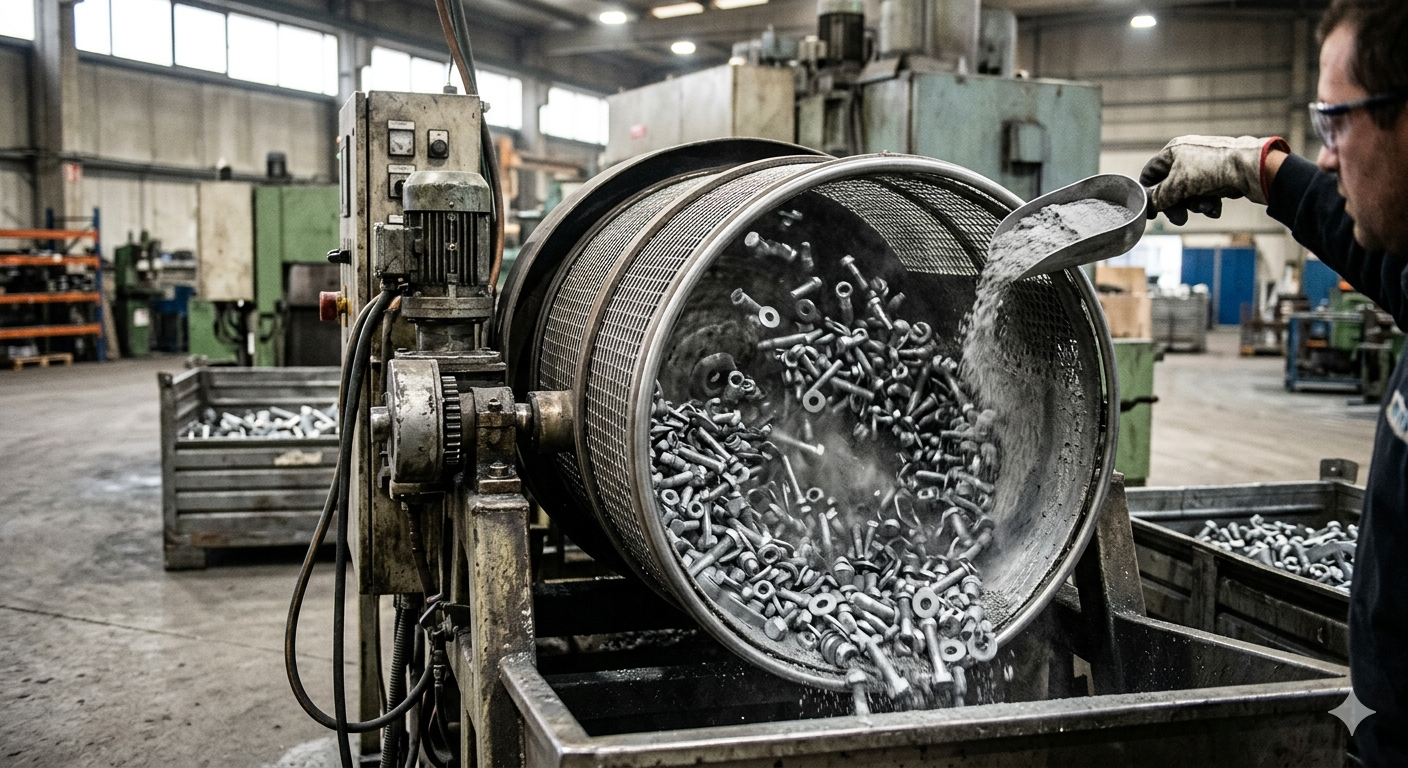
Corrosion never sleeps. Every bolt, bracket, and fastener exposed to moisture, salt, or industrial chemicals is in a constant battle against rust. For engineers who refuse to compromise on part integrity, one process rises above the rest: mechanical galvanizing.
At Plateco, we were founded on this very process. Back in 1973, our founders began mechanical galvanizing with a single barrel cement mixer in a garage. More than 50 years later, we have grown into a 75,000-square-foot facility and have been named a “Top Shop” for six consecutive years by Products Finishing magazine — and mechanical galvanizing remains the cornerstone of what we do.
But what actually happens inside that barrel? What makes this process so different from electroplating or hot-dip galvanizing? And why do engineers working with Grade 8 fasteners, high-strength structural components, and critical agricultural hardware insist on it?
This guide answers all of those questions. We walk you through every single step of the mechanical galvanizing process — from raw, oily parts arriving at our dock to a finished, passivated component ready to face decades of outdoor exposure — and explain why each step matters.
“A lot of metal parts manufacturers assume that zinc plating is a commodity process and that all zinc plating companies are pretty much the same — but nothing could be further from the truth.” — Jim Schweich, Chief Executive Perfectionist, Plateco, Inc.
First: Understanding What Mechanical Galvanizing Is (and Isn’t)
Before diving into the step-by-step process, it is worth clarifying exactly what mechanical galvanizing is, because it is frequently misunderstood.
Mechanical galvanizing — sometimes called “impact plating” or “mechanical zinc plating” — is a room-temperature barrel process that deposits zinc powder onto a steel substrate using kinetic energy rather than electricity or extreme heat. The zinc is driven into and onto the surface of the steel through millions of tiny impacts from glass media beads tumbling inside a rotating barrel.
The result is a zinc coating that is mechanically bonded to the steel — what the industry calls a “cold weld.” This is fundamentally different from:
- Electroplating, which uses electrical current to attract dissolved zinc ions to the steel surface.
- Hot-dip galvanizing, which creates a metallurgical zinc-iron alloy by submerging parts in a bath of molten zinc at approximately 840°F (450°C).
Each process creates a different type of bond, a different coating thickness, and a different set of performance characteristics. Mechanical galvanizing occupies a unique and critical space between these two methods — providing coating thicknesses far superior to standard electroplating, while doing so at room temperature (preserving part integrity) and with far greater precision than hot-dip.
At-a-Glance: Three Zinc Processes Compared
| Feature | Electroplating | Mechanical Galvanizing | Hot-Dip Galvanizing |
|---|---|---|---|
| Bond Type | Electrolytic (chemical-electrical) | Mechanical (cold-weld) | Metallurgical (zinc-iron alloy) |
| Processing Temp. | Ambient | Ambient | ~840°F (450°C) |
| Hydrogen Embrittlement Risk | High — baking required | Near zero | Low |
| Typical Coating Thickness | 0.2 – 0.5 mil (5–12 µm) | 1.0 – 3.0 mil (25–75 µm) | 3.0+ mil (75+ µm) |
| Thread Fit After Coating | Excellent | Very Good | Poor — often requires re-tapping |
| Thickness Consistency | Good | Excellent | Variable |
| Salt Spray Performance | 96–200 hrs (Class 5–8) | 300+ hrs (Class 25+) | Variable — interlayer corrosion risk |
| Effect on Heat-Treated Parts | None | None | Can anneal/soften |
| Best For | Decorative / indoor parts | High-strength fasteners, outdoor hardware | Large structural steel |
Now, let’s walk through the process from start to finish.
Step 1: Engineering Planning — Before a Single Part Enters the Barrel
Most people assume mechanical galvanizing begins when parts go into the barrel. At Plateco, it begins long before that.
When we receive a first-time run of a new part, our Engineering Planning Department takes hundreds of factors into account before we run a single piece. These include:
- Part geometry: Thread pitch, wall thickness, surface area, and part weight all influence how the barrel must be configured, the speed and angle of rotation, and the ratio of glass media to zinc powder.
- Steel grade: High-strength steels (Grade 8, 10.9, 12.9, or any steel exceeding 150,000 psi yield strength) require different handling considerations than mild steel.
- Specification requirements: Whether the parts must meet ASTM B695, John Deere’s JDM F22 specification, MIL-C-81562, or a customer’s proprietary standard determines the target coating thickness and testing requirements.
- Post-plate treatment: The intended environment of the finished part — indoor/outdoor, coastal exposure, agricultural use, or automotive assembly — dictates what passivation or top coat is applied at the end.
This upfront engineering investment is what separates a professional mechanical galvanizing operation from a commodity plating shop. Getting the parameters right before the barrel ever turns is what ensures every batch meets your exact specification.
“When a customer asks us to plate their parts, our attitude is that those parts are very close to perfect. Our job is to get them all the way there — and we’ll do whatever it takes to make that happen.” — Jim Schweich, Chief Executive Perfectionist, Plateco, Inc.
Step 2: Incoming Inspection and Part Preparation
Once the engineering plan is established, parts arrive at our facility for processing. Before anything else, our team conducts an incoming inspection.
This inspection verifies:
- Part count and identity against the work order
- Condition of the parts — looking for pre-existing rust, damaged threads, or surface contamination that falls outside normal manufacturing variation
- Suitability for barrel processing — parts must be able to tumble without being damaged or damaging each other
Parts that pass inspection are staged for the cleaning line. Any anomalies are flagged and communicated to the customer before processing begins. This proactive communication is a core part of the Plateco process — we believe in transparency before, during, and after every run.
Step 3: Multi-Stage Cleaning — The Most Critical Foundation
If there is one stage that determines the ultimate success or failure of a mechanical galvanizing coating, it is the cleaning cycle. A contaminated surface will always result in a failed coating — no amount of impact energy can force zinc to bond to oil, rust, or mill scale.
At Plateco, our cleaning process consists of seven distinct cleaning stages, several of which are proprietary to our operation. Our cleaning capability is one of the most aggressive and comprehensive in the industry, and it is one of the primary reasons our customers trust us with their most critical parts.
Stage 3a: Alkaline Degreasing
Parts are first immersed in a heated alkaline solution — essentially a powerful industrial soap. This removes:
- Machining and stamping oils
- Drawing compounds
- Shop grime and general contamination
- Light greases and lubricants applied during manufacturing or transit
The heat of the solution accelerates the saponification of oils (breaking them down chemically) while the alkalinity emulsifies and lifts them off the steel surface. Agitation — either through barrel tumbling or solution agitation — ensures that all surfaces of the part are contacted by the cleaning solution.
Stage 3b: Acid Pickling
After degreasing, parts are immersed in an acid solution. This step, known as “pickling,” serves a different purpose than degreasing. Rather than removing organic contamination, pickling removes:
- Mill scale — the layer of iron oxides that forms on steel during hot rolling or forging
- Surface rust — any existing red rust on the part’s surface
- Residual oxides — from heat-treating or other thermal processes
Pickling is a chemical reaction: the acid reacts with and dissolves the iron oxides, exposing the bright, reactive steel surface beneath. This “activated” steel surface is what allows the subsequent zinc coating to form a strong mechanical bond.
Stages 3c through 3g: Rinse, Neutralization, and Proprietary Stages
Following degreasing and pickling, parts pass through multiple rinse stages to remove all chemical residues. Plateco’s additional proprietary cleaning stages address contamination types that standard cleaning cycles cannot handle — this is part of what we spent years developing and what allows us to clean directly in our production lines without pre-cleaning. This efficiency provides customers with faster lead times and better pricing.
The cleaning cycle concludes with a final rinse that leaves parts in an ideal state for the next critical step.
Step 4: The Copper Flash (Trans-Coat) — Building the Chemical Bridge
Once the steel is perfectly clean and activated, parts receive a very thin coating of copper before any zinc is applied. This step is called the copper flash or trans-coat, and it is one of the most misunderstood aspects of mechanical galvanizing.
The copper flash is not a corrosion protection layer. You would not want bare copper on the surface of a finished part exposed to moisture — copper and steel create a galvanic couple that actually accelerates corrosion. The copper flash serves an entirely different purpose: it is a chemical bridge.
Zinc powder does not adhere well directly to bare steel during the impact process. The reactivity of fresh steel is beneficial for bonding, but the geometry of the steel surface at a microscopic level does not provide an ideal “landing zone” for zinc particles. Copper, on the other hand, provides a more receptive surface for initial zinc adhesion.
The copper flash is extremely thin — measured in fractions of a micron — and is applied through a brief chemical immersion. By the time the finished product is a full mechanically galvanized coating, the copper is sandwiched between the steel and the zinc, playing no functional role in the corrosion protection of the finished part. But without it, the first layer of zinc would not have a reliable foundation, and coating adhesion would be unpredictable.
Step 5: Loading the Barrel — The Art of the Setup
With clean, copper-flashed parts ready for coating, it is time to load the galvanizing barrel. This step is more of an art than many people expect, and it is where the experience of Plateco’s production artisans — our operators — makes a significant difference.
The barrel must be loaded with the correct ratio of:
- Parts (by weight and surface area)
- Glass impact media (by volume and graded size mix)
- Water (to create the slurry environment)
- Promoter chemicals (to keep zinc particles active)
- Zinc powder (in measured doses matched to the target coating thickness)
Getting this ratio wrong — even slightly — affects coating thickness, uniformity, and adhesion. Too much part load and the glass beads cannot move freely enough to generate adequate impact energy. Too little part load and the media can over-work the parts, potentially damaging delicate features. Too little zinc and the coating will be thin. Too much and the excess zinc will form clumps rather than a uniform coating.
The glass impact media deserves special attention. We use a graded bead mix — beads of multiple sizes working in concert. Larger beads generate the heavy impact force needed to bond zinc to flat, open surfaces. Smaller beads — because of their size — can penetrate into tight spaces, driving zinc powder into the roots of threads, the inside of blind holes, and sharp re-entrant corners. This is how mechanically galvanized bolts achieve the uniform coating in thread roots that electroplating cannot match.
Step 6: The Zinc Build-Up Phase — Where the Magic Happens
With the barrel loaded and sealed, it is time for the heart of the process. The barrel begins rotating at a carefully controlled speed and angle, and the build-up of zinc on the parts begins.
Inside the rotating barrel, the glass beads are in constant motion. They tumble, cascade, and fall through the slurry of water, chemicals, and zinc particles. With every rotation, beads strike the surfaces of the parts. Each individual impact is tiny, but the cumulative effect of millions of impacts per minute is extraordinary.
Here is what happens at a microscopic level during each impact:
- A glass bead strikes a zinc particle that is in contact with the copper-flashed steel surface.
- The kinetic energy of the impact deforms and flattens the zinc particle.
- The flattened zinc particle is pressed into the microscopic irregularities of the steel surface and the previously deposited zinc.
- This deformation creates a mechanical interlock — the zinc is physically embedded in and bonded to the surface, not merely resting on it.
- Successive zinc particles land on previously deposited zinc, building up the coating layer by layer.
This is the “cold weld” phenomenon: zinc being mechanically fused to the steel through compressive force at room temperature. No electricity required. No molten metal required. Just physics, applied with precision and consistency.
Controlling Coating Thickness
Because zinc powder is added to the barrel in measured doses, coating thickness is highly controllable. Unlike hot-dip galvanizing — where the thickness is influenced by the viscosity of the molten zinc, withdrawal speed, and steel chemistry in ways that are difficult to control precisely — mechanical galvanizing allows us to dial in thickness with considerable accuracy.
Standard mechanical galvanizing thicknesses range from approximately 0.5 mil (12.5 microns) to 3.0 mils (75 microns) or more. ASTM B695 defines six thickness classes (Class 5, 8, 12, 25, 40, 50, and 75) allowing engineers to specify the exact level of corrosion protection required for their application.
ASTM B695 Mechanical Galvanizing Thickness Classes
| ASTM B695 Class | Min. Coating Thickness | Min. Zinc Weight | Typical Salt Spray Performance | Common Applications |
|---|---|---|---|---|
| Class 5 | 0.2 mil (5 µm) | 0.2 oz/ft² | ~96 hrs | Light-duty indoor hardware |
| Class 8 | 0.3 mil (8 µm) | 0.3 oz/ft² | ~150 hrs | General commercial fasteners |
| Class 12 | 0.5 mil (12 µm) | 0.5 oz/ft² | ~200 hrs | Moderate outdoor exposure |
| Class 25 | 1.0 mil (25 µm) | 1.0 oz/ft² | 300+ hrs | Agricultural / construction hardware |
| Class 40 | 1.6 mil (40 µm) | 1.6 oz/ft² | 500+ hrs | Heavy outdoor / coastal environments |
| Class 50 | 2.0 mil (50 µm) | 2.0 oz/ft² | 700+ hrs | Marine / infrastructure |
| Class 75 | 3.0 mil (75 µm) | 3.0 oz/ft² | 1,000+ hrs | Maximum corrosion protection |
“The ability to specify and achieve a precise coating class — every time, on every batch — is what separates professional mechanical galvanizing from guesswork. ASTM B695 isn’t just a standard; it’s a promise to the engineer who signed off on the drawing.” — Micah Fulton, Sales and Engineering Manager, Plateco, Inc.
For reference, a single ounce per square foot of zinc (Class 25 per ASTM B695) applied via mechanical galvanizing will typically provide at least 300 hours of protection in a salt spray chamber conducted in accordance with ASTM B117. Hot-dip galvanized parts at similar thickness often do not meet this threshold and can exhibit premature red rust due to “interlayer corrosion” at the iron-zinc alloy layer.
Porosity and Hydrogen Relief
One subtle but significant advantage of the mechanically applied zinc deposit is its natural porosity. The compacted zinc coating — because it is built from individual particles rather than a single continuous electrodeposited layer or a solidified melt — contains microscopic channels.
This porosity is not a weakness; it is a safety feature. In electroplating, hydrogen gas is a byproduct of the plating chemistry. In high-strength steels, atomic hydrogen can diffuse into the steel’s crystalline lattice and cause embrittlement — a potentially catastrophic condition where a bolt that looks perfectly fine suddenly snaps under load without warning. Post-plate “baking” (hydrogen embrittlement relief baking) is required for electroplated high-strength parts.
In mechanical galvanizing, any hydrogen introduced during the acid pickling step can diffuse naturally through the porous zinc coating within 24 to 48 hours without any baking required. This makes mechanical galvanizing the default choice for any steel harder than HRC 35 or with a yield strength above 150,000 psi.
“Hydrogen embrittlement is not a theoretical risk — it is a real-world failure mode that has caused bolts to snap and catastrophic part failures in the field. For any high-strength fastener above Grade 5, the conversation about coating should start and end with mechanical galvanizing.” — Industry perspective, ASTM F16 Committee on Fasteners
Step 7: Barrel Inspection and Thickness Verification
Before parts come out of the production cycle, our quality team performs in-process inspection to verify that the coating build-up is proceeding according to specification.
Coating thickness is verified using calibrated magnetic thickness gauges — a non-destructive measurement method that works reliably on zinc-coated steel. At Plateco, our quality systems are designed not just to catch rejects but to prevent them. Our engineering planning work upfront means that thickness targets are routinely hit on every barrel run.
Any batch that does not meet specification is flagged before it moves to the next stage. This is a core principle of our quality culture: problems are identified and addressed in real time, not discovered after parts have been delivered to a customer.
Step 8: Rinsing and Separation
Once the coating build-up is complete and thickness has been verified, the contents of the barrel are discharged and separated. Parts are separated from the glass impact media — a process that takes advantage of the size difference between parts and beads — and transferred to a rinsing stage.
The rinse removes the residual promoter chemicals, zinc fines, and processing residues from the surface of the parts. Clean, rinsed parts at this stage have a dull, matte gray zinc surface. They are protected, but they are not finished. The final and critical step remains.
Step 9: Passivation — The Performance Multiplier
Freshly deposited zinc, while corrosion-resistant, is still susceptible to white rust — the formation of zinc oxide and zinc hydroxide on the surface when exposed to moisture. White rust does not compromise the underlying steel (the zinc is still sacrificially protecting it), but it is unsightly and can be a concern in applications where cosmetic standards are important.
More significantly, passivation dramatically extends the effective service life of the zinc coating in corrosive environments by sealing the surface and slowing the rate of zinc oxidation.
At Plateco, we offer several passivation options depending on the application requirements:
Passivation Options at a Glance
| Passivate Type | Appearance | Corrosion Boost | Typical Use Case | Spec Compliance |
|---|---|---|---|---|
| Clear Trivalent | Bright / near-clear | Moderate | Consumer hardware, automotive | RoHS compliant |
| Yellow Trivalent | Gold / iridescent | Good | Agricultural, construction | RoHS compliant |
| Black Passivate | Dark matte black | Good | Automotive, consumer goods | RoHS compliant |
| Olive Drab | Military green | Good | Defense / military hardware | MIL-C-81562 |
| Wax / Sealer Top Coat | Varies | Excellent | Coastal, marine, heavy industry | Application-specific |
Clear Trivalent Passivate: Provides a bright, nearly clear appearance and moderate additional corrosion resistance. Commonly specified for parts where aesthetics matter and the base zinc coating provides the primary protection.
Yellow Trivalent Passivate: Provides a gold/iridescent appearance and enhanced corrosion resistance compared to clear. Often specified in agricultural or construction applications where the additional protection is valued.
Black Passivate: Provides a dark, matte black appearance. Used when aesthetics require a darker finish — common in automotive and consumer hardware applications.
Olive Drab: Provides a military-specification appearance. Used for parts meeting MIL-C-81562 requirements.
Wax or Sealer Top Coat: An additional layer applied over the passivate to further seal the surface, improve lubricity, and extend service life in the most demanding environments.
The combination of zinc coating plus passivate plus top coat represents a complete three-layer corrosion protection system — and it is why properly mechanically galvanized parts can outlast electroplated parts by a significant margin in outdoor, agricultural, and industrial environments.
“Passivation is not optional — it is the difference between a part that lasts two seasons and one that lasts two decades. The zinc does the heavy lifting, but the passivate is what seals the deal in harsh environments.” — Plateco Engineering Planning Department
Step 10: Final Inspection, Testing, and Quality Release
Before any parts leave Plateco’s facility, they pass through our final inspection and quality release process.
This includes:
- Visual inspection for coating uniformity, coverage completeness, and passivate appearance
- Magnetic thickness gauge measurement on sample parts to verify that coating thickness meets specification
- Salt spray testing (ASTM B117) on test panels or sample parts when required by specification
- Review against the original engineering plan to confirm that all customer-specified requirements have been met
At Plateco, our quality team leads a daily continuous improvement meeting — held openly on the production floor — reviewing every rejected part from the prior day. Our management team works through root cause analysis and corrective action on each reject. This commitment to continuous improvement is what keeps our reject rate extraordinarily low and what has earned us six consecutive Top Shop designations.
Parts that pass final inspection are labeled, packaged according to customer requirements, and staged for delivery.
Step 11: Delivery — On Spec. On Time. Every Time.
Plateco operates its own freight company — Plateco Transfer — with a fleet of trucks serving a 250-mile radius from our Reedsburg, Wisconsin facility. We promise every customer that their perfectly plated parts will be delivered within five days of pickup. This is not a marketing slogan; it is a commitment that our operations are built around.
For customers outside our direct delivery radius, we coordinate with trusted carriers to ensure the same standard of reliability.
Why the Process Matters: The Real-World Advantages of Mechanical Galvanizing
Having walked through every step of the process, it is worth summarizing the real-world advantages that this process delivers — advantages that are a direct result of how the process works.
No hydrogen embrittlement risk. Because the process uses no electrical current and the chemistry is different from electroplating, there is no generation of atomic hydrogen during coating. High-strength Grade 8, 10.9, and 12.9 fasteners can be coated without the risk of embrittlement — and without the cost and delay of mandatory post-plate baking.
Room-temperature processing preserves part integrity. Unlike hot-dip galvanizing, which subjects parts to 840°F molten zinc, mechanical galvanizing happens at ambient temperature. Heat-treated parts retain exactly the hardness and tensile strength they had before coating. There is no risk of annealing, warping, or distortion.
Superior thread integrity. Hot-dip galvanizing is notorious for filling in thread valleys with excess molten zinc, frequently requiring nuts to be over-tapped (cut larger) to fit — a process that weakens the threaded connection. Electroplating over-builds on thread peaks. Mechanical galvanizing, driven by the graded glass bead mix, coats threads uniformly without filling valleys or over-building on peaks. Coated bolts and nuts mate easily and accurately.
Precise, controllable thickness. Because zinc is added in measured doses, coating thickness is predictable and consistent from part to part and batch to batch. This consistency eliminates the thickness variability that plagues hot-dip galvanizing — where some parts may be substantially under-coated while others are over-coated in the same batch.
Excellent corrosion resistance. At one ounce per square foot (Class 25 per ASTM B695), mechanically galvanized parts typically achieve 300+ hours in a salt spray chamber per ASTM B117. The porous zinc deposit, enhanced by a trivalent passivate and sealer, provides lasting sacrificial protection against the base steel.
Natural lubricity. The zinc surface produced by mechanical galvanizing is naturally lubricious — smooth and slightly slick. This produces more accurate torque-tension relationships in fastener assemblies than hot-dip galvanizing, and eliminates the galling (adhesive wear between sliding surfaces) that can occur with other finishes.
Environmental responsibility. Mechanical galvanizing consumes significantly less energy than both electroplating (no large electrical rectifiers running 24/7) and hot-dip galvanizing (no massive molten zinc baths to maintain). Plateco’s closed-loop systems conserve water, and the elimination of molten zinc hazards creates a safer working environment.
Industry Standards for Mechanical Galvanizing
When specifying mechanical galvanizing for your parts, you will encounter several key standards that govern the process and the performance of the finished coating:
Key Industry Standards for Mechanical Galvanizing
| Standard | Issuing Body | What It Governs | Plateco Qualified? |
|---|---|---|---|
| ASTM B695 | ASTM International | Zinc mechanically deposited on iron and steel — 7 thickness classes | ✅ Yes |
| ASTM A153 (Class C & D) | ASTM International | Zinc coating on hardware — originally hot-dip, now met by mechanical | ✅ Yes |
| MIL-C-81562 | U.S. Department of Defense | Military specification for mechanical coatings | ✅ Yes |
| John Deere JDM F22 | Deere & Company | Proprietary ag/construction equipment fastener specification | ✅ Yes |
| ISO 9001:2015 | ISO | Quality management system certification | ✅ Certified |
ASTM B695 — The standard specification for coatings of zinc mechanically deposited on iron and steel. This is the primary reference standard for mechanical galvanizing, defining seven thickness classes and the performance requirements each must meet.
ASTM A153 (Class C & D) — Originally written for hot-dip galvanizing, this standard’s performance requirements for fasteners and hardware are commonly met by mechanical galvanizing.
MIL-C-81562 — The United States military specification for mechanical coatings. Parts meeting this specification are suitable for the most demanding military and defense applications.
John Deere JDM F22 — A proprietary specification from Deere & Company for mechanically galvanized agricultural and construction equipment hardware. Plateco is qualified to meet this specification.
“Standards like ASTM B695 exist because the market needed a way to communicate corrosion protection requirements without ambiguity. When a drawing calls out Class 25, every link in the supply chain — from the engineer to the plater to the inspector — knows exactly what is expected.” — Plateco Certifications and Engineering Team
At Plateco, meeting these standards is not a checkbox exercise. It is the foundation of how we operate. Every batch of parts is processed according to an engineering plan that is built around meeting your exact specification — whether that is a standard ASTM class or a proprietary customer requirement.
Is Mechanical Galvanizing Right for Your Application?
As a top-of-funnel guide to this process, it is worth helping you assess whether mechanical galvanizing is the right choice for your parts. Here is a practical decision framework:
Mechanical galvanizing is the right choice when:
- Your parts are high-strength steel (Grade 8, 10.9, 12.9, or any steel exceeding 150,000 psi yield strength or HRC 35 hardness)
- Your parts will be used outdoors, in agricultural environments, coastal areas, or industrial settings with regular moisture or chemical exposure
- Your parts are threaded fasteners where dimensional integrity and thread fitment are critical
- Your parts cannot withstand the thermal stress of hot-dip galvanizing
- You need coating thicknesses greater than what standard electroplating can reliably provide
- You want to avoid the cost and delay of mandatory hydrogen embrittlement relief baking
Standard electroplating may be more appropriate when:
- Your parts are low-carbon, low-hardness steel where hydrogen embrittlement is not a concern
- Cosmetic appearance (bright, shiny finish) is the primary requirement
- Parts will be used indoors in low-moisture environments
- Coating thickness requirements are minimal (under 0.5 mil)
- Very tight dimensional tolerances cannot accommodate any zinc buildup
When in doubt, our Engineering Planning team is ready to review your parts, specifications, and application requirements to recommend the right process. At Plateco, we offer three zinc plating processes — rack electroplating, barrel electroplating, and mechanical galvanizing — and we will always recommend the one that is genuinely right for your parts.
The Plateco Difference: Mechanical Galvanizing as an Art Form
We want to close with something important: mechanical galvanizing cannot be fully automated. Unlike some industrial processes that can be handed off to a computer-controlled system and left to run unattended, mechanical galvanizing requires the continuous attention, judgment, and skill of experienced production professionals.
Our artisans — what we call our production operators — control and monitor dozens of variables simultaneously during every barrel run: the concentration of chemicals, the temperature of the solution, the speed and angle of the barrel, the weight of zinc doses, and many more. Every part type presents a unique combination of these variables. Every run is different.
This is why we have invested in our people for over 50 years. It is why our operators are highly trained, meticulous, and deeply knowledgeable about the process. It is why we describe mechanical galvanizing as an art form — because that is exactly what it is.
The result of that craft is a zinc coating that is consistent, durable, specification-compliant, and built to protect your most critical components in the harshest environments your application demands.
Ready to Protect Your Components?
Whether you are specifying mechanical galvanizing for the first time, looking to switch from a process that has been causing problems, or simply want to talk through your options with a team that has been doing this since 1973 — Plateco is ready to help.
Contact Plateco today to request a quote, discuss your part specifications, or schedule a technical consultation with our Engineering Planning team. We serve manufacturers throughout Wisconsin and the upper Midwest, with pickup and delivery service covering a 250-mile radius from our Reedsburg, WI facility.
Because when your parts matter — when failure is not an option — you need a zinc partner who takes the process as seriously as you take your product.
Plateco, Inc. | Reedsburg, Wisconsin | (608) 524-8241 | plateco.net
Certifications: ISO 9001:2015 | ASTM B695 | John Deere JDM F22 | MIL-C-81562 | ASTM A153 Class C & D