

If you work in manufacturing, automotive supply, or industrial equipment production, chances are you’ve heard the term zinc plating. But within the world of zinc plating, there’s an important distinction that many buyers and engineers overlook: the difference between barrel plating and rack plating.
Zinc rack electroplating is a precision plating method designed specifically for parts that need uniform coating thickness, excellent surface finish, and reliable corrosion protection — especially when those parts are too large, too complex, or too critical to be tumbled together in a barrel.
This guide will walk you through exactly what zinc rack electroplating is, how the process works step by step, the key benefits it delivers, and when it’s the right choice for your components. Whether you’re sourcing zinc plating for the first time or evaluating suppliers, this is your starting point.
What Is Zinc Rack Electroplating?
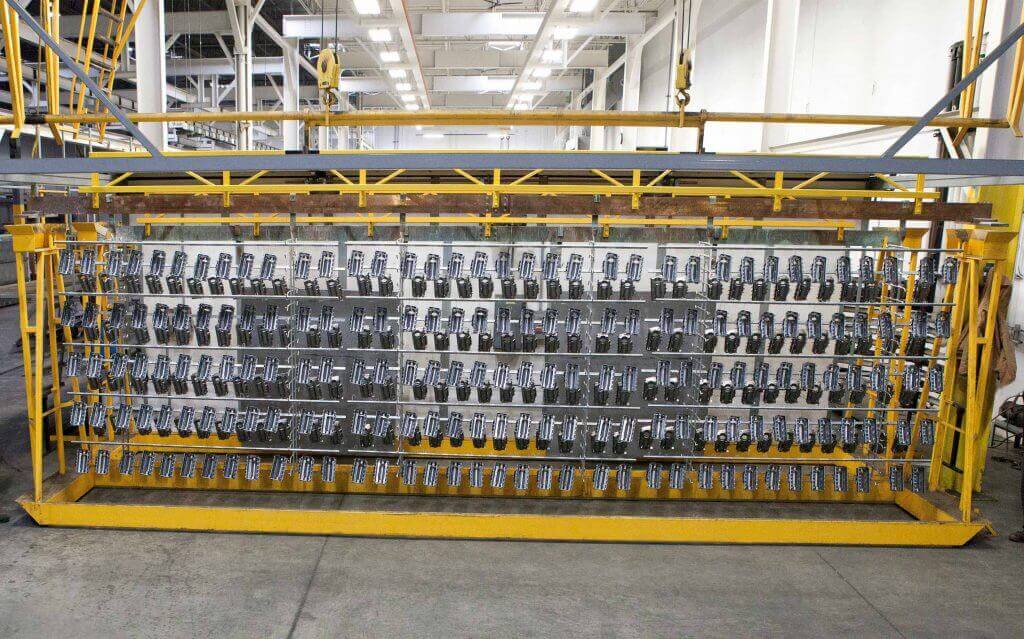
Zinc rack electroplating is an electrochemical surface finishing process in which individual metal parts are physically mounted onto specialized racks — think of them as custom fixtures — and then submerged into a zinc electroplating bath. An electrical current is passed through the solution, which causes zinc ions to bond chemically to the surface of each part, forming a continuous protective zinc coating.
The defining feature of rack plating is that each part is handled individually. Parts are not tumbled together or processed in bulk. Instead, they hang on racks with precise electrical contact points, ensuring controlled, consistent exposure throughout the plating bath.
This approach is fundamentally different from barrel plating, where many small parts are placed inside a rotating barrel together. While barrel plating is efficient and economical for high-volume small parts like fasteners and bolts, rack plating is designed for situations where precision, cosmetic quality, and coating consistency are non-negotiable.
Simple definition: Zinc rack electroplating = individual parts + specialized fixtures + controlled zinc deposition = precision corrosion protection.
What Parts Are Best Suited for Rack Plating?
Rack plating is the preferred method when your parts meet one or more of these criteria:
- Large or heavy components: Parts that are too big to tumble in a barrel — brackets, structural frames, chassis components.
- Complex geometry: Parts with recessed areas, internal features, or irregular shapes that need even coverage everywhere.
- Tight engineering tolerances: Assemblies where coating thickness must fall within a precise specification range.
- Cosmetic requirements: Visible parts where surface appearance — brightness, smoothness, finish consistency — matters to the end customer.
- Quality-critical applications: Components used in automotive, aerospace, or OEM assemblies where defects are unacceptable.
How Does Zinc Rack Electroplating Work? The Step-by-Step Process
Understanding the zinc rack plating process helps you make better decisions when specifying requirements or evaluating a plating supplier. Here is a breakdown of every major stage.
Step 1: Surface Preparation & Cleaning
The process begins long before any electrical current is applied. Parts must be thoroughly cleaned to remove any contamination that could prevent the zinc from bonding properly to the base metal.
This cleaning stage typically involves removing:
- Oils and cutting fluids from machining operations
- Oxide and rust layers from the metal surface
- Dirt, dust, and residual particles
- Drawing compounds or other processing residues
Inadequate cleaning is one of the most common causes of adhesion failures and finish defects in zinc plating. A professional plating facility will use a carefully controlled multi-stage cleaning system — often including alkaline cleaning baths, ultrasonic agitation, and precise chemical concentrations.
Step 2: Acid Activation
After cleaning, parts go through an acid activation step. This etches the metal surface at a microscopic level, removing any remaining oxide layer and creating a fresh, reactive metal surface that bonds effectively with zinc.
Multiple controlled rinse stages follow each chemical treatment to prevent cross-contamination between bath chemistries.
Step 3: Rack Mounting
This is a step unique to rack plating — and one of the most skill-dependent parts of the process. Technicians carefully mount each part onto specialized plating racks. The rack serves multiple functions:
- Provides a secure electrical connection to each part
- Holds the part stable during immersion and current application
- Positions the part for optimal current distribution
- Can be customized with specific hooks, clips, or fixtures for unique part geometries
How a part is racked — its orientation, contact point locations, and position relative to anodes — directly influences how uniformly the zinc deposits. This is where expertise and experience truly matter in rack plating operations.
Step 4: Zinc Deposition in the Electroplating Bath
Once mounted, the racks are lowered into the zinc plating bath, which contains zinc salts dissolved in an aqueous solution. When electrical current flows through the circuit, zinc ions from the solution migrate to the surface of each part — the cathode — and deposit as metallic zinc.
The key variables controlled during this stage include:
- Current density — higher current = faster deposition
- Bath temperature — affects coating quality and consistency
- Electrolyte chemistry — zinc concentration, pH, and additive levels
- Plating time — determines final coating thickness
Because each part hangs individually on a rack, operators can precisely adjust these variables to achieve the exact coating thickness required by the engineering specification. This level of control is not achievable in barrel plating.
Step 5: Rinsing
After zinc deposition, parts are thoroughly rinsed to remove all bath chemistry from the surface before moving to the finishing stages. Multi-stage rinsing is critical for both quality and environmental compliance.
Step 6: Chromate Conversion / Passivation
Most zinc-plated parts receive a post-plating chromate conversion coating, also called a passivate. This treatment chemically reacts with the zinc surface to form a protective conversion film that significantly enhances corrosion resistance.
Common passivation finishes available for rack-plated parts include:
- Clear zinc: A clean, silver-toned finish offering standard corrosion protection.
- Yellow chromate: Enhanced protection with a yellow-golden appearance — widely used in industrial hardware.
- Black trivalent: A dark, aesthetically distinctive finish for visible components.
- Olive drab: Used in specific industrial and military-adjacent applications.
Step 7: Final Drying & Inspection
Parts are dried using controlled processes to prevent water spots or staining. Individual inspection of rack-plated parts is more thorough than bulk methods — each part can be visually assessed, measured for coating thickness, and checked for adhesion and finish quality before shipping.
Key Benefits of Zinc Rack Electroplating
Now that you understand the process, let’s look at why manufacturers across automotive, agricultural, industrial, and OEM sectors choose rack plating for their most critical components.
1. Exceptional Coating Uniformity
Because every part hangs individually with controlled electrical contact and consistent bath exposure, zinc rack plating delivers superior coating uniformity — even across parts with complex geometry, recessed features, or internal bores.
This matters enormously in assemblies where every surface must meet a minimum coating thickness for corrosion protection. Barrel plating cannot guarantee the same level of uniformity, particularly on larger or more complex parts.
2. Precise Thickness Control
Engineering specifications for zinc plating often call for coating thicknesses within tight ranges — for example, ASTM B633 specifies different service classes with defined minimum thicknesses depending on the corrosion exposure environment.
Rack plating allows operators to dial in coating thickness precisely by controlling current, time, and bath chemistry. This is critical for components that must fit within tight dimensional tolerances after plating, or that must meet specific salt spray test performance targets.
3. Superior Surface Finish & Cosmetic Quality
Rack-plated parts consistently produce smoother, brighter, and more visually consistent finishes than barrel-plated parts. In barrel plating, parts can contact each other and develop small marks, dents, or inconsistencies.
For components that are visible in the final assembly — automotive trim parts, exterior hardware, consumer-facing industrial products — rack plating’s cosmetic quality advantage is significant.
4. Handles Large, Heavy, and Complex Parts
Barrel plating is simply not viable for parts above a certain size and weight. Rack plating has no such limitation. Whether the part is a small precision machined component or a large structural bracket, rack plating can accommodate it — with custom fixtures designed for the specific part geometry.
5. Sacrificial Corrosion Protection
Like all zinc plating, rack-plated zinc provides sacrificial protection to the base steel. This means that if the zinc coating becomes scratched or damaged, the zinc will continue to oxidize preferentially — protecting the underlying steel from rust.
This electrochemical protection mechanism is why zinc plating extends component service life even in harsh environments: road salt, industrial moisture, agricultural exposure, and outdoor weathering.
6. Customizable Finish Options
As outlined in the process section, rack plating supports a range of passivation finishes that can be tailored to specific corrosion resistance requirements, appearance specifications, or environmental compliance needs (such as RoHS-compliant trivalent chromate).
7. Thorough Quality Inspection
Because parts are plated and handled individually, post-plating inspection is far more comprehensive. Coating thickness can be measured at multiple points, adhesion can be tested, and visual finish can be assessed part by part — not just from a random sample pulled from a barrel batch.
Zinc Rack Plating vs. Zinc Barrel Plating: When to Choose Which
Both methods offer excellent corrosion protection through zinc electroplating, but they serve different needs. Here’s a direct comparison to help you decide:
| Factor | Zinc Rack Plating | Zinc Barrel Plating |
| Best for | Large, complex, or quality-critical parts | Small, high-volume parts (fasteners, bolts, washers) |
| Coating uniformity | Excellent — individual control per part | Good — slight variation due to tumbling |
| Thickness control | Precise — engineered to spec | Good — consistent for simple shapes |
| Surface finish | Smooth, bright, cosmetically superior | Good — minor surface contact marks possible |
| Part size | No upper limit — large & heavy parts supported | Limited — small to medium parts only |
| Cost efficiency | Best value for precision/complex parts | Most cost-efficient for high-volume small parts |
| Inspection | Part-by-part — thorough | Batch sampling |
The bottom line: if your parts are large, complex, visible, or must meet strict engineering specifications, rack plating is the right process. If you’re processing millions of small identical fasteners, barrel plating is your best option for cost efficiency.
Industry Applications: Where Zinc Rack Plating Is Used
Zinc rack electroplating is used across a wide range of industries wherever precision corrosion protection and consistent coating quality are required:
- Automotive manufacturing: Brackets, frames, engine components, suspension hardware, and visible exterior parts that must meet OEM specifications.
- Agricultural equipment: Linkage components, structural parts, and hardware exposed to soil, fertilizers, moisture, and outdoor weathering.
- Industrial machinery: Machined components, assembly hardware, and structural parts in manufacturing equipment.
- Construction hardware: Anchors, connectors, brackets, and fasteners used in structural applications.
- OEM component manufacturing: Engineered parts with strict dimensional and coating specifications supplied to larger assemblers.
What Makes a High-Quality Zinc Rack Plating Operation?
Not all zinc plating facilities are equal. When evaluating a rack plating supplier for your industrial components, here are the key indicators of a truly capable operation:
Process Control Systems
Professional rack plating requires automated monitoring of bath chemistry, temperature, and current. Suppliers relying on manual checks alone are more prone to variability and batch-to-batch inconsistency.
Custom Rack Fixture Engineering
A capable supplier will design and fabricate custom rack fixtures for your specific part geometry. Generic rack setups produce inconsistent results on complex parts. Custom fixtures ensure every part hangs in the optimal position for uniform current distribution.
Quality Systems & Certifications
Look for suppliers operating under ISO 9001-certified quality management systems. Certification signals that the supplier has documented, auditable quality processes — not just a quality policy on a wall.
Traceability & Documentation
For aerospace, automotive, or defense-adjacent applications, your plating supplier should be able to provide coating thickness reports, bath chemistry logs, and test data to support your quality audits.
On-Time Delivery Performance
Corrosion protection is meaningless if it arrives after your assembly line shuts down. Track record on delivery performance is a critical differentiator among zinc plating suppliers.
Frequently Asked Questions About Zinc Rack Electroplating
Is zinc rack plating more expensive than barrel plating?
For small, simple parts in high volumes, barrel plating is more cost-efficient. However, for parts that are larger, more complex, or must meet tight engineering specifications, rack plating delivers value that barrel plating cannot match. The precision, finish quality, and reduced rejection rates often make rack plating the lower total cost option for critical components.
What coating thicknesses are achievable with zinc rack plating?
Zinc rack plating can be engineered to virtually any coating thickness required by your specification. Common thickness classes referenced in ASTM B633 range from 5 microns (Fe/Zn 5) for mild environments up to 25 microns (Fe/Zn 25) or greater for severe corrosion exposure.
How does zinc rack plating protect against corrosion?
Zinc provides sacrificial galvanic protection. Because zinc is more electrochemically active than steel, it oxidizes preferentially when exposed to moisture and oxygen. Even if the surface is scratched, the zinc around the scratch will corrode first, protecting the underlying steel from rust.
Can rack-plated parts meet RoHS compliance requirements?
Yes. Modern zinc rack plating operations use trivalent chromate passivation systems that are RoHS-compliant. Hexavalent chromate (Cr6+) finishes, while historically common, have been largely replaced by trivalent alternatives in compliance with environmental regulations.
How do I know if my parts need rack plating or barrel plating?
Start by asking these questions: Are my parts larger than roughly 6 inches in any dimension? Do they have complex geometry, recesses, or internal features? Do they have cosmetic appearance requirements? Must they meet a precise coating thickness specification? If you answered yes to any of these, rack plating is likely the right process.
Zinc Rack Electroplating Is Built for Precision
Zinc rack electroplating is not simply an alternative to barrel plating — it is the right engineering solution for a specific category of parts that demand individual attention, coating precision, and consistent quality.
From the surface preparation that ensures adhesion, to the custom rack fixtures that position each part for optimal current distribution, to the passivation finishes that push corrosion resistance to engineered performance targets — every step of the rack plating process is designed around precision.
If your components are large, geometrically complex, cosmetically visible, or held to strict engineering specifications, zinc rack electroplating is the corrosion protection solution built for the job.
Ready to Specify Zinc Rack Plating for Your Components?
At Plateco, Inc. in Reedsburg, Wisconsin, we operate advanced zinc rack plating systems with custom fixture engineering, ISO 9001-certified quality systems, and a track record of 95%+ on-time delivery. Tell us about your part specifications and we will recommend the right zinc rack plating solution for your application.
Request a Quote: plateco.net/rfq | Call: (608) 524-8241 | 1375 Industrial Street, Reedsburg, WI 53959